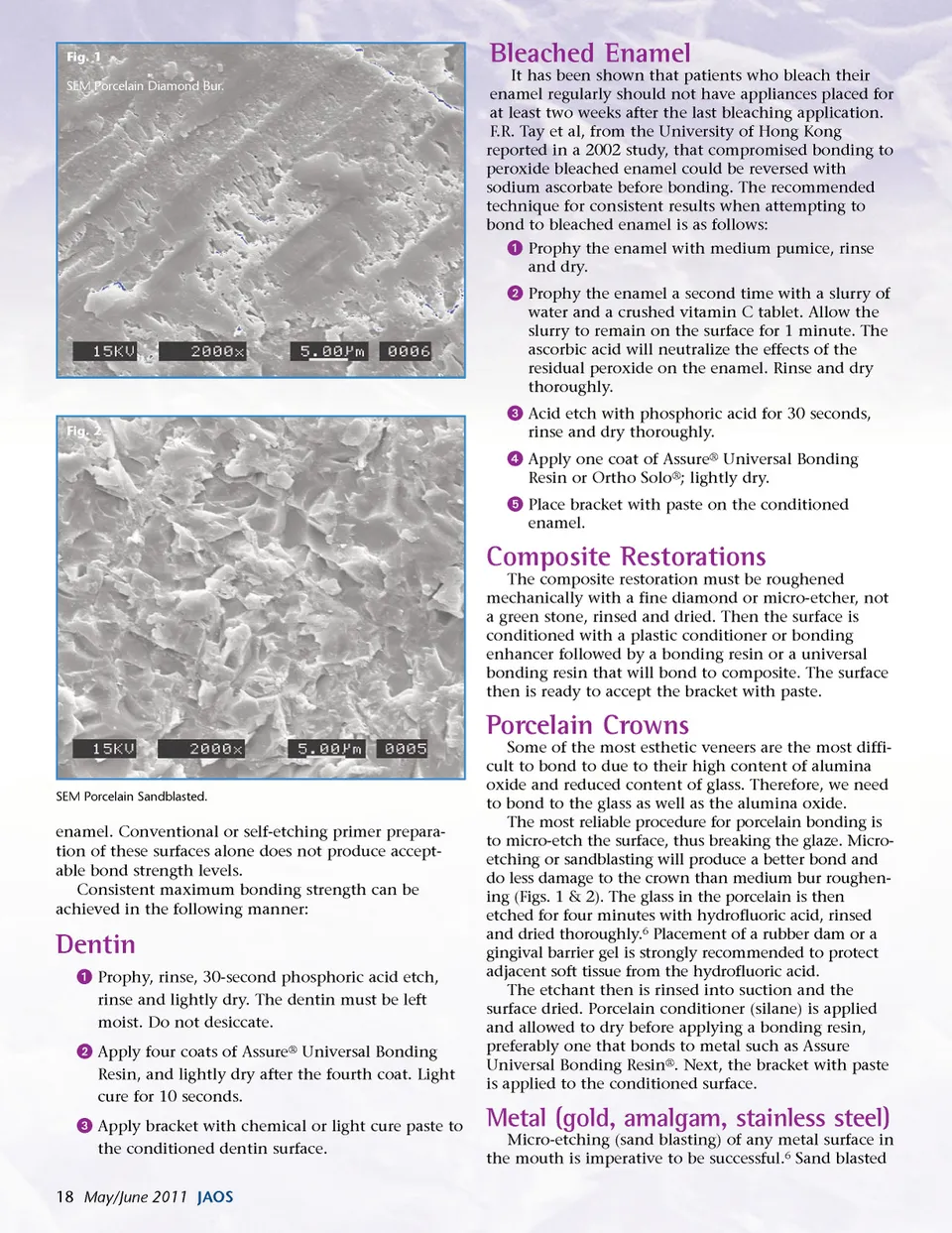
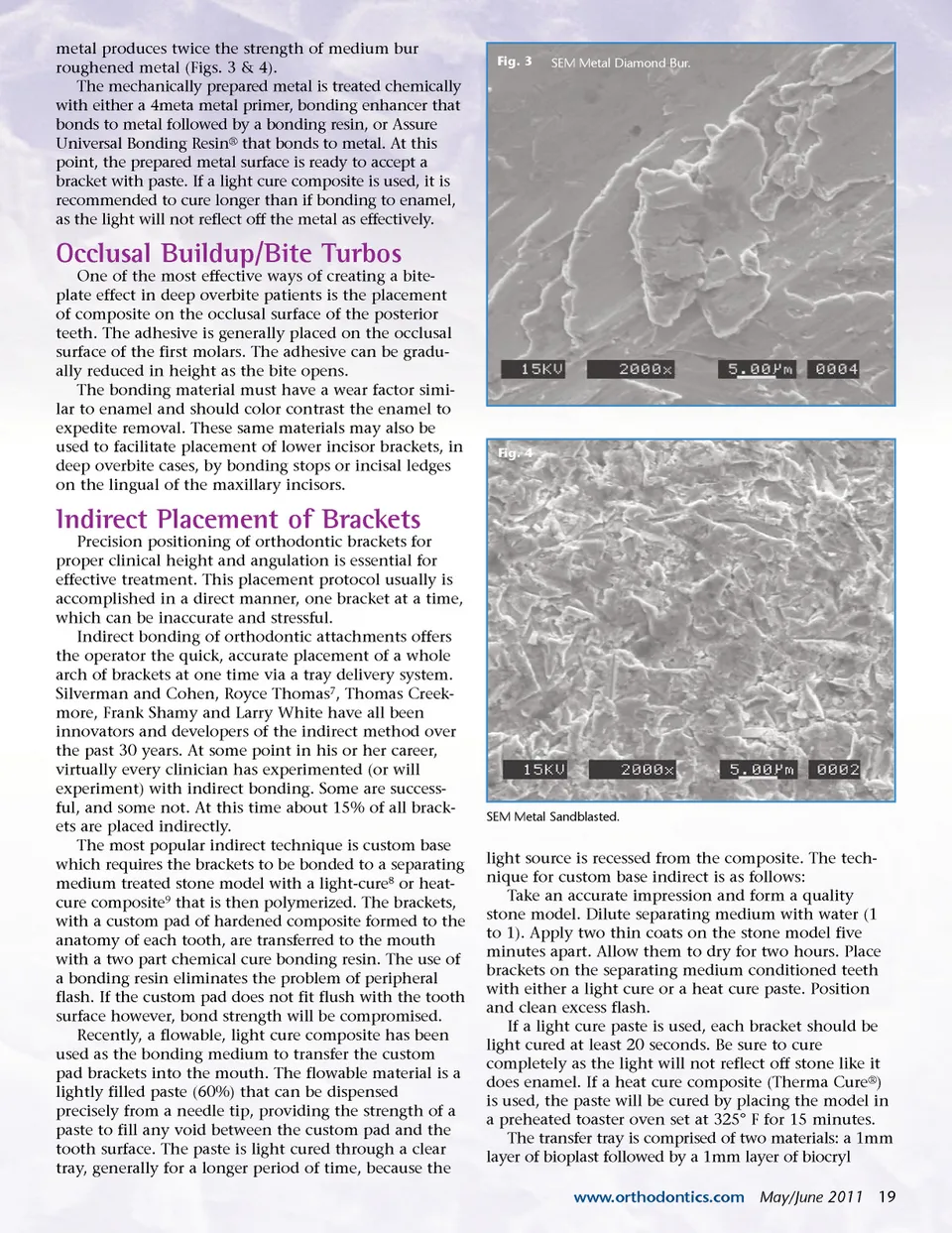
Fig. 1 SEM Porcelain Diamond Bur. Bleached Enamel It has been shown that patients who bleach their enamel regularly should not have appliances placed for at least two weeks after the last bleaching application. F.R. Tay et al, from the University of Hong Kong reported in a 2002 study, that compromised bonding to peroxide bleached enamel could be reversed with sodium ascorbate before bonding. The recommended technique for consistent results when attempting to bond to bleached enamel is as follows: ᕡ Prophy the enamel with medium pumice, rinse and dry. ᕢ Prophy the enamel a second time with a slurry of water and a crushed vitamin C tablet. Allow the slurry to remain on the surface for 1 minute. The ascorbic acid will neutralize the effects of the residual peroxide on the enamel. Rinse and dry thoroughly. Fig. 2 ᕣ Acid etch with phosphoric acid for 30 seconds, rinse and dry thoroughly. ᕤ Apply one coat of Assure ® Universal Bonding Resin or Ortho Solo ® ; lightly dry. ᕥ Place bracket with paste on the conditioned enamel. Composite Restorations The composite restoration must be roughened mechanically with a fine diamond or micro-etcher, not a green stone, rinsed and dried. Then the surface is conditioned with a plastic conditioner or bonding enhancer followed by a bonding resin or a universal bonding resin that will bond to composite. The surface then is ready to accept the bracket with paste. Porcelain Crowns SEM Porcelain Sandblasted. enamel. Conventional or self-etching primer prepara-tion of these surfaces alone does not produce accept-able bond strength levels. Consistent maximum bonding strength can be achieved in the following manner: Dentin ᕡ Prophy, rinse, 30-second phosphoric acid etch, rinse and lightly dry. The dentin must be left moist. Do not desiccate. ᕢ Apply four coats of Assure ® Universal Bonding Resin, and lightly dry after the fourth coat. Light cure for 10 seconds. ᕣ Apply bracket with chemical or light cure paste to the conditioned dentin surface. 18 May/June 2011 JAOS Some of the most esthetic veneers are the most diffi-cult to bond to due to their high content of alumina oxide and reduced content of glass. Therefore, we need to bond to the glass as well as the alumina oxide. The most reliable procedure for porcelain bonding is to micro-etch the surface, thus breaking the glaze. Micro-etching or sandblasting will produce a better bond and do less damage to the crown than medium bur roughen-ing (Figs. 1 & 2). The glass in the porcelain is then etched for four minutes with hydrofluoric acid, rinsed and dried thoroughly. 6 Placement of a rubber dam or a gingival barrier gel is strongly recommended to protect adjacent soft tissue from the hydrofluoric acid. The etchant then is rinsed into suction and the surface dried. Porcelain conditioner (silane) is applied and allowed to dry before applying a bonding resin, preferably one that bonds to metal such as Assure Universal Bonding Resin ® . Next, the bracket with paste is applied to the conditioned surface. Metal (gold, amalgam, stainless steel) Micro-etching (sand blasting) of any metal surface in the mouth is imperative to be successful. 6 Sand blasted
Journal of the American Orthodontic Society May-June 2011: Page 18