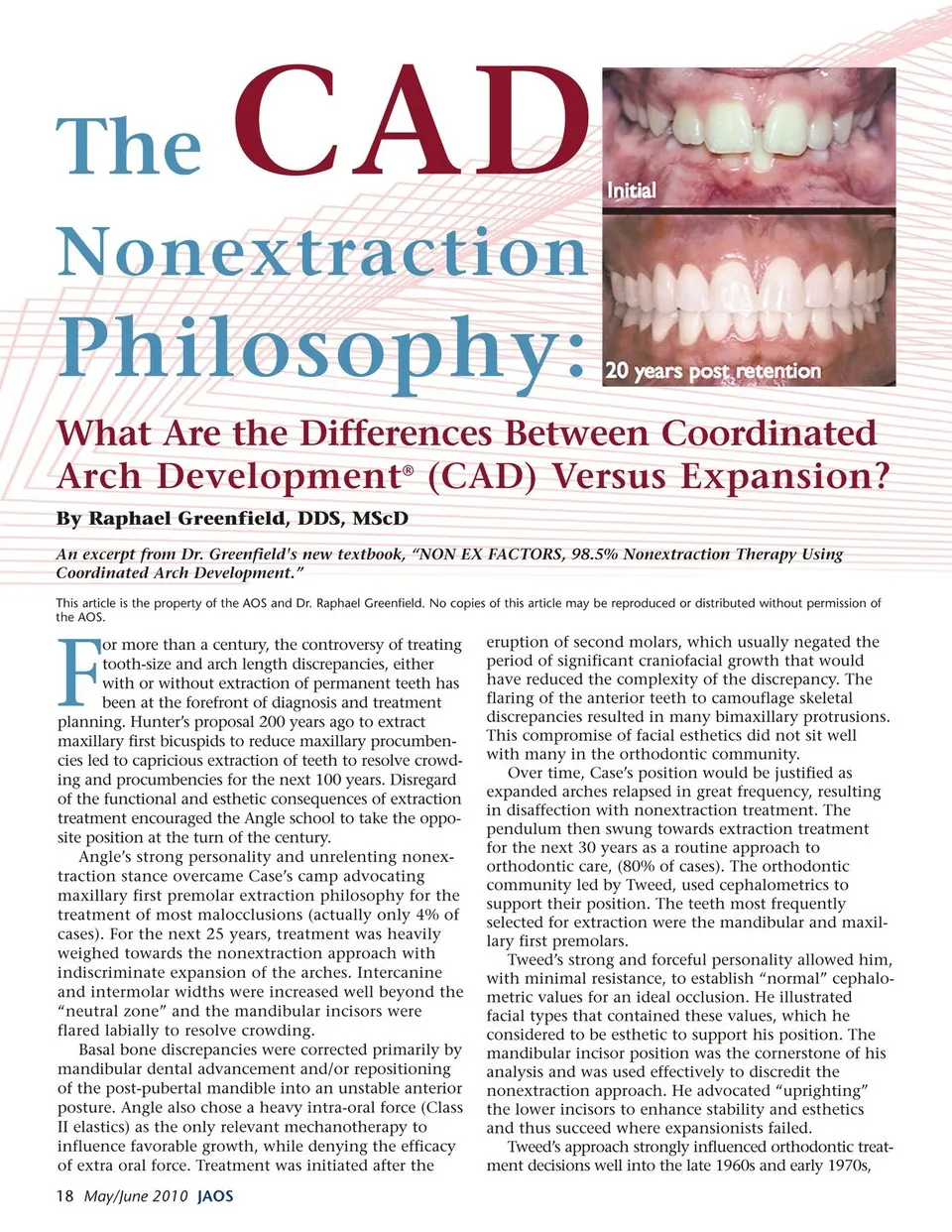
and to a lesser degree still influences our profession today. Even with Tweed’s approach that included uprighting lower incisors over basal bone, maintaining the original transverse dimension and archform, root parallelism and a relatively flat profile, the lower anterior crowding relapsed. Deep bites recurred and the denture retruded relative to the facial skeleton. Recent long-term post-retention studies have confirmed some of these earlier observations. As a result of these studies, a lengthier treatment protocol was advocated, at least until the eruption of third molars. However, several studies have indicated that the length of retention may not be a factor in long-term stability for any approach. In fact, many studies blamed the third molars for the instability of the mandibular incisor position. Recent studies have implied that anterior crowding is more of a normal occurrence associated with the aging of the face. It can now be suggested that retraction of the lower incisors is not neces- sarily more stable than reason- able proclination. Many orthodontists attempted to legiti- matize the compromised facial esthetics of extraction through various facial analyses. While attempting to find a range of normal values, esthetics was biased by the analyst’s concept of esthetics. The samples used to create these analyses were not randomly selected from a cross section of different racial and ethnic groups. The general public “...it is generally agreed within the orthodontic community that the most opportune time to initiate orthodontic therapy is the late mixed dentition.” and the dental community disagreed with the almost empirical approach of extractionists and the pendulum began to swing back towards the nonextraction approach. Initially, there was a small group that advo- cated second molar extraction as the new panacea. However, many third molars erupted with a poor angulation and thus had to be retreated postorthodon- tically. Consequently, this philosophy has seen mini- mal support by the orthodontic profession. So here we are at the beginning of the 21st century, back to a predominantly nonextraction approach —- an approach that was discarded 70 years ago. What changes have taken place to influence our profession to such a degree? Certainly, our philosophy of treatment timing has changed radically. Instead of waiting for the completion of second molar eruption and missing the pubertal growth spurt, we generally believe that basal discrepancies are positively impacted when we use the greatest growth increments to our advantage. Begin- ning in the 1960s and after encountering significant resistance for almost 15 years, extra oral appliances such as headgears and functional appliances to temporarily redirect growth gained widespread popular- ity and considerable support in the literature. As a consequence, modern orthodontics has seen the emergence of a new controversy. “Is our concept of earlier intervention too early?” The so-called “two-phase treatment” with the first phase being the early resolution of basal discrepancies and the second phase correcting the malocclusion’s dental components has been debated throughout the last decade. The concept is offered as an approach to creating a more stable maxillo-mandibular relationship long term and controlling of the leeway space during the transition of the mixed to the perma- nent dentition. While a better long-term skeletal rela- tionship and the correction of developmental cross bites and functional shifts may be true, the literature to date does not support different dentoalveolar results between a two-phase and single-phase treatment approaches. It appears that early intervention is patient specific and should not be thought of as the most productive way to treat the majority of Class II and III cases. It is justified only if it provides “additional” benefits such as preventing tooth injury, psychoso- cial advantages, shorter treat- ment times and enhanced func- tion, etc. Recent studies actually have described prolonged treat- ment times, resulting in prema- ture termination of treatment in two-phase treatment cases with compliance issues in phase 2. Thus the most severe cases may benefit the most. That said, it is generally agreed within the orthodontic community that the most opportune time to initiate orthodontic therapy is the late mixed dentition. Leeway space can thus be utilized for tooth- size or arch-size discrepancy problems in addition to early resolution of basal discrepancies. The Heart of the Debate From the above historical perspective (review), it appears there are four distinct controversial and interre- lated areas of orthodontics: extraction vs. nonextraction lower incisor crowding facial esthetics timing of treatment At the moment, the pendulum has clearly swung in favor of a nonextraction approach due to the following reasons. First, lower incisor crowding appears to be a normal phenomenon and cannot be used as the decid- ing factor upon which to base a treatment decision. Also, third molars generally cannot be implicated as a causative factor. Second, and maybe more importantly, our management of nonextraction cases has improved. Our knowledge of orthopedics and the positive effects it has on basal discrepancies has greatly reduced the number of extraction cases. Non-compliant appliances and space age metallurgy has clearly facilitated the attainment of nonextraction treatment goals. www.orthodontics.com May/June 2010 19
Journal of the American Orthodontic Society May-June 2010: Page 19