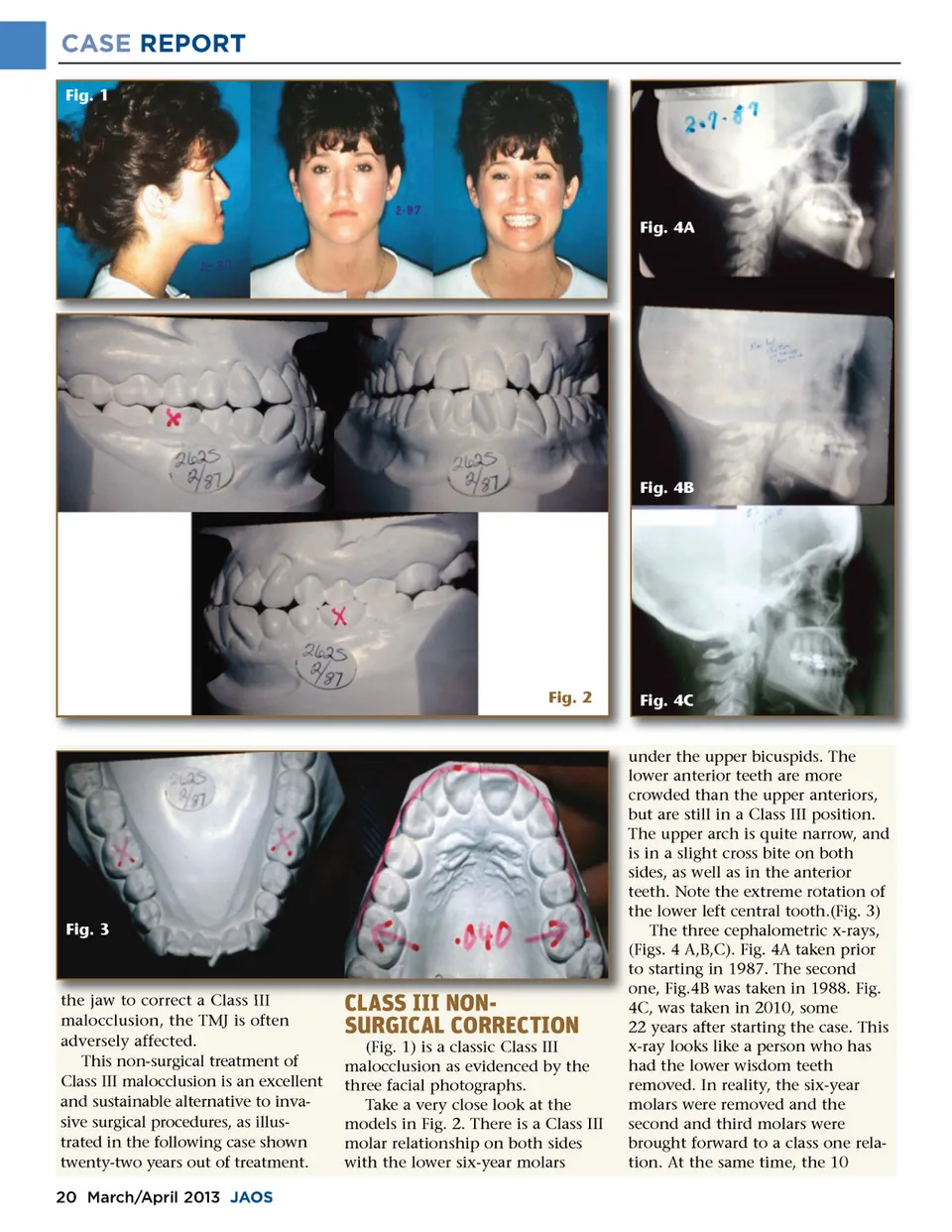
CASE REPORT Fig. 1 Fig. 4A Fig. 4B Fig. 2 Fig. 4C Fig. 3 the jaw to correct a Class III malocclusion, the TMJ is often adversely affected. This non-surgical treatment of Class III malocclusion is an excellent and sustainable alternative to inva-sive surgical procedures, as illus-trated in the following case shown twenty-two years out of treatment. 20 March/April 2013 JAOS CLASS I III II NON NON-SURGICAL CORRECTION (Fig. 1) is a classic Class III malocclusion as evidenced by the three facial photographs. Take a very close look at the models in Fig. 2. There is a Class III molar relationship on both sides with the lower six-year molars under the upper bicuspids. The u l lower anterior teeth are more c crowded than the upper anteriors, but are still in a Class III position. b The upper arch is quite narrow, and T i is in a slight cross bite on both sides, as well as in the anterior s teeth. Note the extreme rotation of t the lower left central tooth.(Fig. 3) t The three cephalometric x-rays, (Figs. 4 A,B,C). Fig. 4A taken prior to starting in 1987. The second t o one, Fig.4B was taken in 1988. Fig. 4C, was taken in 2010, some 22 years after starting the case. This x-ray looks like a person who has had the lower wisdom teeth removed. In reality, the six-year molars were removed and the second and third molars were brought forward to a class one rela-tion. At the same time, the 10
Journal of the American Orthodontic Society March-April 2013: Page 20