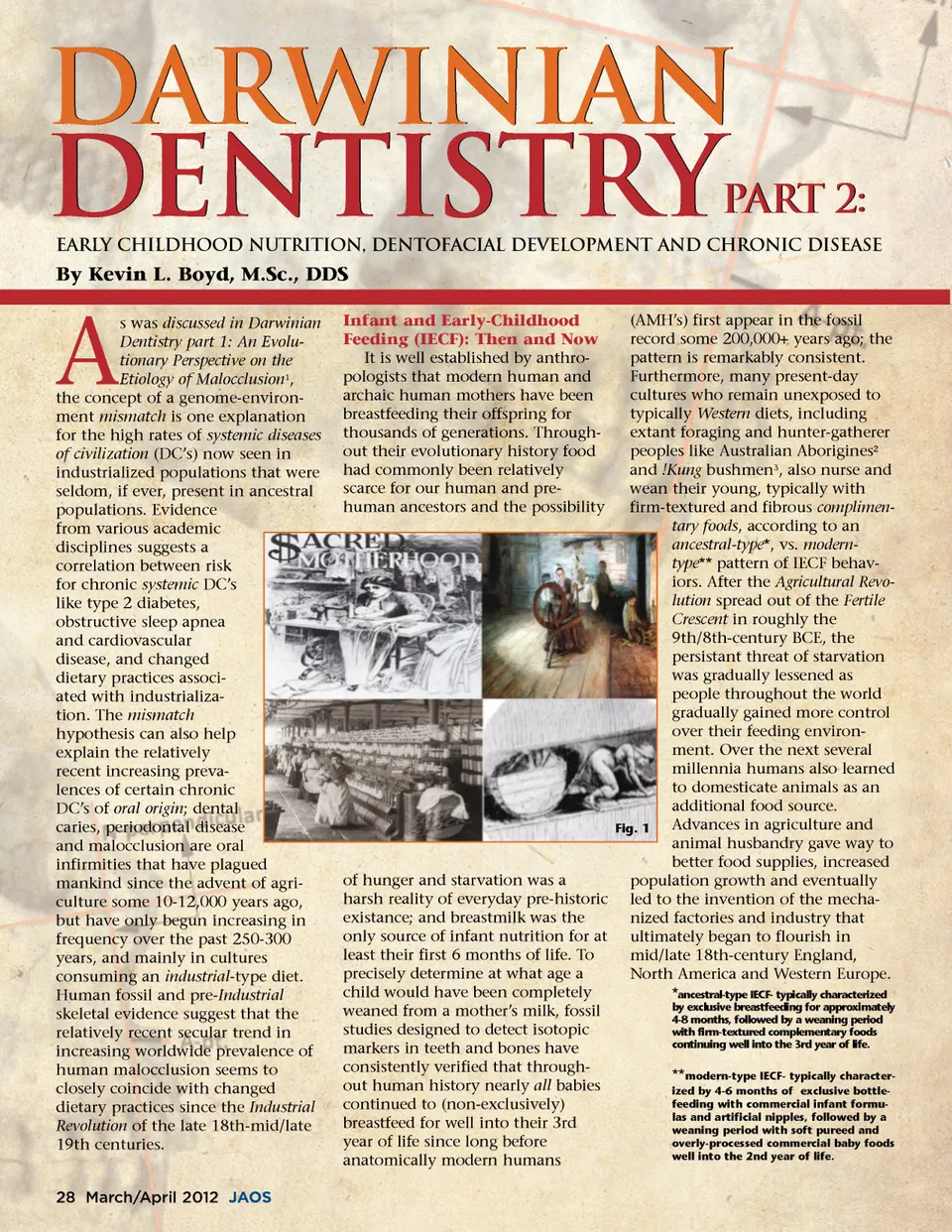
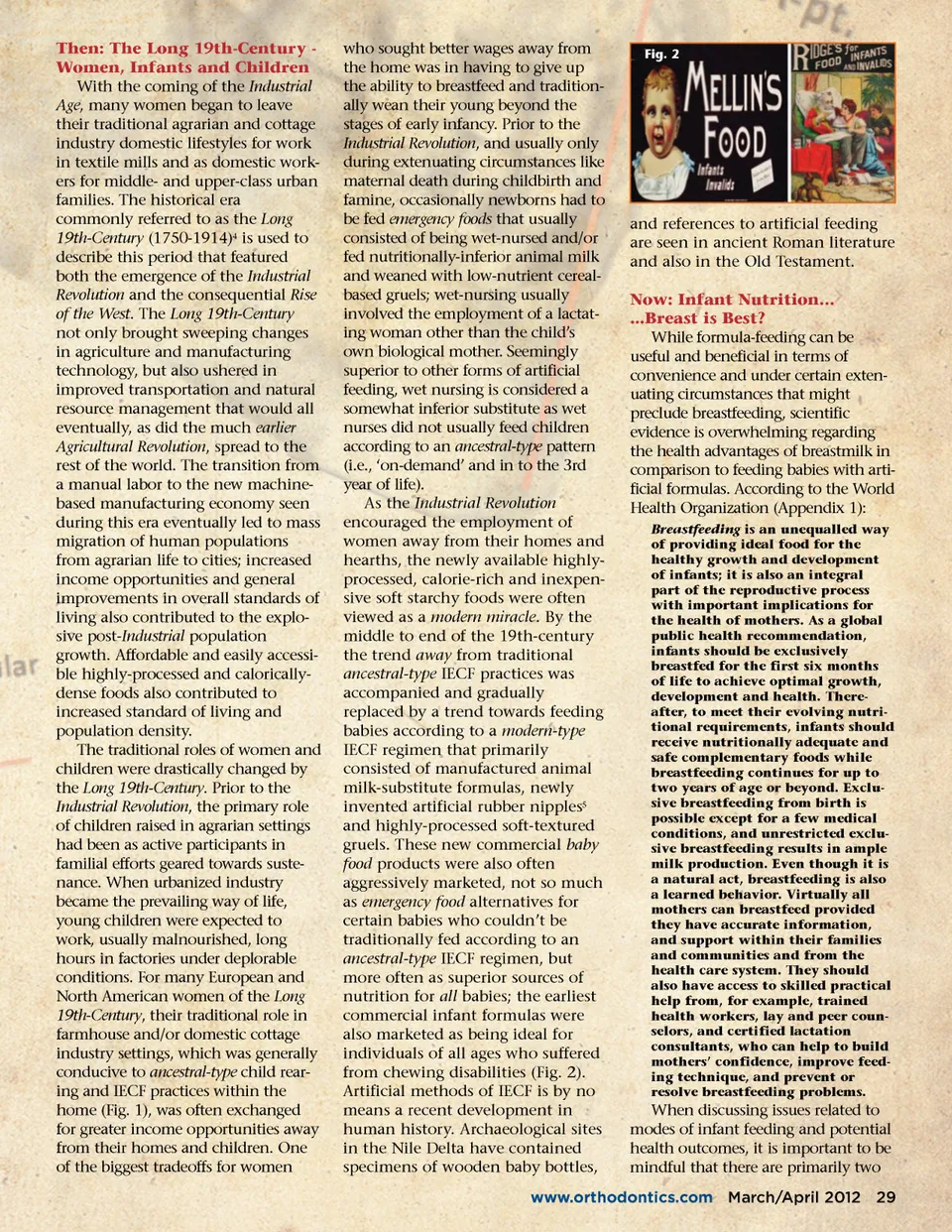
DARWINIAN DENTISTRY By Kevin L. Boyd, M.Sc., DDS PART 2: Early Childhood Nutrition, Dentofacial Development and Chronic Disease A s was discussed in Darwinian Dentistry part 1: An Evolu-tionary Perspective on the Etiology of Malocclusion 1 , the concept of a genome-environ-ment mismatch is one explanation for the high rates of systemic diseases of civilization (DC’s) now seen in industrialized populations that were seldom, if ever, present in ancestral populations. Evidence from various academic disciplines suggests a correlation between risk for chronic systemic DC’s like type 2 diabetes, obstructive sleep apnea and cardiovascular disease, and changed dietary practices associ-ated with industrializa-tion. The mismatch hypothesis can also help explain the relatively recent increasing preva-lences of certain chronic DC’s of oral origin ; dental caries, periodontal disease and malocclusion are oral infirmities that have plagued mankind since the advent of agri-culture some 10-12,000 years ago, but have only begun increasing in frequency over the past 250-300 years, and mainly in cultures consuming an industrial -type diet. Human fossil and pre-Industrial skeletal evidence suggest that the relatively recent secular trend in increasing worldwide prevalence of human malocclusion seems to closely coincide with changed dietary practices since the Industrial Revolution of the late 18th-mid/late 19th centuries. (AMH’s) first appear in the fossil record some 200,000+ years ago; the pattern is remarkably consistent. Furthermore, many present-day cultures who remain unexposed to typically Western diets, including extant foraging and hunter-gatherer peoples like Australian Aborigines 2 and !Kung bushmen 3 , also nurse and wean their young, typically with firm-textured and fibrous complimen-tary foods , according to an ancestral-type *, vs. modern-type ** pattern of IECF behav-iors. After the Agricultural Revo-lution spread out of the Fertile Crescent in roughly the 9th/8th-century BCE, the persistant threat of starvation was gradually lessened as people throughout the world gradually gained more control over their feeding environ-ment. Over the next several millennia humans also learned to domesticate animals as an additional food source. Advances in agriculture and Fig. 1 animal husbandry gave way to better food supplies, increased of hunger and starvation was a population growth and eventually harsh reality of everyday pre-historic led to the invention of the mecha-existance; and breastmilk was the nized factories and industry that only source of infant nutrition for at ultimately began to flourish in least their first 6 months of life. To mid/late 18th-century England, precisely determine at what age a North America and Western Europe. child would have been completely * ancestral-type IECF-typically characterized by exclusive breastfeeding for approximately weaned from a mother’s milk, fossil 4-8 months, followed by a weaning period studies designed to detect isotopic with firm-textured complementary foods continuing well into the 3rd year of life. markers in teeth and bones have consistently verified that through-** modern-type IECF-typically character-out human history nearly all babies ized by 4-6 months of exclusive bottle-feeding with commercial infant formu-continued to (non-exclusively) las and artificial nipples, followed by a breastfeed for well into their 3rd weaning period with soft pureed and year of life since long before overly-processed commercial baby foods well into the 2nd year of life. anatomically modern humans Infant and Early-Childhood Feeding (IECF): Then and Now It is well established by anthro-pologists that modern human and archaic human mothers have been breastfeeding their offspring for thousands of generations. Through-out their evolutionary history food had commonly been relatively scarce for our human and pre-human ancestors and the possibility 28 March/April 2012 JAOS
Journal of the American Orthodontic Society March-April 2012: Page 28