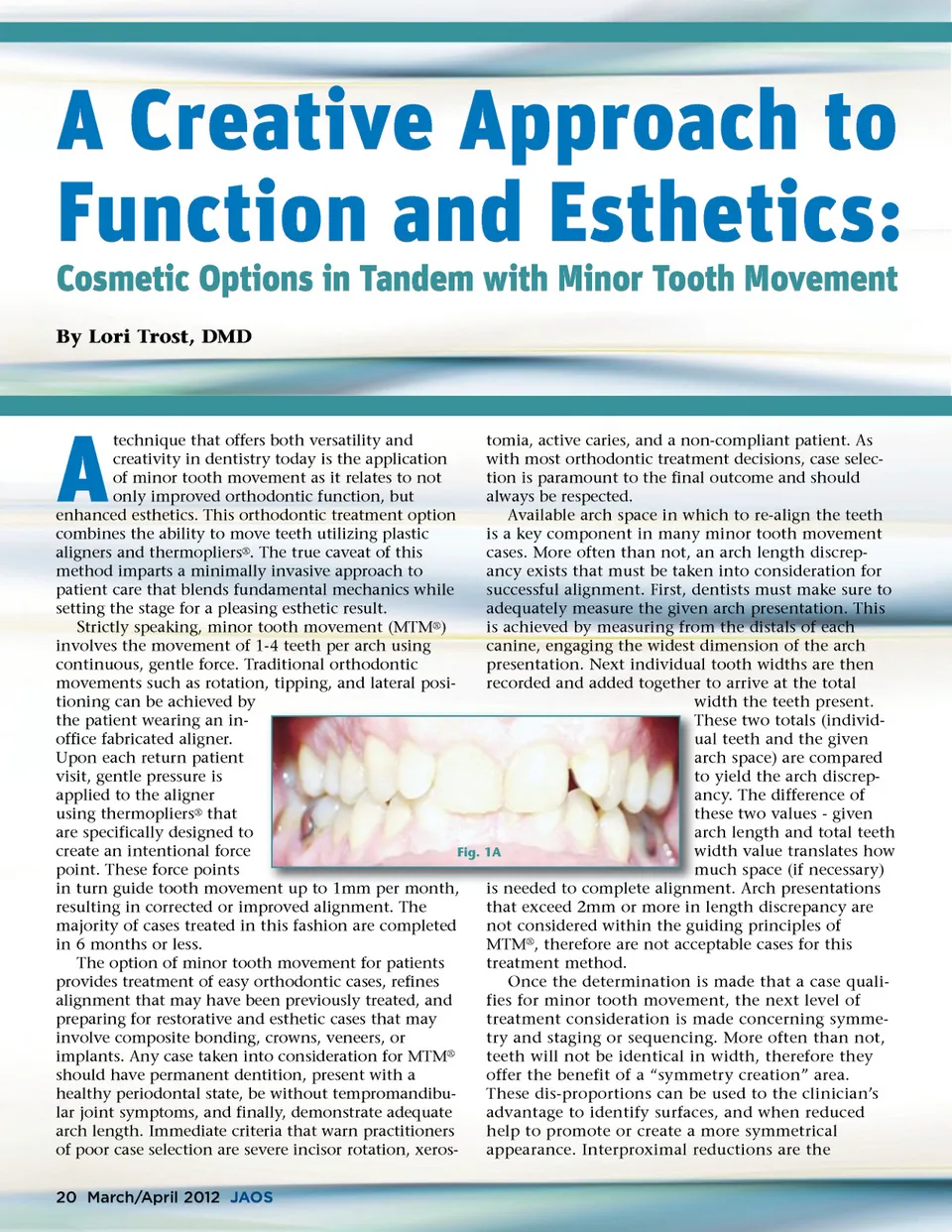
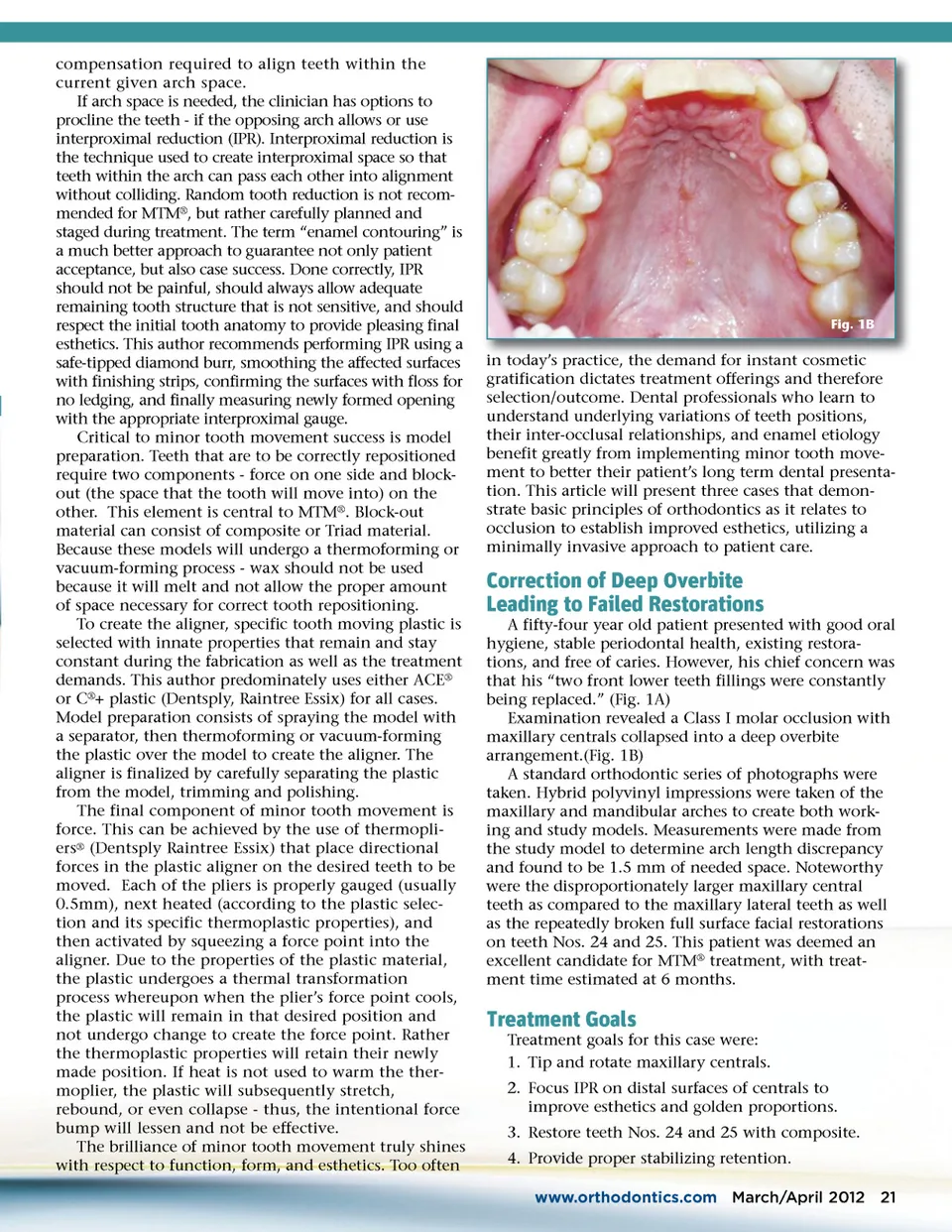
A Creative Approach to Function and Esthetics: Cosmetic Options in Tandem with Minor Tooth Movement By Lori Trost, DMD tomia, active caries, and a non-compliant patient. As technique that offers both versatility and with most orthodontic treatment decisions, case selec-creativity in dentistry today is the application tion is paramount to the final outcome and should of minor tooth movement as it relates to not always be respected. only improved orthodontic function, but Available arch space in which to re-align the teeth enhanced esthetics. This orthodontic treatment option is a key component in many minor tooth movement combines the ability to move teeth utilizing plastic cases. More often than not, an arch length discrep-aligners and thermopliers ® . The true caveat of this ancy exists that must be taken into consideration for method imparts a minimally invasive approach to successful alignment. First, dentists must make sure to patient care that blends fundamental mechanics while adequately measure the given arch presentation. This setting the stage for a pleasing esthetic result. is achieved by measuring from the distals of each Strictly speaking, minor tooth movement (MTM ® ) canine, engaging the widest dimension of the arch involves the movement of 1-4 teeth per arch using presentation. Next individual tooth widths are then continuous, gentle force. Traditional orthodontic recorded and added together to arrive at the total movements such as rotation, tipping, and lateral posi-width the teeth present. tioning can be achieved by These two totals (individ-the patient wearing an in-T ual teeth and the given office fabricated aligner. u arch space) are compared Upon each return patient a to yield the arch discrep-visit, gentle pressure is t ancy. The difference of applied to the aligner a these two values -given using thermopliers ® that t arch length and total teeth are specifically designed to a width value translates how create an intentional force w Fig. 1A much space (if necessary) point. These force points m alignment. Arch presentations in turn guide tooth movement ent up to 1mm per month, month is needed to complete alignm that exceed 2mm or more in length discrepancy are resulting in corrected or improved alignment. The not considered within the guiding principles of majority of cases treated in this fashion are completed MTM ® , therefore are not acceptable cases for this in 6 months or less. The option of minor tooth movement for patients treatment method. provides treatment of easy orthodontic cases, refines Once the determination is made that a case quali-alignment that may have been previously treated, and fies for minor tooth movement, the next level of preparing for restorative and esthetic cases that may treatment consideration is made concerning symme-involve composite bonding, crowns, veneers, or try and staging or sequencing. More often than not, implants. Any case taken into consideration for MTM ® teeth will not be identical in width, therefore they offer the benefit of a “symmetry creation” area. should have permanent dentition, present with a These dis-proportions can be used to the clinician’s healthy periodontal state, be without tempromandibu-advantage to identify surfaces, and when reduced lar joint symptoms, and finally, demonstrate adequate help to promote or create a more symmetrical arch length. Immediate criteria that warn practitioners appearance. Interproximal reductions are the of poor case selection are severe incisor rotation, xeros-20 March/April 2012 JAOS A
Journal of the American Orthodontic Society March-April 2012: Page 20