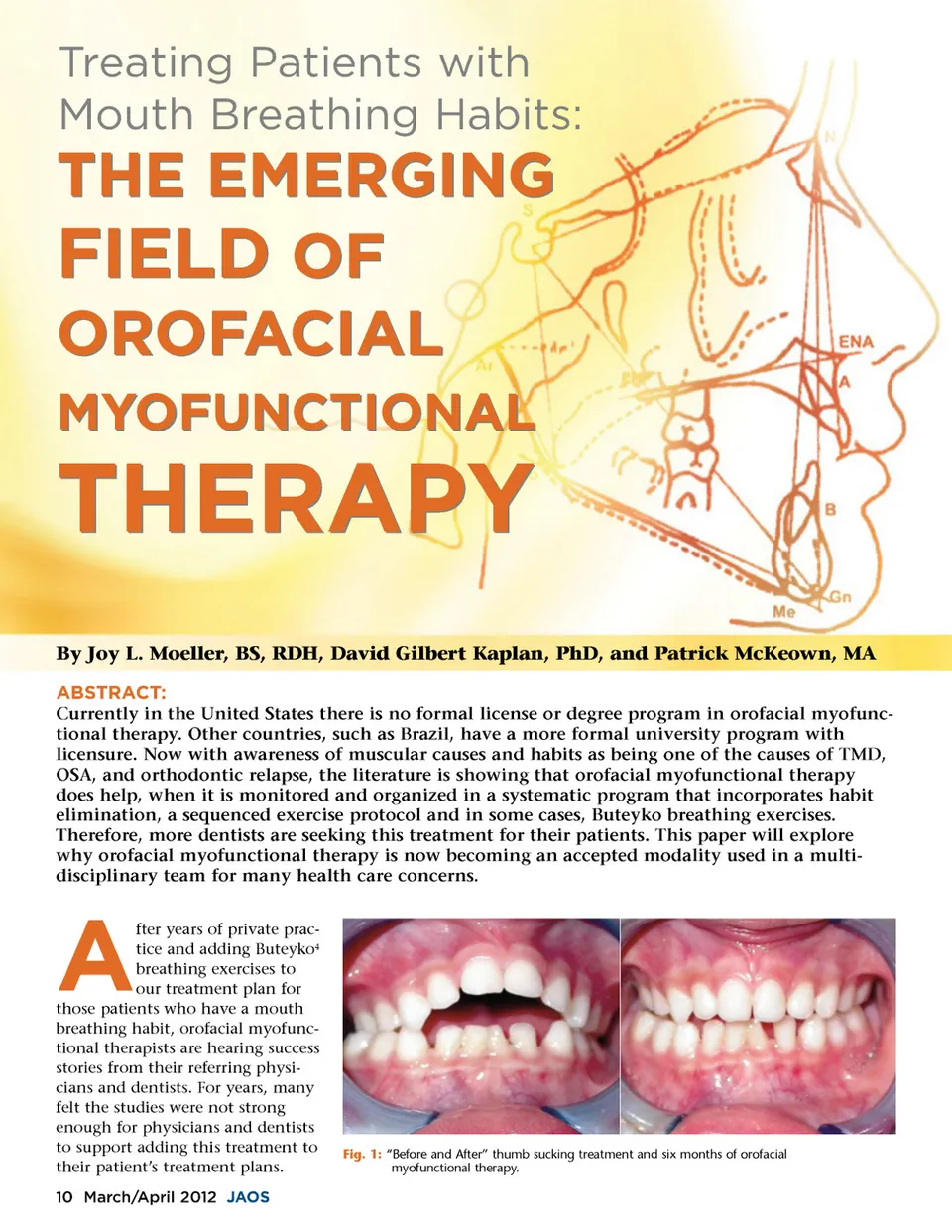
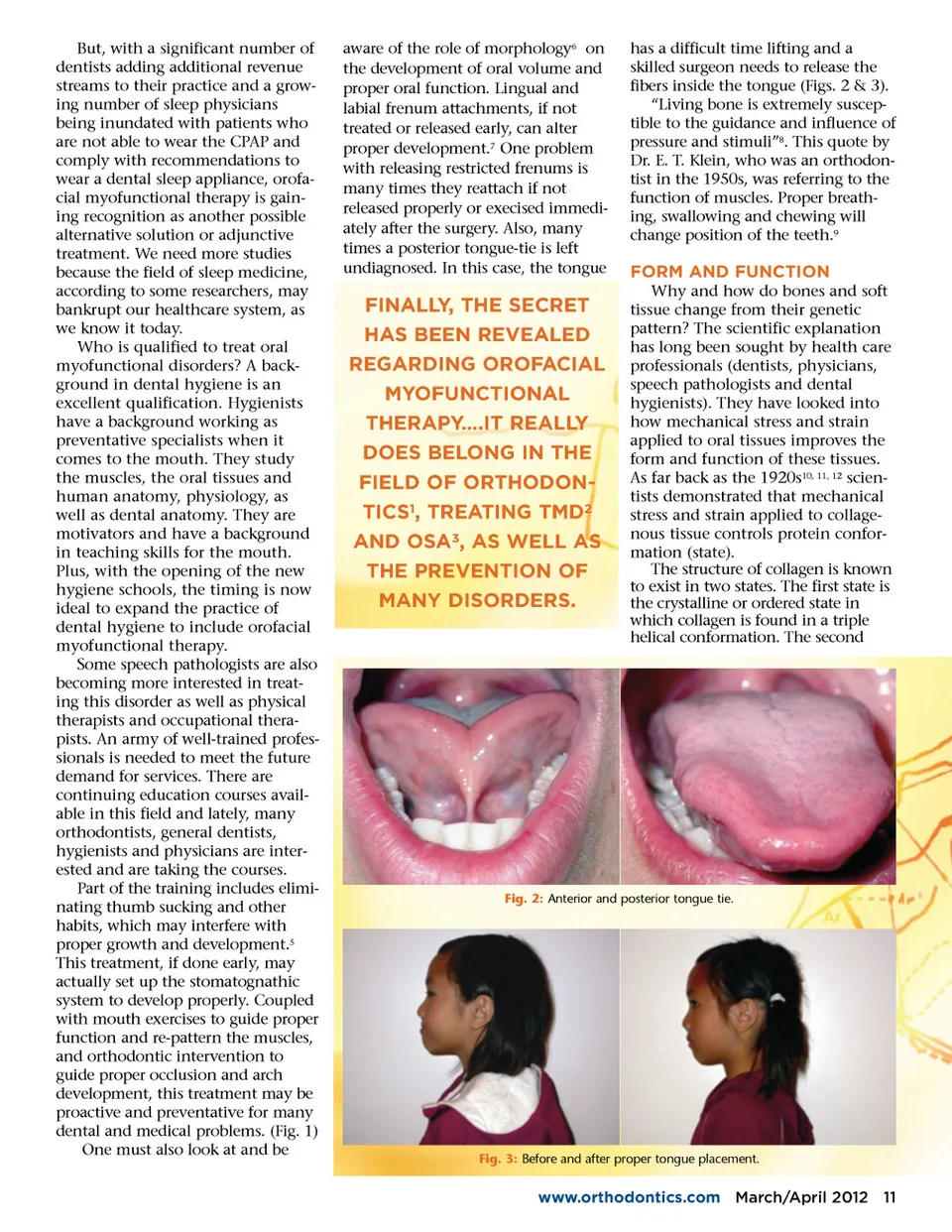
Treating Patients with Mouth Breathing Habits: THE EMERGING FIELD OF OROFACIAL MYOFUNCTIONAL THERAPY By Joy L. Moeller, BS, RDH, David Gilbert Kaplan, PhD, and Patrick McKeown, MA ABSTRACT: Currently in the United States there is no formal license or degree program in orofacial myofunc-tional therapy. Other countries, such as Brazil, have a more formal university program with licensure. Now with awareness of muscular causes and habits as being one of the causes of TMD, OSA, and orthodontic relapse, the literature is showing that orofacial myofunctional therapy does help, when it is monitored and organized in a systematic program that incorporates habit elimination, a sequenced exercise protocol and in some cases, Buteyko breathing exercises. Therefore, more dentists are seeking this treatment for their patients. This paper will explore why orofacial myofunctional therapy is now becoming an accepted modality used in a multi-disciplinary team for many health care concerns. fter years of private prac-tice and adding Buteyko 4 breathing exercises to our treatment plan for those patients who have a mouth breathing habit, orofacial myofunc-tional therapists are hearing success stories from their referring physi-cians and dentists. For years, many felt the studies were not strong enough for physicians and dentists to support adding this treatment to their patient’s treatment plans. 10 March/April 2012 JAOS A Fig. 1: “Before and After” thumb sucking treatment and six months of orofacial myofunctional therapy.
Journal of the American Orthodontic Society March-April 2012: Page 10