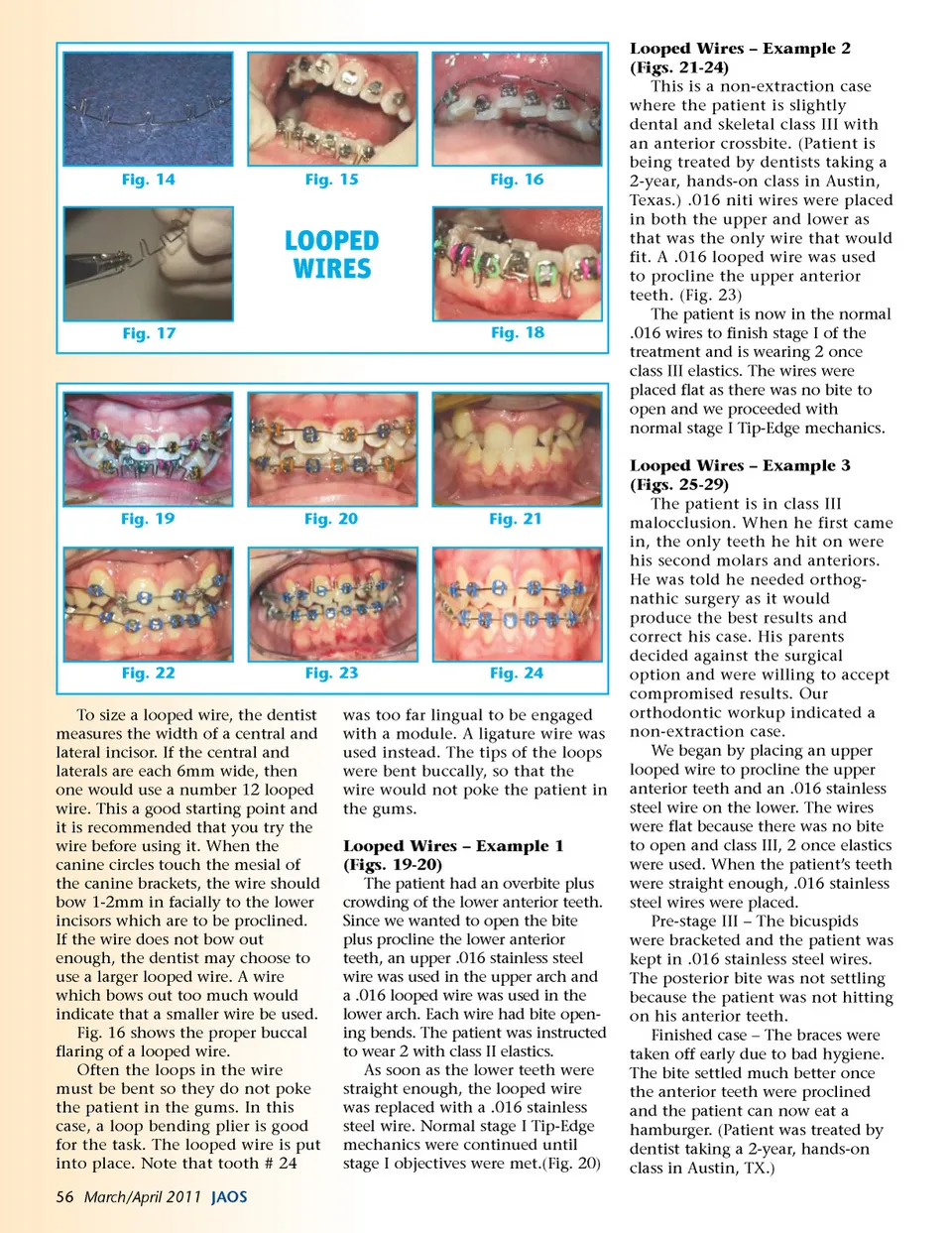
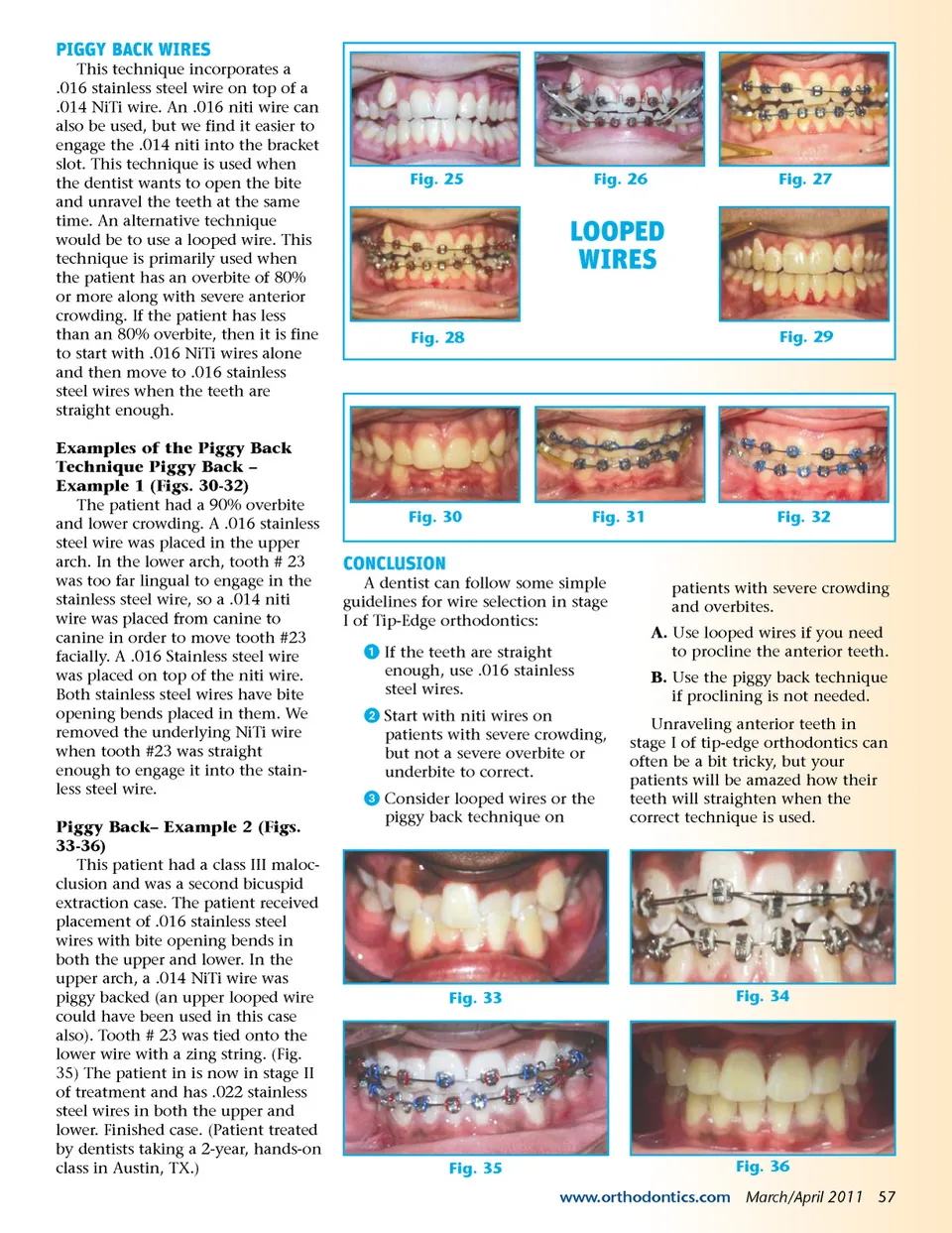
PIGGY BACK WIRES This technique incorporates a .016 stainless steel wire on top of a .014 NiTi wire. An .016 niti wire can also be used, but we find it easier to engage the .014 niti into the bracket slot. This technique is used when the dentist wants to open the bite and unravel the teeth at the same time. An alternative technique would be to use a looped wire. This technique is primarily used when the patient has an overbite of 80% or more along with severe anterior crowding. If the patient has less than an 80% overbite, then it is fine to start with .016 NiTi wires alone and then move to .016 stainless steel wires when the teeth are straight enough. Examples of the Piggy Back Technique Piggy Back – Example 1 (Figs. 30-32) The patient had a 90% overbite and lower crowding. A .016 stainless steel wire was placed in the upper arch. In the lower arch, tooth # 23 was too far lingual to engage in the stainless steel wire, so a .014 niti wire was placed from canine to canine in order to move tooth #23 facially. A .016 Stainless steel wire was placed on top of the niti wire. Both stainless steel wires have bite opening bends placed in them. We removed the underlying NiTi wire when tooth #23 was straight enough to engage it into the stain-less steel wire. Piggy Back– Example 2 (Figs. 33-36) This patient had a class III maloc-clusion and was a second bicuspid extraction case. The patient received placement of .016 stainless steel wires with bite opening bends in both the upper and lower. In the upper arch, a .014 NiTi wire was piggy backed (an upper looped wire could have been used in this case also). Tooth # 23 was tied onto the lower wire with a zing string. (Fig. 35) The patient in is now in stage II of treatment and has .022 stainless steel wires in both the upper and lower. Finished case. (Patient treated by dentists taking a 2-year, hands-on class in Austin, TX.) Fig. 25 Fig. 26 Fig. 27 LOOPED WIRES Fig. 28 Fig. 29 Fig. 30 Fig. 31 Fig. 32 CONCLUSION A dentist can follow some simple guidelines for wire selection in stage I of Tip-Edge orthodontics: ᕡ If the teeth are straight enough, use .016 stainless steel wires. ᕢ Start with niti wires on patients with severe crowding, but not a severe overbite or underbite to correct. ᕣ Consider looped wires or the piggy back technique on patients with severe crowding and overbites. A. Use looped wires if you need to procline the anterior teeth. B. Use the piggy back technique if proclining is not needed. Unraveling anterior teeth in stage I of tip-edge orthodontics can often be a bit tricky, but your patients will be amazed how their teeth will straighten when the correct technique is used. Fig. 33 Fig. 34 Fig. 35 Fig. 36 www.orthodontics.com March/April 2011 57
Journal of the American Orthodontic Society March-April 2011: Page 57