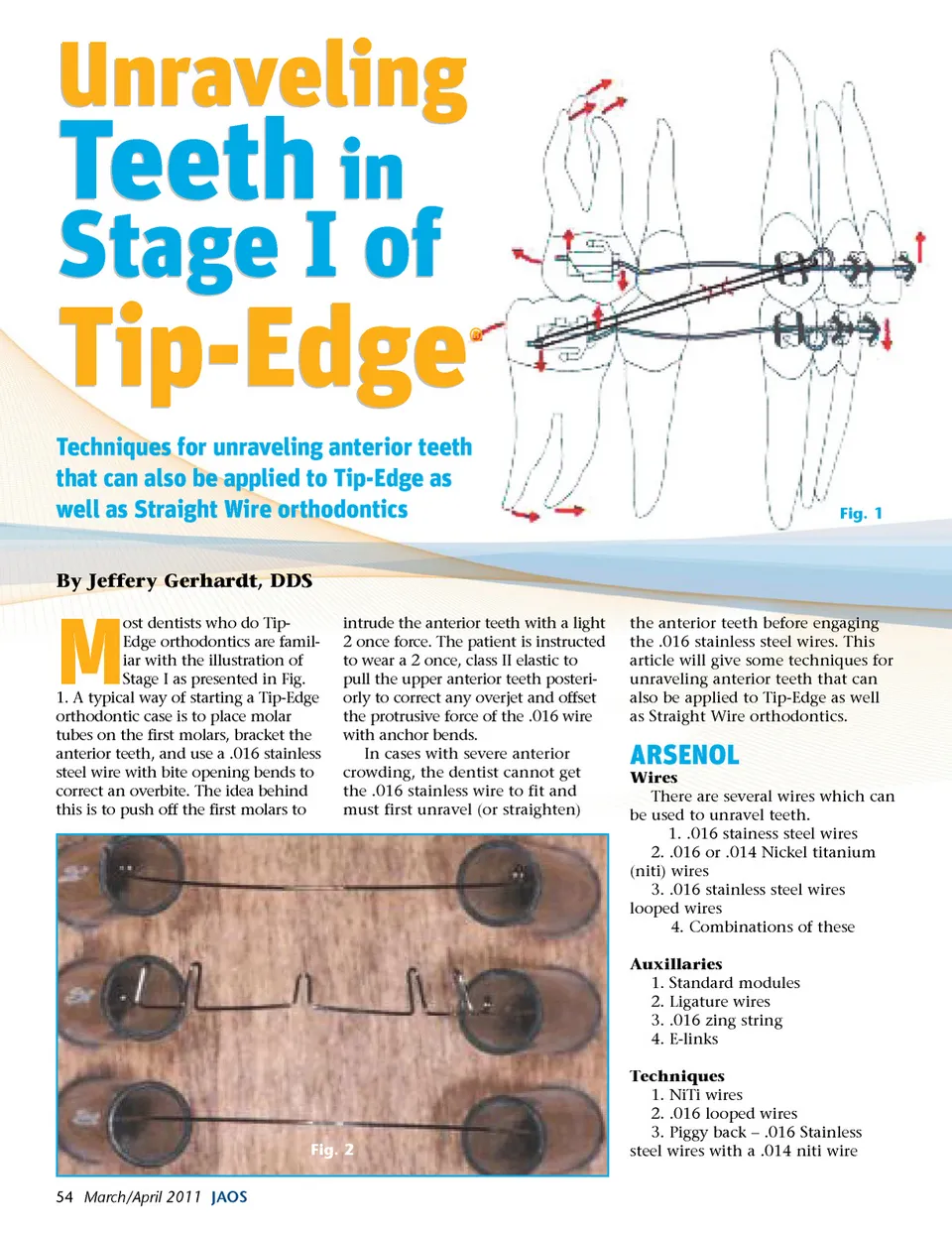
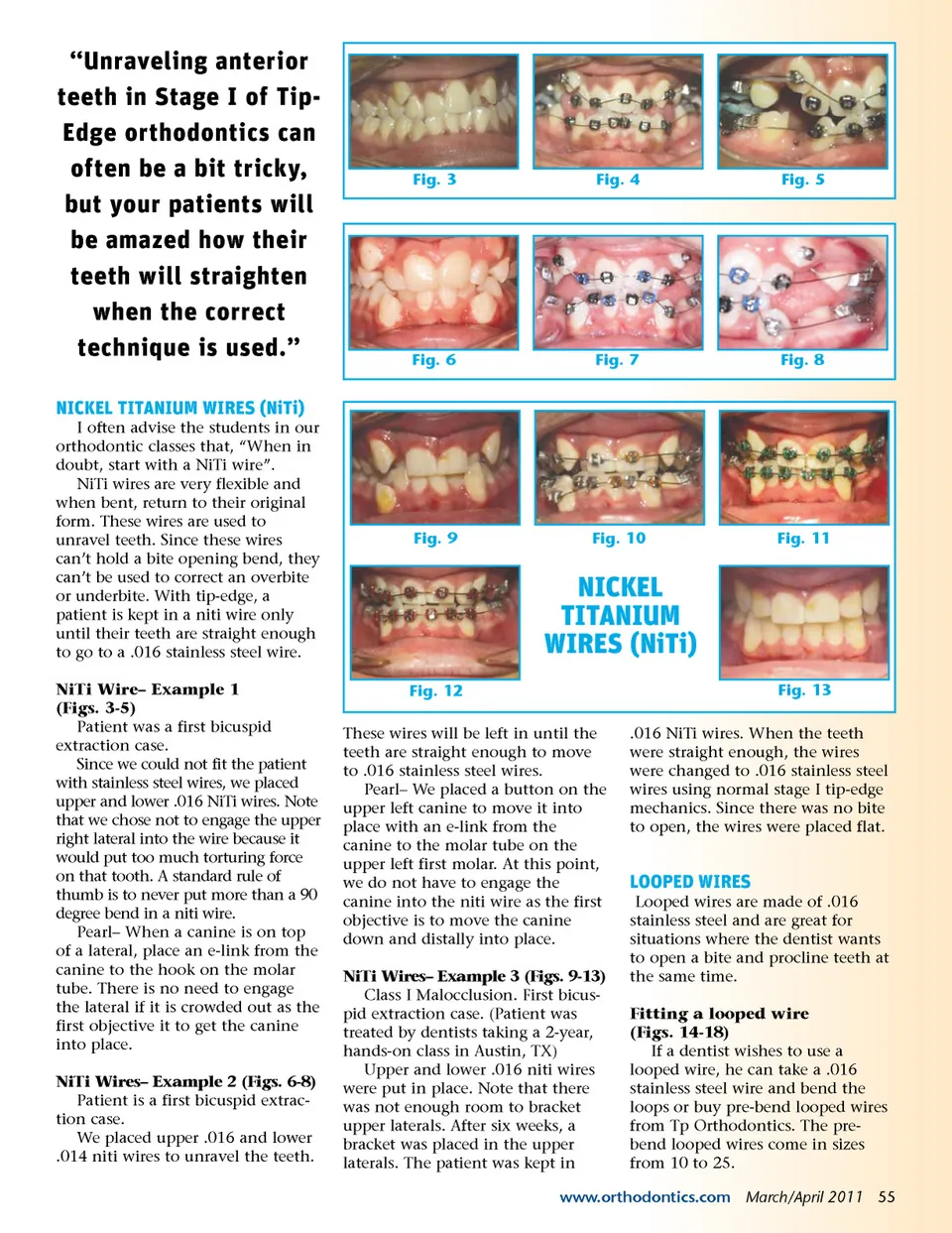
“Unraveling anterior teeth in Stage I of Tip-Edge orthodontics can often be a bit tricky, but your patients will be amazed how their teeth will straighten when the correct technique is used.” NICKEL TITANIUM WIRES (NiTi) I often advise the students in our orthodontic classes that, “When in doubt, start with a NiTi wire”. NiTi wires are very flexible and when bent, return to their original form. These wires are used to unravel teeth. Since these wires can’t hold a bite opening bend, they can’t be used to correct an overbite or underbite. With tip-edge, a patient is kept in a niti wire only until their teeth are straight enough to go to a .016 stainless steel wire. NiTi Wire– Example 1 (Figs. 3-5) Patient was a first bicuspid extraction case. Since we could not fit the patient with stainless steel wires, we placed upper and lower .016 NiTi wires. Note that we chose not to engage the upper right lateral into the wire because it would put too much torturing force on that tooth. A standard rule of thumb is to never put more than a 90 degree bend in a niti wire. Pearl– When a canine is on top of a lateral, place an e-link from the canine to the hook on the molar tube. There is no need to engage the lateral if it is crowded out as the first objective it to get the canine into place. NiTi Wires– Example 2 (Figs. 6-8) Patient is a first bicuspid extrac-tion case. We placed upper .016 and lower .014 niti wires to unravel the teeth. Fig. 3 Fig. 4 Fig. 5 Fig. 6 Fig. 7 Fig. 8 Fig. 9 Fig. 10 Fig. 11 NICKEL TITANIUM WIRES (NiTi) Fig. 12 These wires will be left in until the teeth are straight enough to move to .016 stainless steel wires. Pearl– We placed a button on the upper left canine to move it into place with an e-link from the canine to the molar tube on the upper left first molar. At this point, we do not have to engage the canine into the niti wire as the first objective is to move the canine down and distally into place. NiTi Wires– Example 3 (Figs. 9-13) Class I Malocclusion. First bicus-pid extraction case. (Patient was treated by dentists taking a 2-year, hands-on class in Austin, TX) Upper and lower .016 niti wires were put in place. Note that there was not enough room to bracket upper laterals. After six weeks, a bracket was placed in the upper laterals. The patient was kept in Fig. 13 .016 NiTi wires. When the teeth were straight enough, the wires were changed to .016 stainless steel wires using normal stage I tip-edge mechanics. Since there was no bite to open, the wires were placed flat. LOOPED WIRES Looped wires are made of .016 stainless steel and are great for situations where the dentist wants to open a bite and procline teeth at the same time. Fitting a looped wire (Figs. 14-18) If a dentist wishes to use a looped wire, he can take a .016 stainless steel wire and bend the loops or buy pre-bend looped wires from Tp Orthodontics. The pre-bend looped wires come in sizes from 10 to 25. www.orthodontics.com March/April 2011 55
Journal of the American Orthodontic Society March-April 2011: Page 55