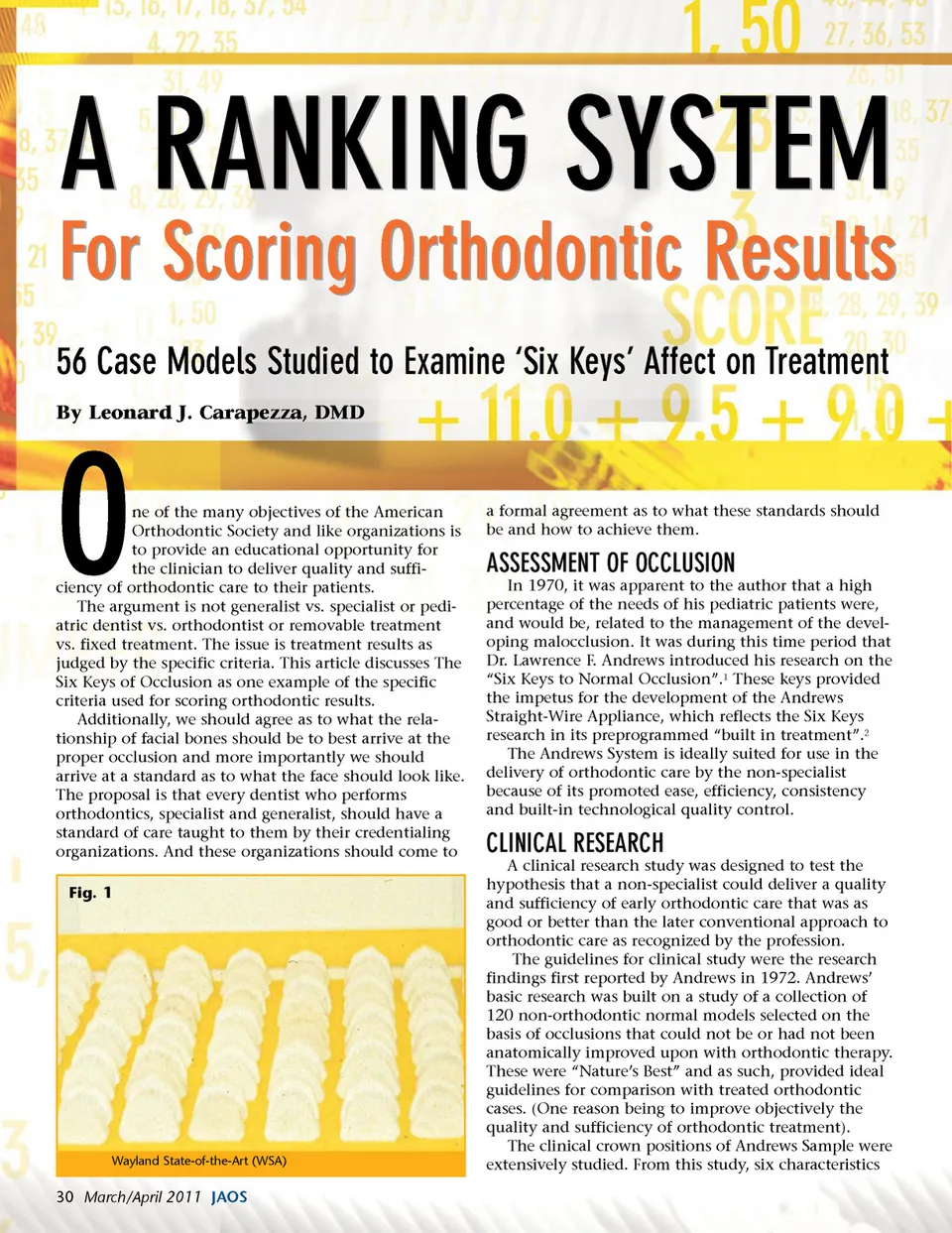
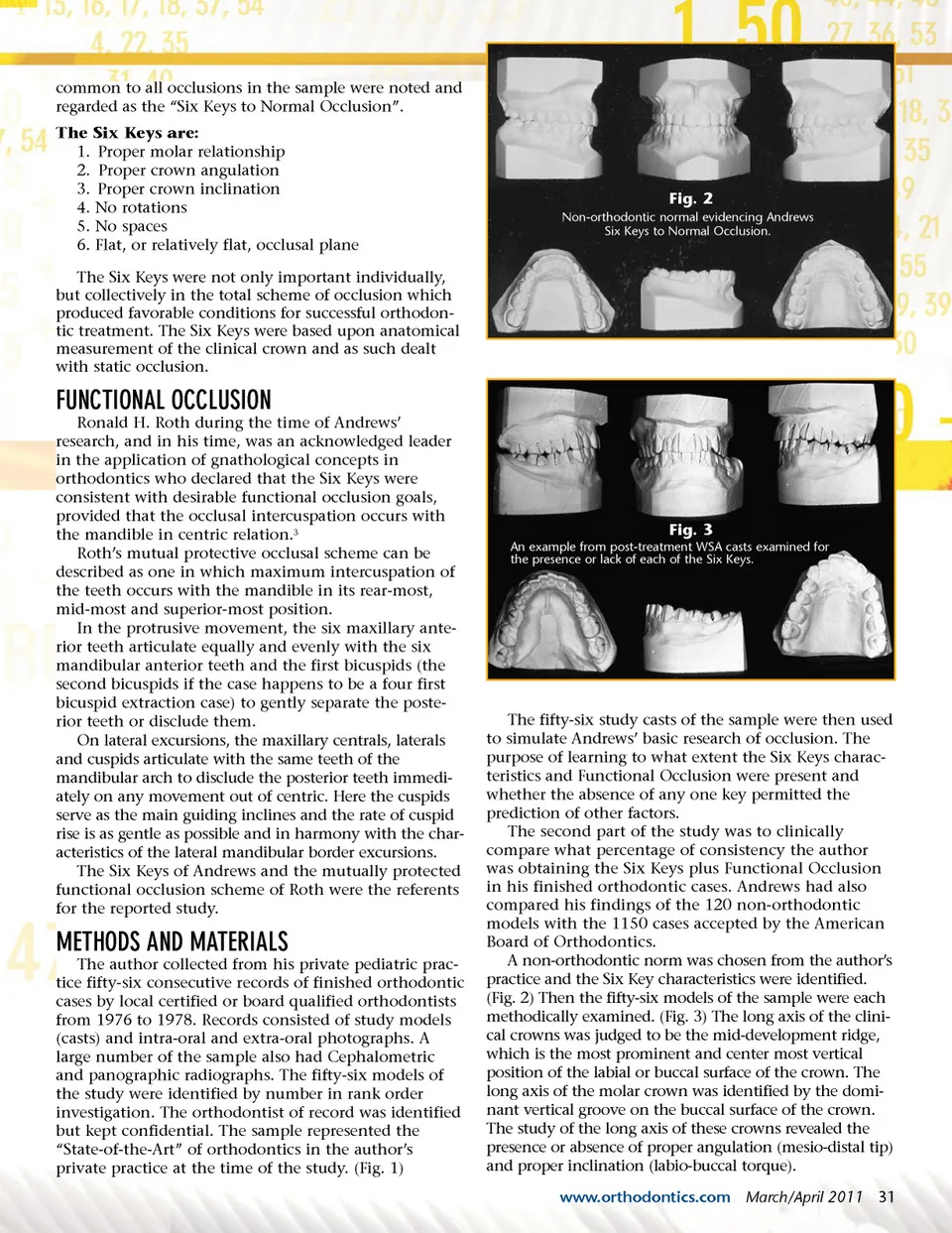
common to all occlusions in the sample were noted and regarded as the “Six Keys to Normal Occlusion”. The Six Keys are: 1. Proper molar relationship 2. Proper crown angulation 3. Proper crown inclination 4. No rotations 5. No spaces 6. Flat, or relatively flat, occlusal plane The Six Keys were not only important individually, but collectively in the total scheme of occlusion which produced favorable conditions for successful orthodon-tic treatment. The Six Keys were based upon anatomical measurement of the clinical crown and as such dealt with static occlusion. Fig. 2 Non-orthodontic normal evidencing Andrews Six Keys to Normal Occlusion. FUNCTIONAL OCCLUSION Ronald H. Roth during the time of Andrews’ research, and in his time, was an acknowledged leader in the application of gnathological concepts in orthodontics who declared that the Six Keys were consistent with desirable functional occlusion goals, provided that the occlusal intercuspation occurs with the mandible in centric relation. 3 Roth’s mutual protective occlusal scheme can be described as one in which maximum intercuspation of the teeth occurs with the mandible in its rear-most, mid-most and superior-most position. In the protrusive movement, the six maxillary ante-rior teeth articulate equally and evenly with the six mandibular anterior teeth and the first bicuspids (the second bicuspids if the case happens to be a four first bicuspid extraction case) to gently separate the poste-rior teeth or disclude them. On lateral excursions, the maxillary centrals, laterals and cuspids articulate with the same teeth of the mandibular arch to disclude the posterior teeth immedi-ately on any movement out of centric. Here the cuspids serve as the main guiding inclines and the rate of cuspid rise is as gentle as possible and in harmony with the char-acteristics of the lateral mandibular border excursions. The Six Keys of Andrews and the mutually protected functional occlusion scheme of Roth were the referents for the reported study. Fig. 3 An example from post-treatment WSA casts examined for the presence or lack of each of the Six Keys. METHODS AND MATERIALS The author collected from his private pediatric prac-tice fifty-six consecutive records of finished orthodontic cases by local certified or board qualified orthodontists from 1976 to 1978. Records consisted of study models (casts) and intra-oral and extra-oral photographs. A large number of the sample also had Cephalometric and panographic radiographs. The fifty-six models of the study were identified by number in rank order investigation. The orthodontist of record was identified but kept confidential. The sample represented the “State-of-the-Art” of orthodontics in the author’s private practice at the time of the study. (Fig. 1) The fifty-six study casts of the sample were then used to simulate Andrews’ basic research of occlusion. The purpose of learning to what extent the Six Keys charac-teristics and Functional Occlusion were present and whether the absence of any one key permitted the prediction of other factors. The second part of the study was to clinically compare what percentage of consistency the author was obtaining the Six Keys plus Functional Occlusion in his finished orthodontic cases. Andrews had also compared his findings of the 120 non-orthodontic models with the 1150 cases accepted by the American Board of Orthodontics. A non-orthodontic norm was chosen from the author’s practice and the Six Key characteristics were identified. (Fig. 2) Then the fifty-six models of the sample were each methodically examined. (Fig. 3) The long axis of the clini-cal crowns was judged to be the mid-development ridge, which is the most prominent and center most vertical position of the labial or buccal surface of the crown. The long axis of the molar crown was identified by the domi-nant vertical groove on the buccal surface of the crown. The study of the long axis of these crowns revealed the presence or absence of proper angulation (mesio-distal tip) and proper inclination (labio-buccal torque). www.orthodontics.com March/April 2011 31
Journal of the American Orthodontic Society March-April 2011: Page 31