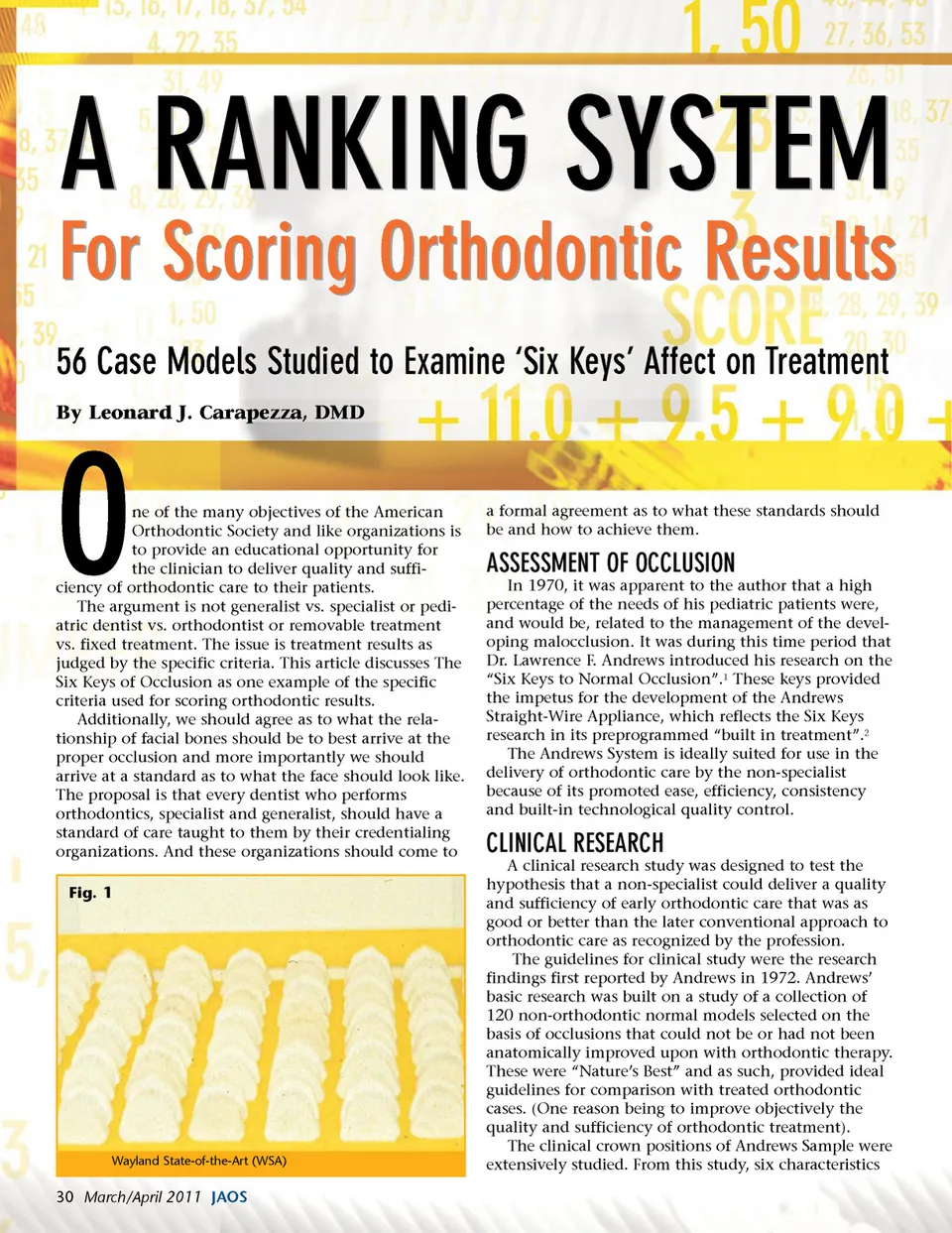
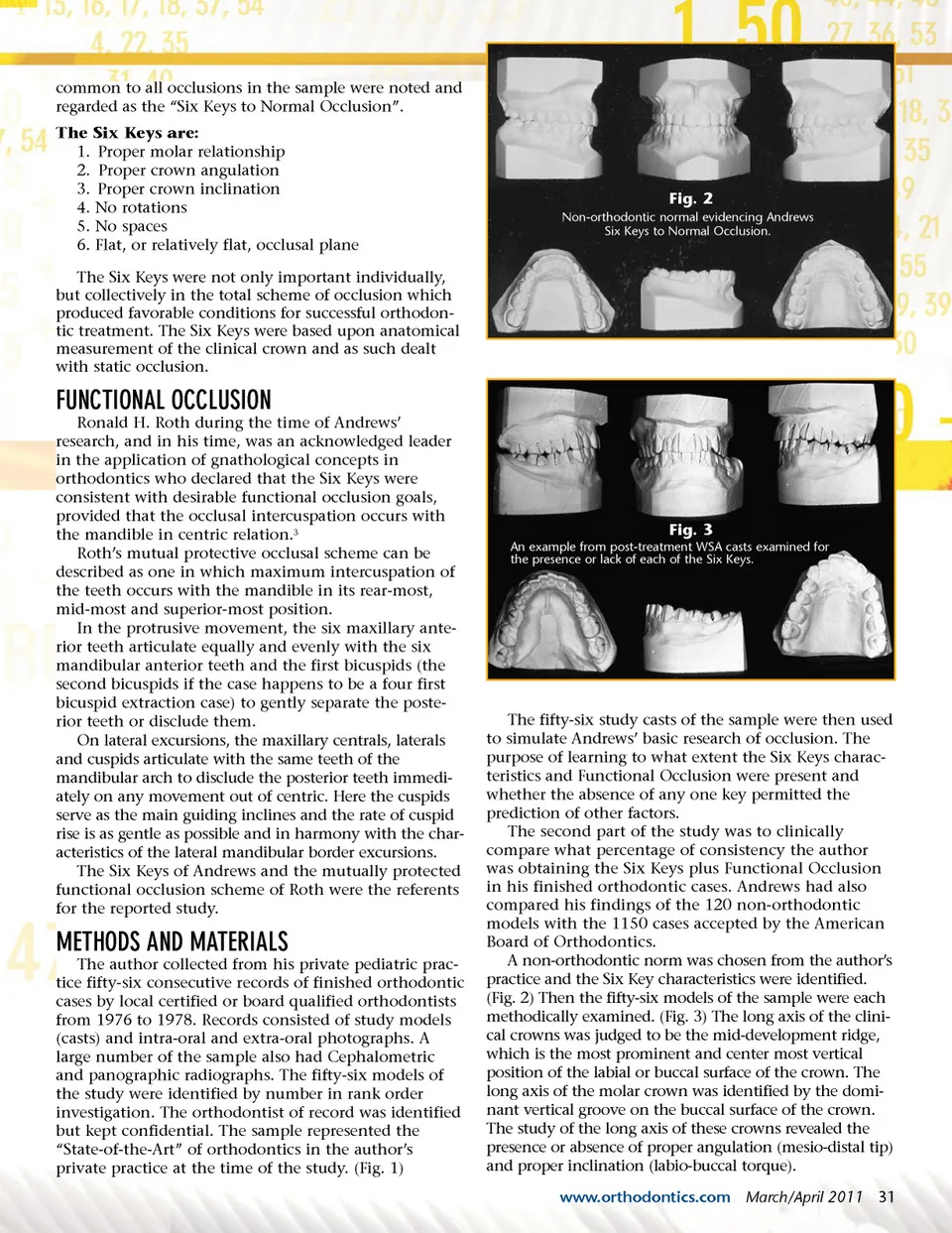
A RANKING SYSTEM For Scoring Orthodontic Results 56 Case Models Studied to Examine ‘Six Keys’ Affect on Treatment By Leonard J. Carapezza, DMD ne of the many objectives of the American Orthodontic Society and like organizations is to provide an educational opportunity for the clinician to deliver quality and suffi-ciency of orthodontic care to their patients. The argument is not generalist vs. specialist or pedi-atric dentist vs. orthodontist or removable treatment vs. fixed treatment. The issue is treatment results as judged by the specific criteria. This article discusses The Six Keys of Occlusion as one example of the specific criteria used for scoring orthodontic results. Additionally, we should agree as to what the rela-tionship of facial bones should be to best arrive at the proper occlusion and more importantly we should arrive at a standard as to what the face should look like. The proposal is that every dentist who performs orthodontics, specialist and generalist, should have a standard of care taught to them by their credentialing organizations. And these organizations should come to Fig. 1 O a formal agreement as to what these standards should be and how to achieve them. ASSESSMENT OF OCCLUSION In 1970, it was apparent to the author that a high percentage of the needs of his pediatric patients were, and would be, related to the management of the devel-oping malocclusion. It was during this time period that Dr. Lawrence F. Andrews introduced his research on the “Six Keys to Normal Occlusion”. 1 These keys provided the impetus for the development of the Andrews Straight-Wire Appliance, which reflects the Six Keys research in its preprogrammed “built in treatment”. 2 The Andrews System is ideally suited for use in the delivery of orthodontic care by the non-specialist because of its promoted ease, efficiency, consistency and built-in technological quality control. CLINICAL RESEARCH A clinical research study was designed to test the hypothesis that a non-specialist could deliver a quality and sufficiency of early orthodontic care that was as good or better than the later conventional approach to orthodontic care as recognized by the profession. The guidelines for clinical study were the research findings first reported by Andrews in 1972. Andrews’ basic research was built on a study of a collection of 120 non-orthodontic normal models selected on the basis of occlusions that could not be or had not been anatomically improved upon with orthodontic therapy. These were “Nature’s Best” and as such, provided ideal guidelines for comparison with treated orthodontic cases. (One reason being to improve objectively the quality and sufficiency of orthodontic treatment). The clinical crown positions of Andrews Sample were extensively studied. From this study, six characteristics Wayland State-of-the-Art (WSA) 30 March/April 2011 JAOS
Journal of the American Orthodontic Society March-April 2011: Page 30