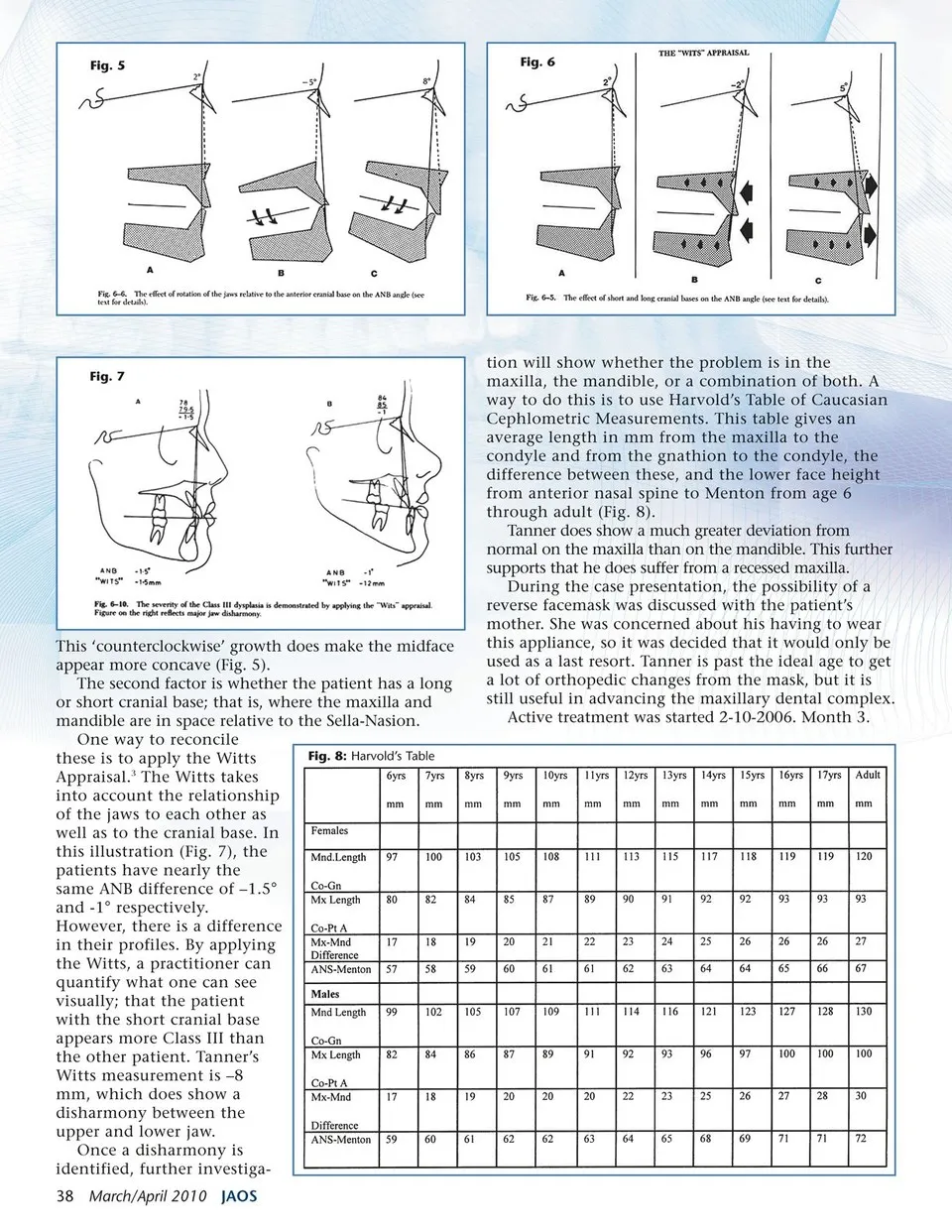
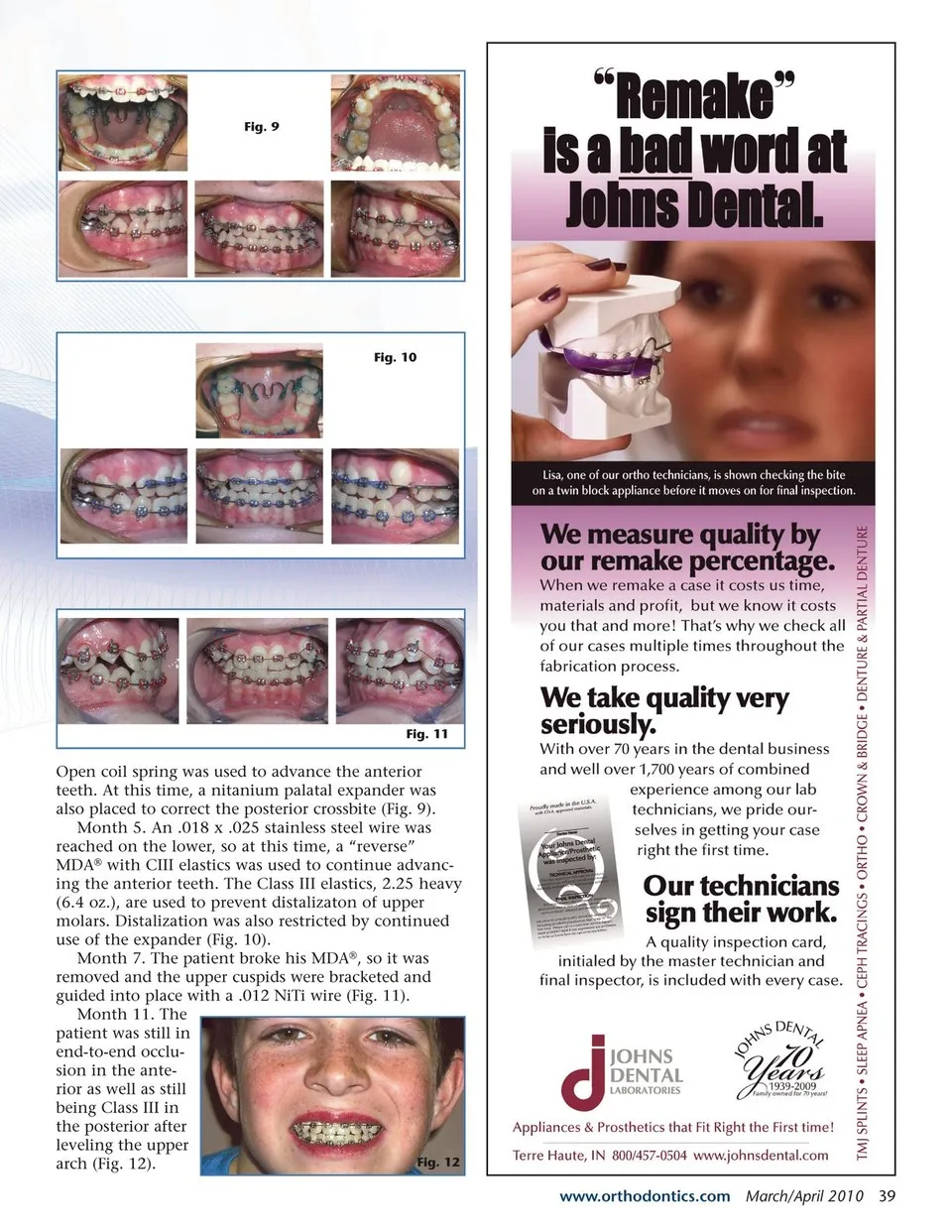
Fig. 5 Fig. 6 Fig. 7 This ‘counterclockwise’ growth does make the midface appear more concave (Fig. 5). The second factor is whether the patient has a long or short cranial base; that is, where the maxilla and mandible are in space relative to the Sella-Nasion. One way to reconcile these is to apply the Witts Appraisal.3 Fig. 8: Harvold’s Table The Witts takes into account the relationship of the jaws to each other as well as to the cranial base. In this illustration (Fig. 7), the patients have nearly the same ANB difference of –1.5° and -1° respectively. However, there is a difference in their profiles. By applying the Witts, a practitioner can quantify what one can see visually; that the patient with the short cranial base appears more Class III than the other patient. Tanner’s Witts measurement is –8 mm, which does show a disharmony between the upper and lower jaw. Once a disharmony is identified, further investiga- 38 March/April 2010 JAOS tion will show whether the problem is in the maxilla, the mandible, or a combination of both. A way to do this is to use Harvold’s Table of Caucasian Cephlometric Measurements. This table gives an average length in mm from the maxilla to the condyle and from the gnathion to the condyle, the difference between these, and the lower face height from anterior nasal spine to Menton from age 6 through adult (Fig. 8). Tanner does show a much greater deviation from normal on the maxilla than on the mandible. This further supports that he does suffer from a recessed maxilla. During the case presentation, the possibility of a reverse facemask was discussed with the patient’s mother. She was concerned about his having to wear this appliance, so it was decided that it would only be used as a last resort. Tanner is past the ideal age to get a lot of orthopedic changes from the mask, but it is still useful in advancing the maxillary dental complex. Active treatment was started 2-10-2006. Month 3.
Journal of the American Orthodontic Society March - April 2010: Page 38