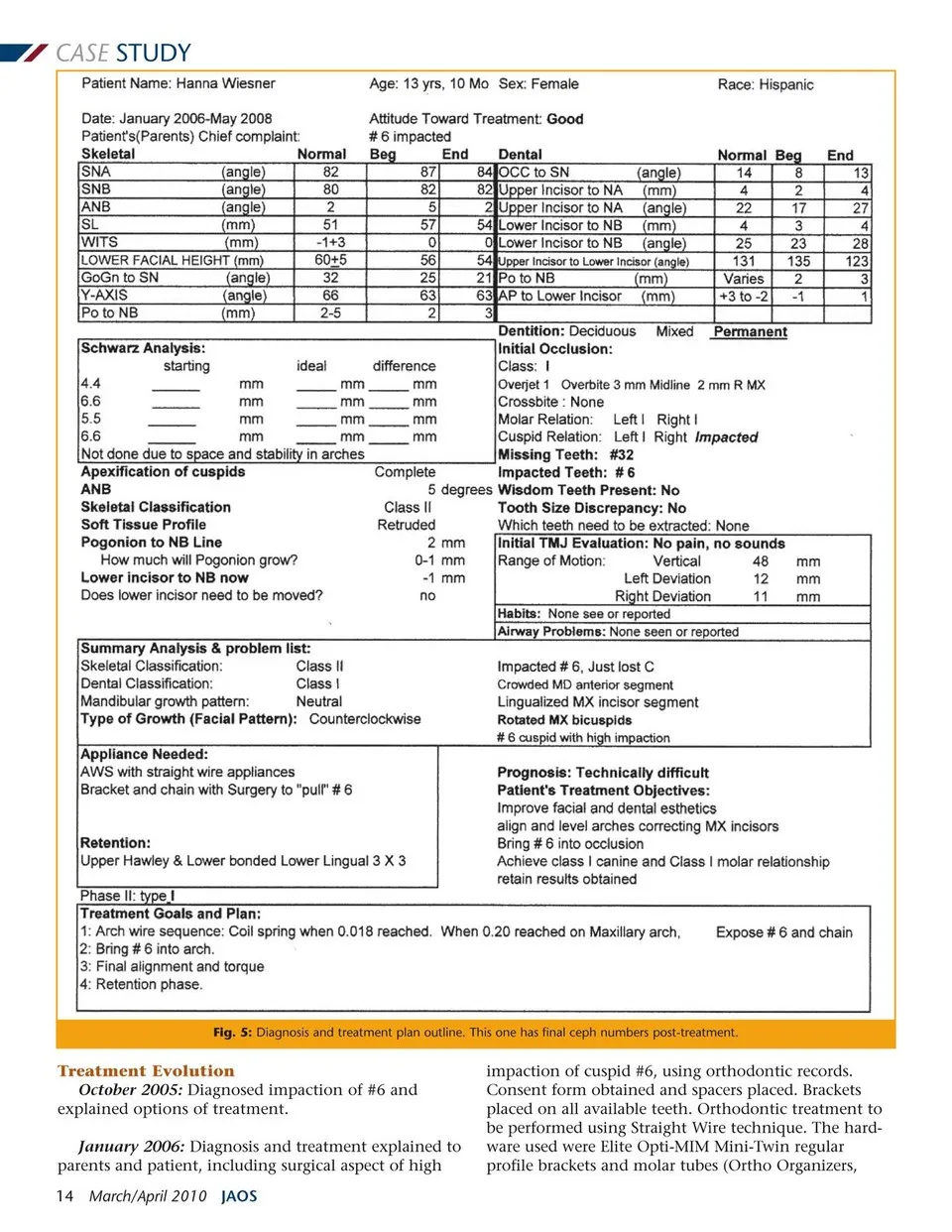
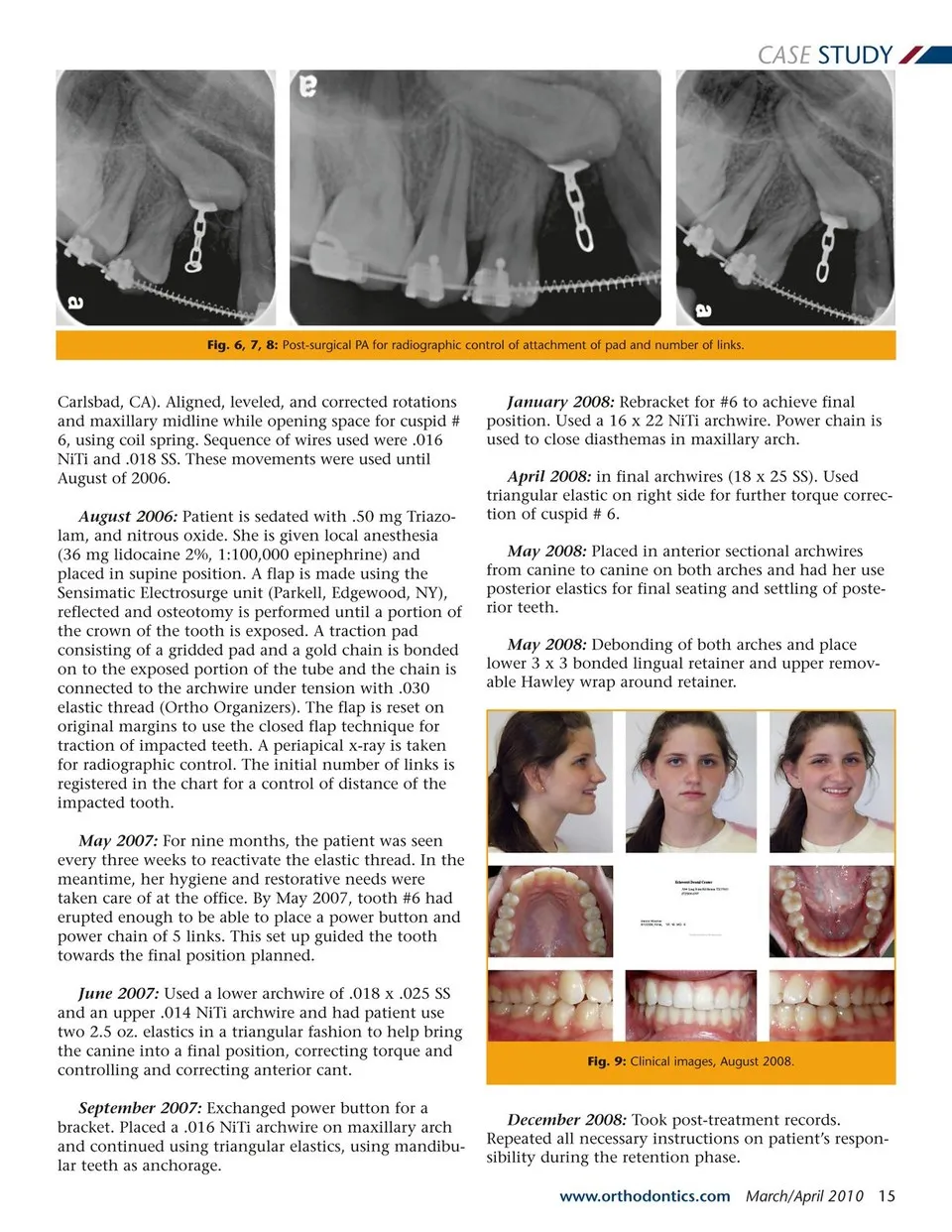
CASE STUDY Fig. 6, 7, 8: Post-surgical PA for radiographic control of attachment of pad and number of links. Carlsbad, CA). Aligned, leveled, and corrected rotations and maxillary midline while opening space for cuspid # 6, using coil spring. Sequence of wires used were .016 NiTi and .018 SS. These movements were used until August of 2006. August 2006: Patient is sedated with .50 mg Triazo- lam, and nitrous oxide. She is given local anesthesia (36 mg lidocaine 2%, 1:100,000 epinephrine) and placed in supine position. A flap is made using the Sensimatic Electrosurge unit (Parkell, Edgewood, NY), reflected and osteotomy is performed until a portion of the crown of the tooth is exposed. A traction pad consisting of a gridded pad and a gold chain is bonded on to the exposed portion of the tube and the chain is connected to the archwire under tension with .030 elastic thread (Ortho Organizers). The flap is reset on original margins to use the closed flap technique for traction of impacted teeth. A periapical x-ray is taken for radiographic control. The initial number of links is registered in the chart for a control of distance of the impacted tooth. May 2007: For nine months, the patient was seen every three weeks to reactivate the elastic thread. In the meantime, her hygiene and restorative needs were taken care of at the office. By May 2007, tooth #6 had erupted enough to be able to place a power button and power chain of 5 links. This set up guided the tooth towards the final position planned. June 2007: Used a lower archwire of .018 x .025 SS and an upper .014 NiTi archwire and had patient use two 2.5 oz. elastics in a triangular fashion to help bring the canine into a final position, correcting torque and controlling and correcting anterior cant. September 2007: Exchanged power button for a bracket. Placed a .016 NiTi archwire on maxillary arch and continued using triangular elastics, using mandibu- lar teeth as anchorage. January 2008: Rebracket for #6 to achieve final position. Used a 16 x 22 NiTi archwire. Power chain is used to close diasthemas in maxillary arch. April 2008: in final archwires (18 x 25 SS). Used triangular elastic on right side for further torque correc- tion of cuspid # 6. May 2008: Placed in anterior sectional archwires from canine to canine on both arches and had her use posterior elastics for final seating and settling of poste- rior teeth. May 2008: Debonding of both arches and place lower 3 x 3 bonded lingual retainer and upper remov- able Hawley wrap around retainer. Fig. 9: Clinical images, August 2008. December 2008: Took post-treatment records. Repeated all necessary instructions on patient’s respon- sibility during the retention phase. www.orthodontics.com March/April 2010 15
Journal of the American Orthodontic Society March - April 2010: Page 15