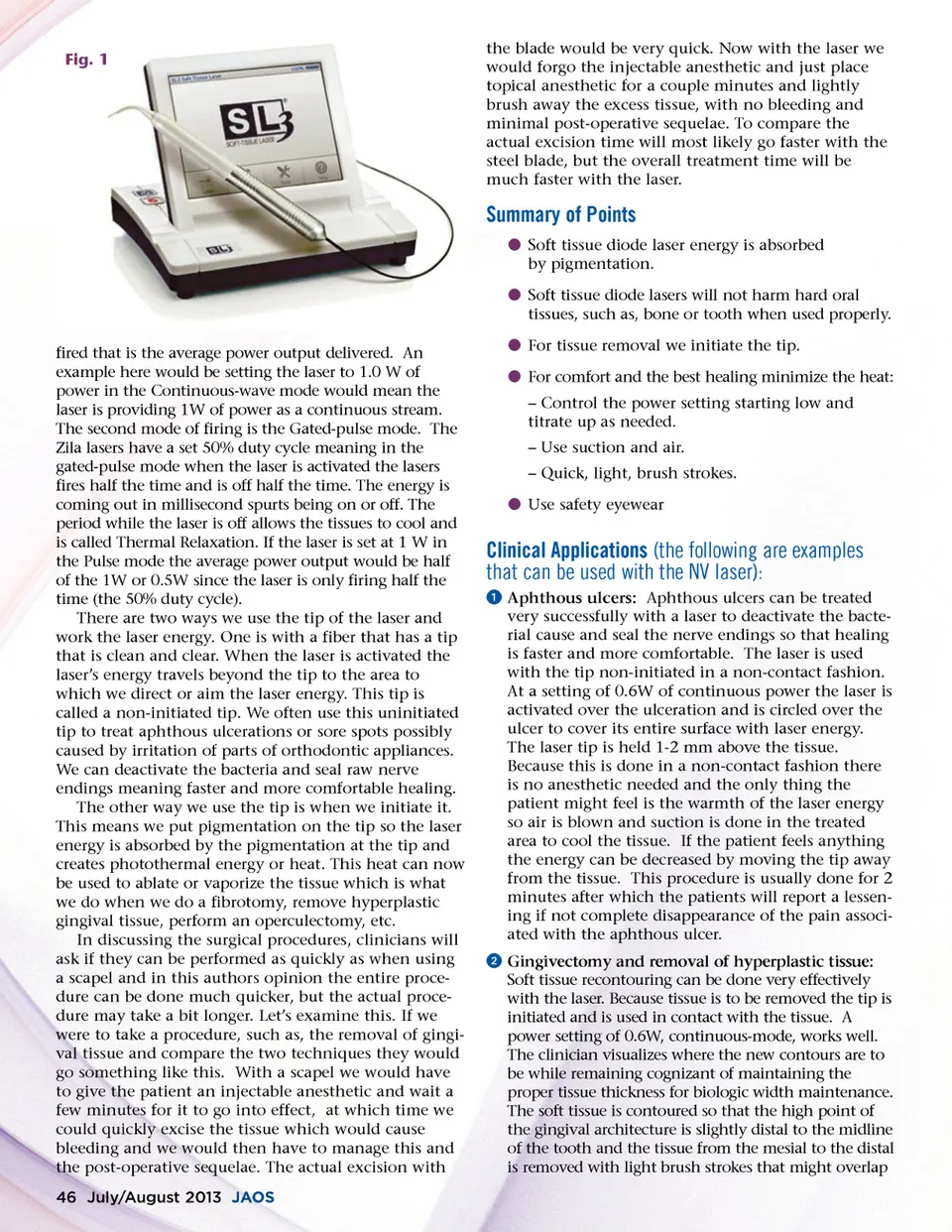
Fig. 1 the blade would be very quick. Now with the laser we would forgo the injectable anesthetic and just place topical anesthetic for a couple minutes and lightly brush away the excess tissue, with no bleeding and minimal post-operative sequelae. To compare the actual excision time will most likely go faster with the steel blade, but the overall treatment time will be much faster with the laser. Summary of Points b Soft tissue diode laser energy is absorbed by pigmentation. b Soft tissue diode lasers will not harm hard oral tissues, such as, bone or tooth when used properly. fired that is the average power output delivered. An example here would be setting the laser to 1.0 W of power in the Continuous-wave mode would mean the laser is providing 1W of power as a continuous stream. The second mode of firing is the Gated-pulse mode. The Zila lasers have a set 50% duty cycle meaning in the gated-pulse mode when the laser is activated the lasers fires half the time and is off half the time. The energy is coming out in millisecond spurts being on or off. The period while the laser is off allows the tissues to cool and is called Thermal Relaxation. If the laser is set at 1 W in the Pulse mode the average power output would be half of the 1W or 0.5W since the laser is only firing half the time (the 50% duty cycle). There are two ways we use the tip of the laser and work the laser energy. One is with a fiber that has a tip that is clean and clear. When the laser is activated the laser’s energy travels beyond the tip to the area to which we direct or aim the laser energy. This tip is called a non-initiated tip. We often use this uninitiated tip to treat aphthous ulcerations or sore spots possibly caused by irritation of parts of orthodontic appliances. We can deactivate the bacteria and seal raw nerve endings meaning faster and more comfortable healing. The other way we use the tip is when we initiate it. This means we put pigmentation on the tip so the laser energy is absorbed by the pigmentation at the tip and creates photothermal energy or heat. This heat can now be used to ablate or vaporize the tissue which is what we do when we do a fibrotomy, remove hyperplastic gingival tissue, perform an operculectomy, etc. In discussing the surgical procedures, clinicians will ask if they can be performed as quickly as when using a scapel and in this authors opinion the entire proce-dure can be done much quicker, but the actual proce-dure may take a bit longer. Let’s examine this. If we were to take a procedure, such as, the removal of gingi-val tissue and compare the two techniques they would go something like this. With a scapel we would have to give the patient an injectable anesthetic and wait a few minutes for it to go into effect, at which time we could quickly excise the tissue which would cause bleeding and we would then have to manage this and the post-operative sequelae. The actual excision with 46 July/August 2013 JAOS b For tissue removal we initiate the tip. b For comfort and the best healing minimize the heat: – Control the power setting starting low and titrate up as needed. – Use suction and air. – Quick, light, brush strokes. b Use safety eyewear Clinical Applications (the following are examples that can be used with the NV laser): ᕡ Aphthous ulcers: Aphthous ulcers can be treated very successfully with a laser to deactivate the bacte-rial cause and seal the nerve endings so that healing is faster and more comfortable. The laser is used with the tip non-initiated in a non-contact fashion. At a setting of 0.6W of continuous power the laser is activated over the ulceration and is circled over the ulcer to cover its entire surface with laser energy. The laser tip is held 1-2 mm above the tissue. Because this is done in a non-contact fashion there is no anesthetic needed and the only thing the patient might feel is the warmth of the laser energy so air is blown and suction is done in the treated area to cool the tissue. If the patient feels anything the energy can be decreased by moving the tip away from the tissue. This procedure is usually done for 2 minutes after which the patients will report a lessen-ing if not complete disappearance of the pain associ-ated with the aphthous ulcer. ᕢ Gingivectomy and removal of hyperplastic tissue: Soft tissue recontouring can be done very effectively with the laser. Because tissue is to be removed the tip is initiated and is used in contact with the tissue. A power setting of 0.6W, continuous-mode, works well. The clinician visualizes where the new contours are to be while remaining cognizant of maintaining the proper tissue thickness for biologic width maintenance. The soft tissue is contoured so that the high point of the gingival architecture is slightly distal to the midline of the tooth and the tissue from the mesial to the distal is removed with light brush strokes that might overlap
Journal of the American Orthodontic Society July-August 2013 Buyer's Guide: Page 46