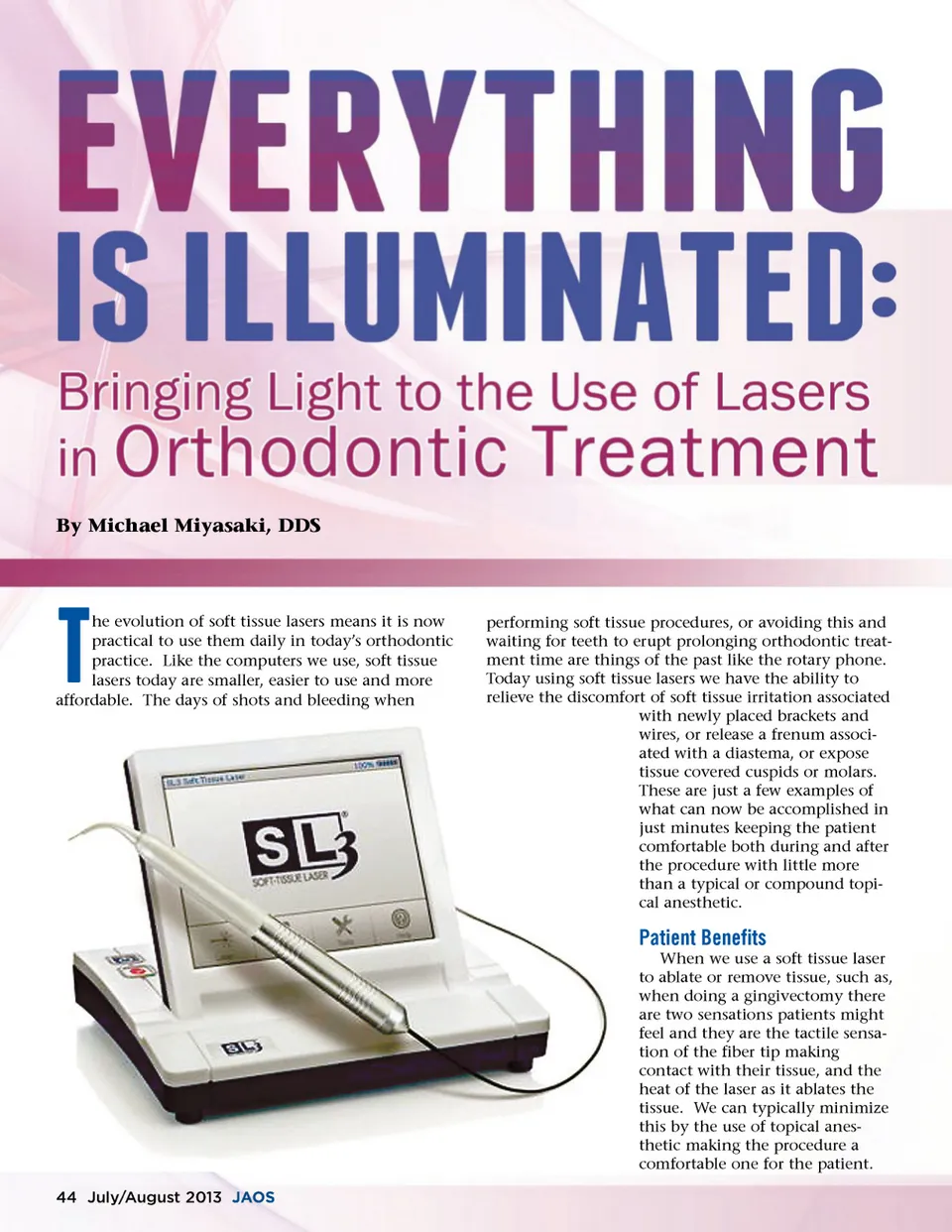
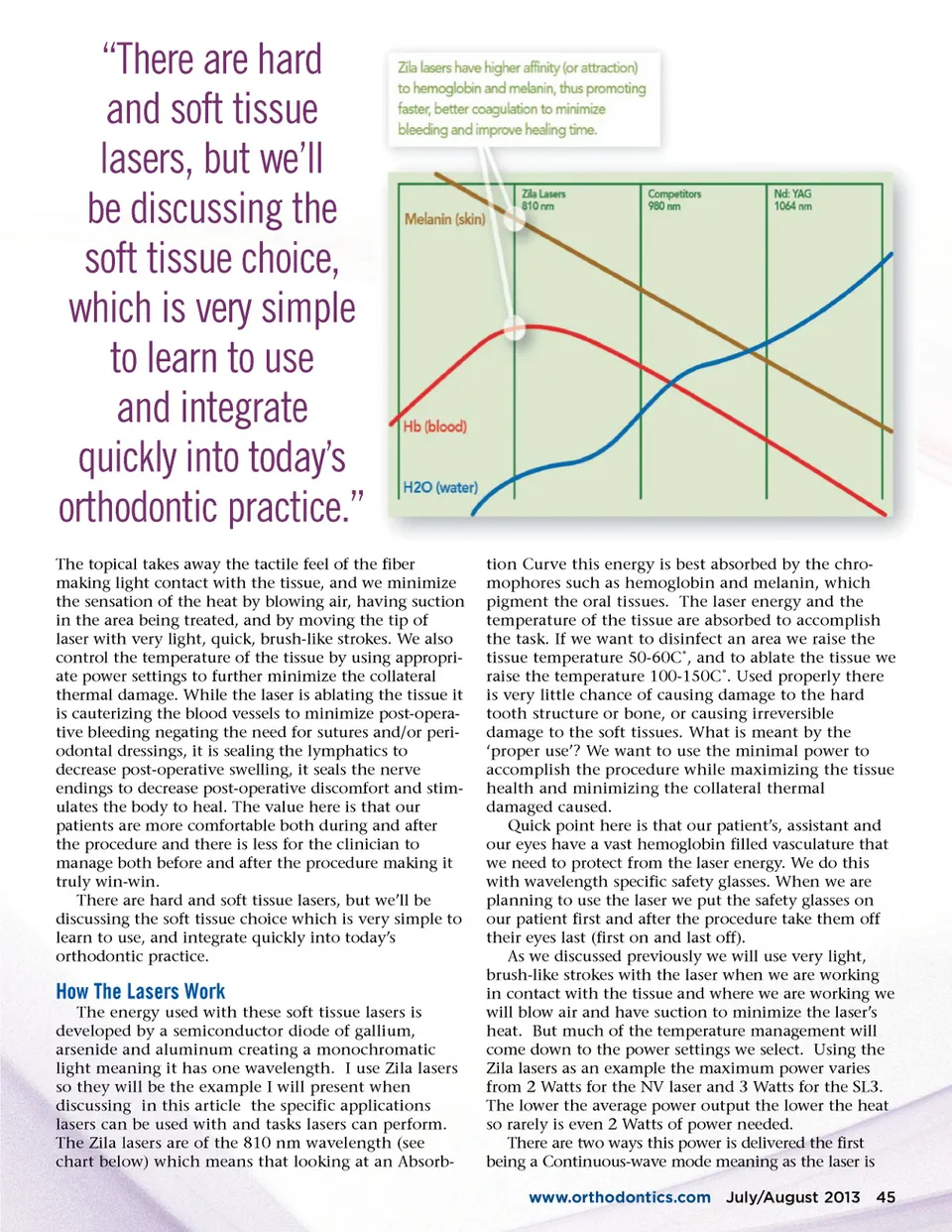
By Michael Miyasaki, DDS  he evolution of soft tissue lasers means it is now practical to use them daily in today’s orthodontic practice. Like the computers we use, soft tissue lasers today are smaller, easier to use and more affordable. The days of shots and bleeding when performing soft tissue procedures, or avoiding this and waiting for teeth to erupt prolonging orthodontic treat-ment time are things of the past like the rotary phone. Today using soft tissue lasers we have the ability to relieve the discomfort of soft tissue irritation associated with newly placed brackets and wires, or release a frenum associ-ated with a diastema, or expose tissue covered cuspids or molars. These are just a few examples of what can now be accomplished in just minutes keeping the patient comfortable both during and after the procedure with little more than a typical or compound topi-cal anesthetic. Patient Benefits When we use a soft tissue laser to ablate or remove tissue, such as, when doing a gingivectomy there are two sensations patients might feel and they are the tactile sensa-tion of the fiber tip making contact with their tissue, and the heat of the laser as it ablates the tissue. We can typically minimize this by the use of topical anes-thetic making the procedure a comfortable one for the patient. 44 July/August 2013 JAOS
Journal of the American Orthodontic Society July-August 2013 Buyer's Guide: Page 44