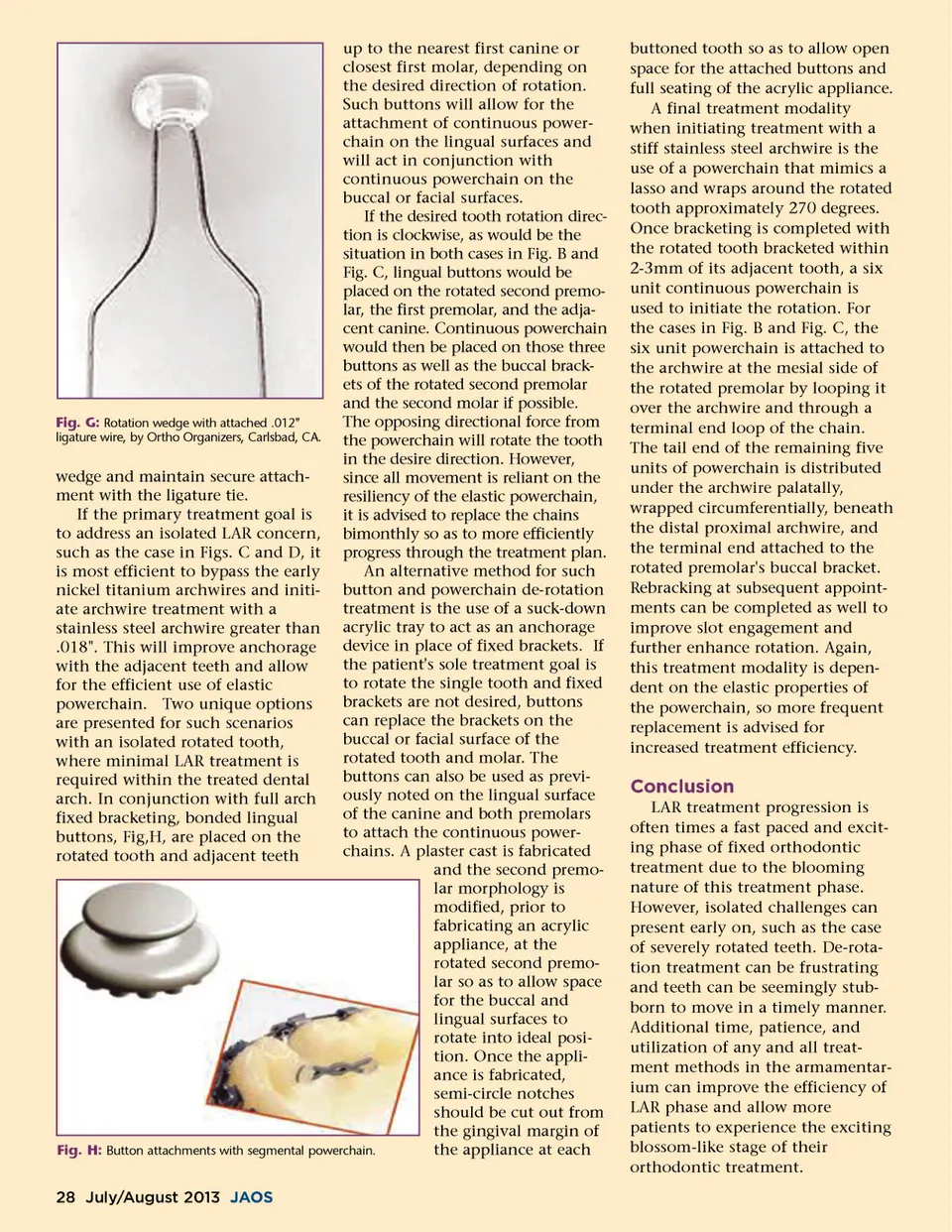
up to the nearest first canine or closest first molar, depending on the desired direction of rotation. Such buttons will allow for the attachment of continuous power-chain on the lingual surfaces and will act in conjunction with continuous powerchain on the buccal or facial surfaces. If the desired tooth rotation direc-tion is clockwise, as would be the situation in both cases in Fig. B and Fig. C, lingual buttons would be placed on the rotated second premo-lar, the first premolar, and the adja-cent canine. Continuous powerchain would then be placed on those three buttons as well as the buccal brack-ets of the rotated second premolar and the second molar if possible. The opposing directional force from Fig. G: Rotation wedge with attached .012" ligature wire, by Ortho Organizers, Carlsbad, CA. the powerchain will rotate the tooth in the desire direction. However, wedge and maintain secure attach-since all movement is reliant on the ment with the ligature tie. resiliency of the elastic powerchain, If the primary treatment goal is it is advised to replace the chains to address an isolated LAR concern, bimonthly so as to more efficiently such as the case in Figs. C and D, it progress through the treatment plan. An alternative method for such is most efficient to bypass the early nickel titanium archwires and initi-button and powerchain de-rotation treatment is the use of a suck-down ate archwire treatment with a stainless steel archwire greater than acrylic tray to act as an anchorage device in place of fixed brackets. If .018". This will improve anchorage the patient's sole treatment goal is with the adjacent teeth and allow to rotate the single tooth and fixed for the efficient use of elastic brackets are not desired, buttons powerchain. Two unique options can replace the brackets on the are presented for such scenarios buccal or facial surface of the with an isolated rotated tooth, rotated tooth and molar. The where minimal LAR treatment is buttons can also be used as previ-required within the treated dental ously noted on the lingual surface arch. In conjunction with full arch of the canine and both premolars fixed bracketing, bonded lingual to attach the continuous power-buttons, Fig,H, are placed on the chains. A plaster cast is fabricated rotated tooth and adjacent teeth and the second premo-lar morphology is modified, prior to fabricating an acrylic appliance, at the rotated second premo-lar so as to allow space for the buccal and lingual surfaces to rotate into ideal posi-tion. Once the appli-ance is fabricated, semi-circle notches should be cut out from the gingival margin of the appliance at each Fig. H: Button attachments with segmental powerchain. 28 July/August 2013 JAOS buttoned tooth so as to allow open space for the attached buttons and full seating of the acrylic appliance. A final treatment modality when initiating treatment with a stiff stainless steel archwire is the use of a powerchain that mimics a lasso and wraps around the rotated tooth approximately 270 degrees. Once bracketing is completed with the rotated tooth bracketed within 2-3mm of its adjacent tooth, a six unit continuous powerchain is used to initiate the rotation. For the cases in Fig. B and Fig. C, the six unit powerchain is attached to the archwire at the mesial side of the rotated premolar by looping it over the archwire and through a terminal end loop of the chain. The tail end of the remaining five units of powerchain is distributed under the archwire palatally, wrapped circumferentially, beneath the distal proximal archwire, and the terminal end attached to the rotated premolar's buccal bracket. Rebracking at subsequent appoint-ments can be completed as well to improve slot engagement and further enhance rotation. Again, this treatment modality is depen-dent on the elastic properties of the powerchain, so more frequent replacement is advised for increased treatment efficiency. Conclusion LAR treatment progression is often times a fast paced and excit-ing phase of fixed orthodontic treatment due to the blooming nature of this treatment phase. However, isolated challenges can present early on, such as the case of severely rotated teeth. De-rota-tion treatment can be frustrating and teeth can be seemingly stub-born to move in a timely manner. Additional time, patience, and utilization of any and all treat-ment methods in the armamentar-ium can improve the efficiency of LAR phase and allow more patients to experience the exciting blossom-like stage of their orthodontic treatment.
Journal of the American Orthodontic Society July-August 2013 Buyer's Guide: Page 28