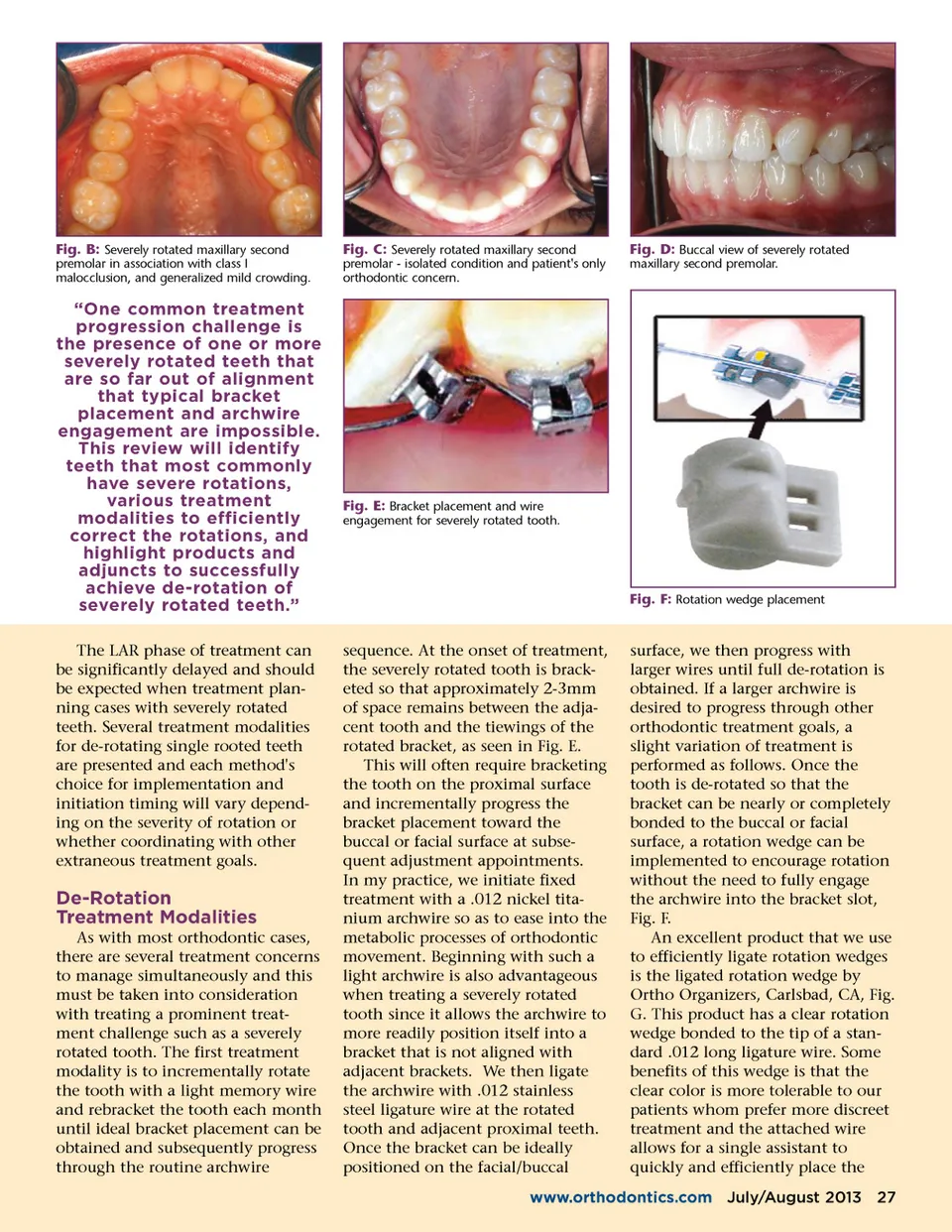
Etiology, Treatment, and Orthodontic Adjuncts Review By Ryan C. Galligan, DDS ixed orthodontic treatment of the adult dentition most often begins with the progressive series of arch-wires to obtain leveling, alignment, and alleviate rotations within the dentition. This initial phase sequence of events is oftentimes routine as the properties of nickel titanium arch-wires and bracket placement are expressed. However, challenges can arise early in treatment plans that inhibit a smooth transition amongst the level, alignment, and rotation (LAR) phase of treatment. One common treatment progres-sion challenge is the presence of one or more severely rotated teeth that are so far out of alignment that typi-cal bracket placement and archwire engagement are impossible. This review will identify teeth that most commonly have severe rotations, various treatment modalities to effi-ciently correct the rotations, and highlight products and adjuncts to successfully achieve de-rotation of severely rotated teeth. 26 July/August 2013 JAOS F Clinical Presentations and Suspected Etiologies In my practice, I have found that although all teeth are susceptible to ectopic eruption or malalignment, severe rotations seem to most commonly occur with mandibular canines and maxillary premolars. Such teeth will be the focus of this treatment review. A common etiol-ogy of mandibular canine rotations is likely related to the loss of adequate canine space following exfoliation of deciduous canines and subsequent lateral incisor drift. An additional etiology that is less understood by this author is the association of severely rotated canines in association with delayed or slow canine eruption and/or maxillary canine impaction. Figure A demonstrates a rotated mandibu-lar canine that although sufficient eruption space was present, the tooth still erupted rotated nearly ninety degrees. Maxillary premolar rotations can present with anywhere from 0 to Fig. A: Severely rotated mandibular canine. 180 degrees of rotation with 90 degree rotation being quite common. Although such rotations can be related to a divergent or disrupted growth path, as may be the case with the aforementioned canines, a more common scenario is an over-retained deciduous molar. This typically results in the erupting premolar taking a divergent and rotated path of eruption. Fig. B and Fig. C present maxillary second premolars that have erupted in a severely rotated position. Fig. D illustrates the buccal relationship of the same dentition noted in Fig. C.
Journal of the American Orthodontic Society July-August 2013 Buyer's Guide: Page 26