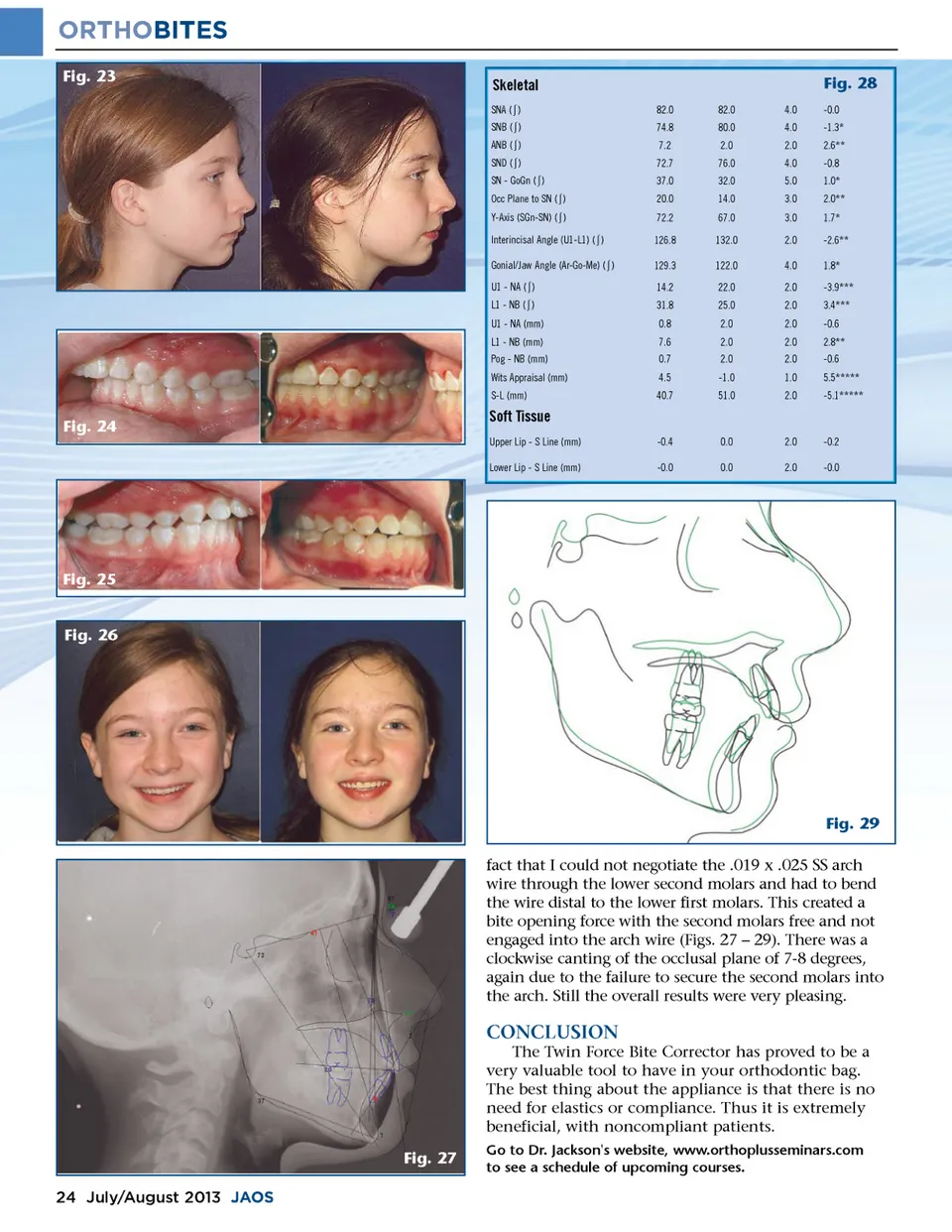
ORTHOBITES Fig. 23 Skeletal SNA ( ∫ ) SNB ( ∫ ) ANB ( ∫ ) SND ( ∫ ) SN -GoGn ( ∫ ) Occ Plane to SN ( ∫ ) Y-Axis (SGn-SN) ( ∫ ) Interincisal Angle (U1-L1) ( ∫ ) Gonial/Jaw Angle (Ar-Go-Me) ( ∫ ) U1 -NA ( ∫ ) L1 -NB ( ∫ ) U1 -NA (mm) L1 -NB (mm) Pog -NB (mm) Wits Appraisal (mm) S-L (mm) 82.0 74.8 7.2 72.7 37.0 20.0 72.2 126.8 129.3 14.2 31.8 0.8 7.6 0.7 4.5 40.7 82.0 80.0 2.0 76.0 32.0 14.0 67.0 132.0 122.0 22.0 25.0 2.0 2.0 2.0 -1.0 51.0 4.0 4.0 2.0 4.0 5.0 3.0 3.0 2.0 4.0 2.0 2.0 2.0 2.0 2.0 1.0 2.0 Fig. 28 -0.0 -1.3* 2.6** -0.8 1.0* 2.0** 1.7* -2.6** 1.8* -3.9*** 3.4*** -0.6 2.8** -0.6 5.5***** -5.1***** Fig. 24 Soft Tissue Upper Lip -S Line (mm) Lower Lip -S Line (mm) -0.4 -0.0 0.0 0.0 2.0 2.0 -0.2 -0.0 Fig. 25 Fig. 26 Fig. 29 fact that I could not negotiate the .019 x .025 SS arch wire through the lower second molars and had to bend the wire distal to the lower first molars. This created a bite opening force with the second molars free and not engaged into the arch wire (Figs. 27 – 29). There was a clockwise canting of the occlusal plane of 7-8 degrees, again due to the failure to secure the second molars into the arch. Still the overall results were very pleasing. CONCLUSION The Twin Force Bite Corrector has proved to be a very valuable tool to have in your orthodontic bag. The best thing about the appliance is that there is no need for elastics or compliance. Thus it is extremely beneficial, with noncompliant patients. Fig. 27 24 July/August 2013 JAOS Go to Dr. Jackson's website, www.orthoplusseminars.com to see a schedule of upcoming courses.
Journal of the American Orthodontic Society July-August 2013 Buyer's Guide: Page 24