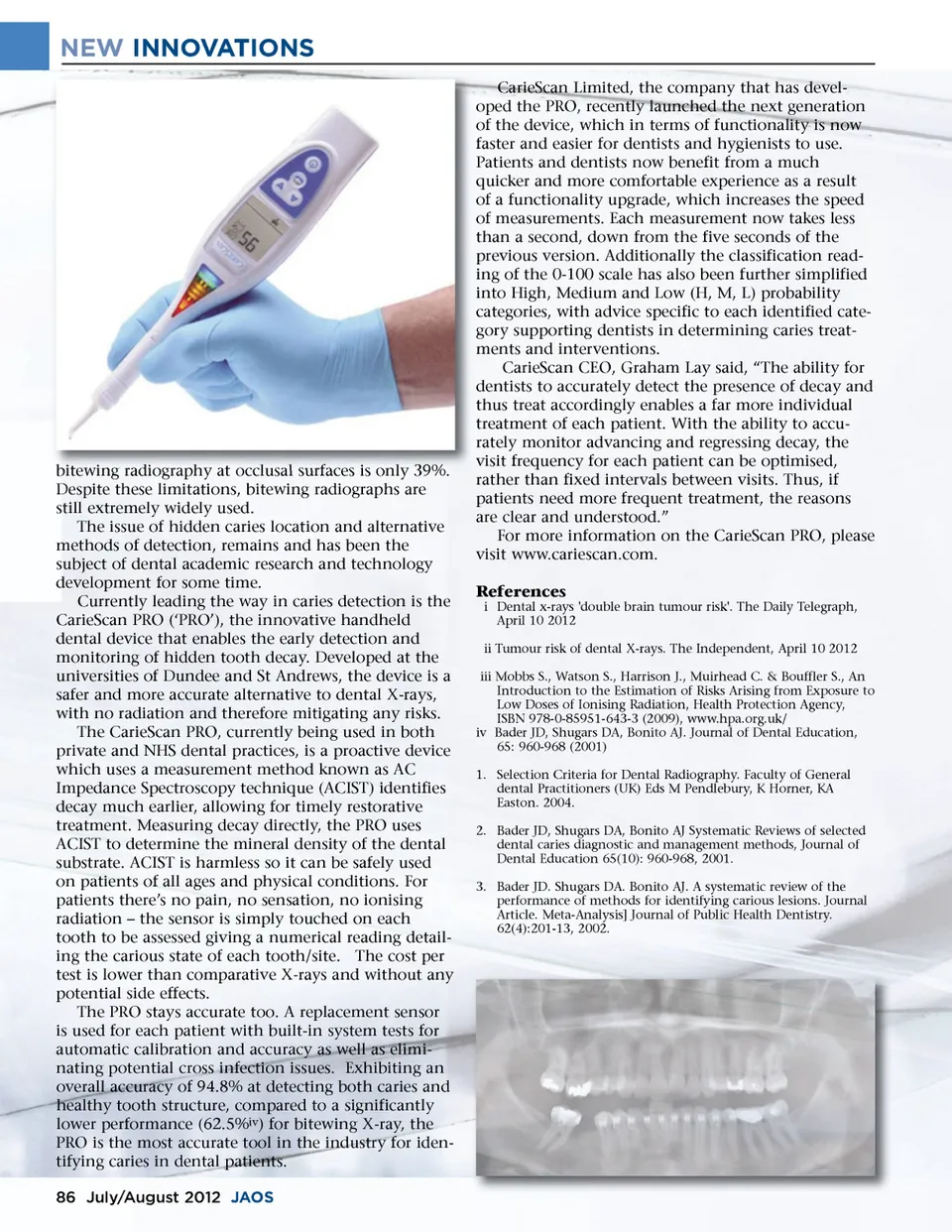
NEW INNOVATIONS CarieScan Limited, the company that has devel-oped the PRO, recently launched the next generation of the device, which in terms of functionality is now faster and easier for dentists and hygienists to use. Patients and dentists now benefit from a much quicker and more comfortable experience as a result of a functionality upgrade, which increases the speed of measurements. Each measurement now takes less than a second, down from the five seconds of the previous version. Additionally the classification read-ing of the 0-100 scale has also been further simplified into High, Medium and Low (H, M, L) probability categories, with advice specific to each identified cate-gory supporting dentists in determining caries treat-ments and interventions. CarieScan CEO, Graham Lay said, “The ability for dentists to accurately detect the presence of decay and thus treat accordingly enables a far more individual treatment of each patient. With the ability to accu-rately monitor advancing and regressing decay, the visit frequency for each patient can be optimised, rather than fixed intervals between visits. Thus, if patients need more frequent treatment, the reasons are clear and understood.” For more information on the CarieScan PRO, please visit www.cariescan.com. References i Dental x-rays 'double brain tumour risk'. The Daily Telegraph, April 10 2012 ii Tumour risk of dental X-rays. The Independent, April 10 2012 iii Mobbs S., Watson S., Harrison J., Muirhead C. & Bouffler S., An Introduction to the Estimation of Risks Arising from Exposure to Low Doses of Ionising Radiation, Health Protection Agency, ISBN 978-0-85951-643-3 (2009), www.hpa.org.uk/ iv Bader JD, Shugars DA, Bonito AJ. Journal of Dental Education, 65: 960-968 (2001) 1. Selection Criteria for Dental Radiography. Faculty of General dental Practitioners (UK) Eds M Pendlebury, K Horner, KA Easton. 2004. 2. Bader JD, Shugars DA, Bonito AJ Systematic Reviews of selected dental caries diagnostic and management methods, Journal of Dental Education 65(10): 960-968, 2001. 3. Bader JD. Shugars DA. Bonito AJ. A systematic review of the performance of methods for identifying carious lesions. Journal Article. Meta-Analysis] Journal of Public Health Dentistry. 62(4):201-13, 2002. 39%. bitewing radiography at occlusal surfaces is only 39% Despite these limitations, bitewing radiographs are still extremely widely used. The issue of hidden caries location and alternative methods of detection, remains and has been the subject of dental academic research and technology development for some time. Currently leading the way in caries detection is the CarieScan PRO (‘PRO’), the innovative handheld dental device that enables the early detection and monitoring of hidden tooth decay. Developed at the universities of Dundee and St Andrews, the device is a safer and more accurate alternative to dental X-rays, with no radiation and therefore mitigating any risks. The CarieScan PRO, currently being used in both private and NHS dental practices, is a proactive device which uses a measurement method known as AC Impedance Spectroscopy technique (ACIST) identifies decay much earlier, allowing for timely restorative treatment. Measuring decay directly, the PRO uses ACIST to determine the mineral density of the dental substrate. ACIST is harmless so it can be safely used on patients of all ages and physical conditions. For patients there’s no pain, no sensation, no ionising radiation – the sensor is simply touched on each tooth to be assessed giving a numerical reading detail-ing the carious state of each tooth/site. The cost per test is lower than comparative X-rays and without any potential side effects. The PRO stays accurate too. A replacement sensor is used for each patient with built-in system tests for automatic calibration and accuracy as well as elimi-nating potential cross infection issues. Exhibiting an overall accuracy of 94.8% at detecting both caries and healthy tooth structure, compared to a significantly lower performance (62.5% iv ) for bitewing X-ray, the PRO is the most accurate tool in the industry for iden-tifying caries in dental patients. 86 July/August 2012 JAOS
Journal of the American Orthodontic Society July-August 2012 Buyer's Guide: Page 86