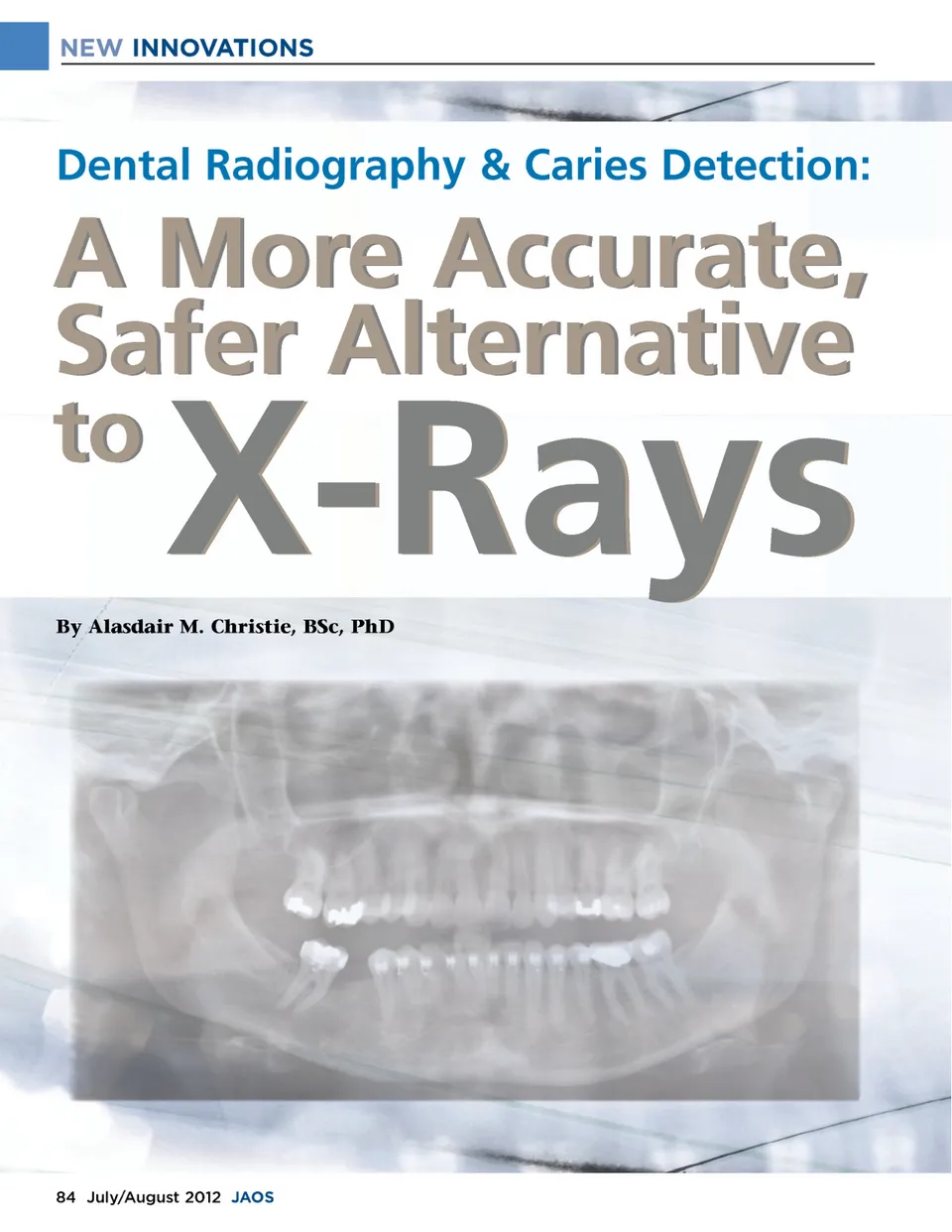
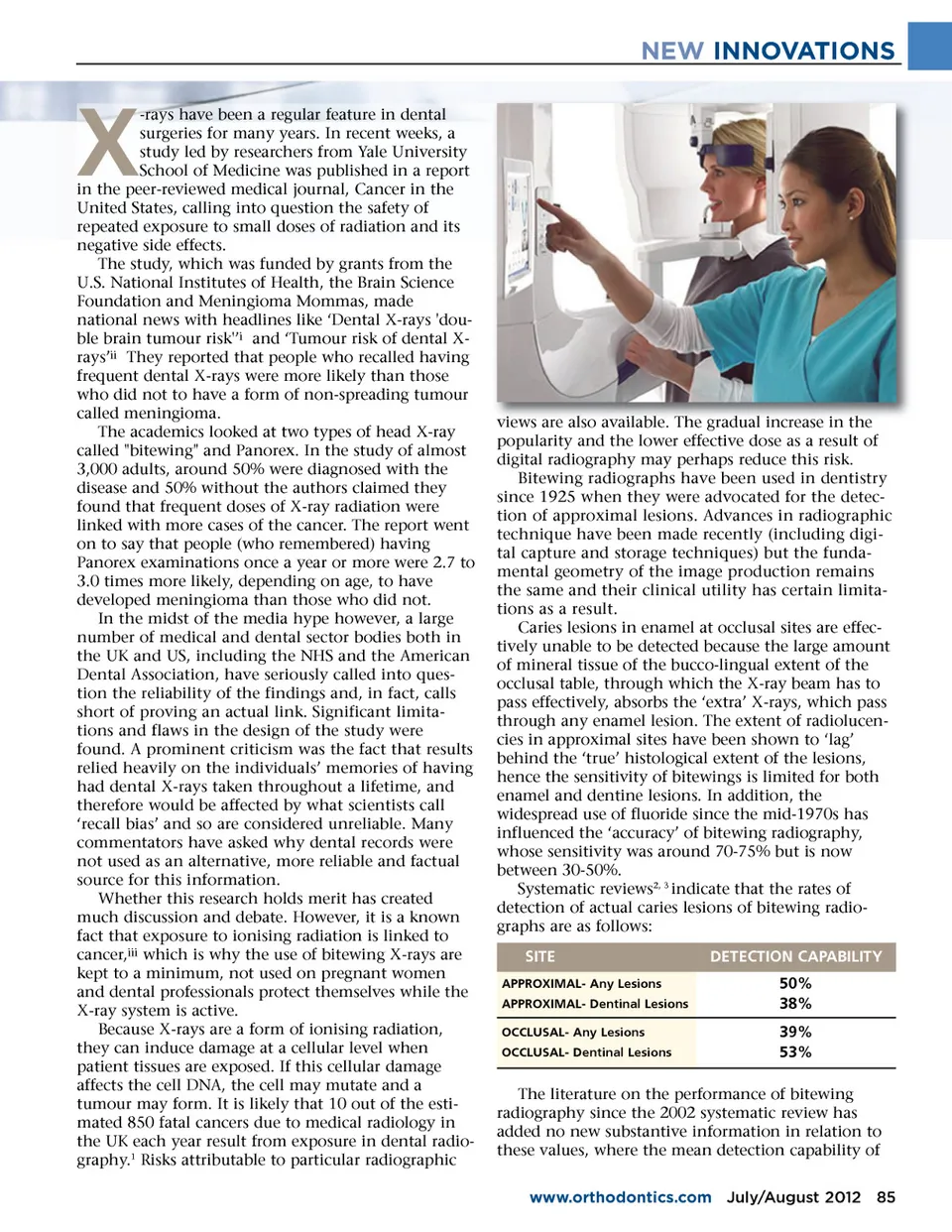
NEW INNOVATIONS X -rays have been a regular feature in dental surgeries for many years. In recent weeks, a study led by researchers from Yale University School of Medicine was published in a report in the peer-reviewed medical journal, Cancer in the United States, calling into question the safety of repeated exposure to small doses of radiation and its negative side effects. The study, which was funded by grants from the U.S. National Institutes of Health, the Brain Science Foundation and Meningioma Mommas, made national news with headlines like ‘Dental X-rays 'dou-ble brain tumour risk'’ i and ‘Tumour risk of dental X-rays’ ii They reported that people who recalled having frequent dental X-rays were more likely than those who did not to have a form of non-spreading tumour called meningioma. The academics looked at two types of head X-ray called "bitewing" and Panorex. In the study of almost 3,000 adults, around 50% were diagnosed with the disease and 50% without the authors claimed they found that frequent doses of X-ray radiation were linked with more cases of the cancer. The report went on to say that people (who remembered) having Panorex examinations once a year or more were 2.7 to 3.0 times more likely, depending on age, to have developed meningioma than those who did not. In the midst of the media hype however, a large number of medical and dental sector bodies both in the UK and US, including the NHS and the American Dental Association, have seriously called into ques-tion the reliability of the findings and, in fact, calls short of proving an actual link. Significant limita-tions and flaws in the design of the study were found. A prominent criticism was the fact that results relied heavily on the individuals’ memories of having had dental X-rays taken throughout a lifetime, and therefore would be affected by what scientists call ‘recall bias’ and so are considered unreliable. Many commentators have asked why dental records were not used as an alternative, more reliable and factual source for this information. Whether this research holds merit has created much discussion and debate. However, it is a known fact that exposure to ionising radiation is linked to cancer, iii which is why the use of bitewing X-rays are kept to a minimum, not used on pregnant women and dental professionals protect themselves while the X-ray system is active. Because X-rays are a form of ionising radiation, they can induce damage at a cellular level when patient tissues are exposed. If this cellular damage affects the cell DNA, the cell may mutate and a tumour may form. It is likely that 10 out of the esti-mated 850 fatal cancers due to medical radiology in the UK each year result from exposure in dental radio-graphy. 1 Risks attributable to particular radiographic views are also available available. The gradual increase in the popularity and the lower effective dose as a result of digital radiography may perhaps reduce this risk. Bitewing radiographs have been used in dentistry since 1925 when they were advocated for the detec-tion of approximal lesions. Advances in radiographic technique have been made recently (including digi-tal capture and storage techniques) but the funda-mental geometry of the image production remains the same and their clinical utility has certain limita-tions as a result. Caries lesions in enamel at occlusal sites are effec-tively unable to be detected because the large amount of mineral tissue of the bucco-lingual extent of the occlusal table, through which the X-ray beam has to pass effectively, absorbs the ‘extra’ X-rays, which pass through any enamel lesion. The extent of radiolucen-cies in approximal sites have been shown to ‘lag’ behind the ‘true’ histological extent of the lesions, hence the sensitivity of bitewings is limited for both enamel and dentine lesions. In addition, the widespread use of fluoride since the mid-1970s has influenced the ‘accuracy’ of bitewing radiography, whose sensitivity was around 70-75% but is now between 30-50%. Systematic reviews 2, 3 indicate that the rates of detection of actual caries lesions of bitewing radio-graphs are as follows: SITE APPROXIMAL-Any Lesions APPROXIMAL-Dentinal Lesions OCCLUSAL-Any Lesions OCCLUSAL-Dentinal Lesions DETECTION CAPABILITY 50% 38% 39% 53% The literature on the performance of bitewing radiography since the 2002 systematic review has added no new substantive information in relation to these values, where the mean detection capability of www.orthodontics.com July/August 2012 85
Journal of the American Orthodontic Society July-August 2012 Buyer's Guide: Page 85