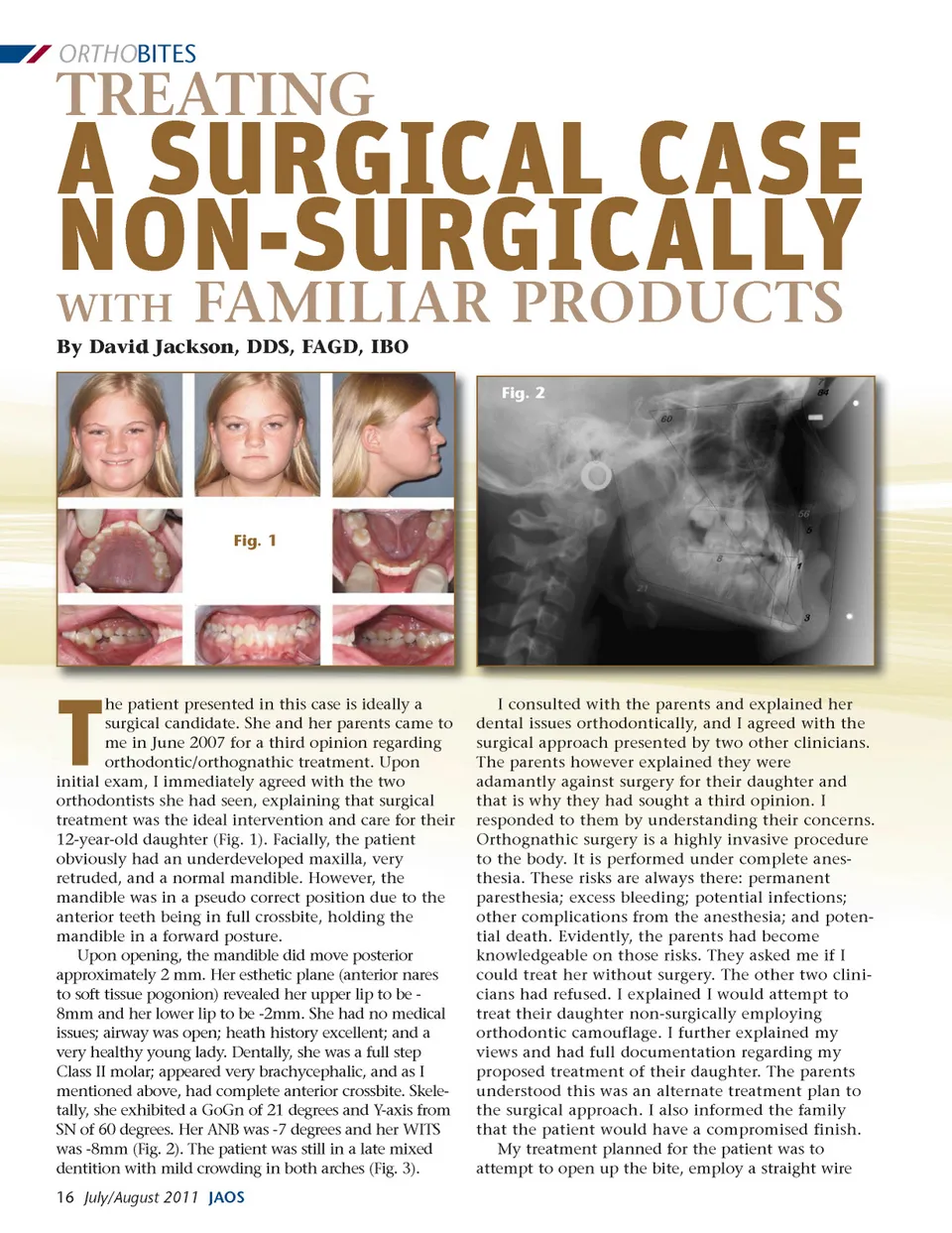
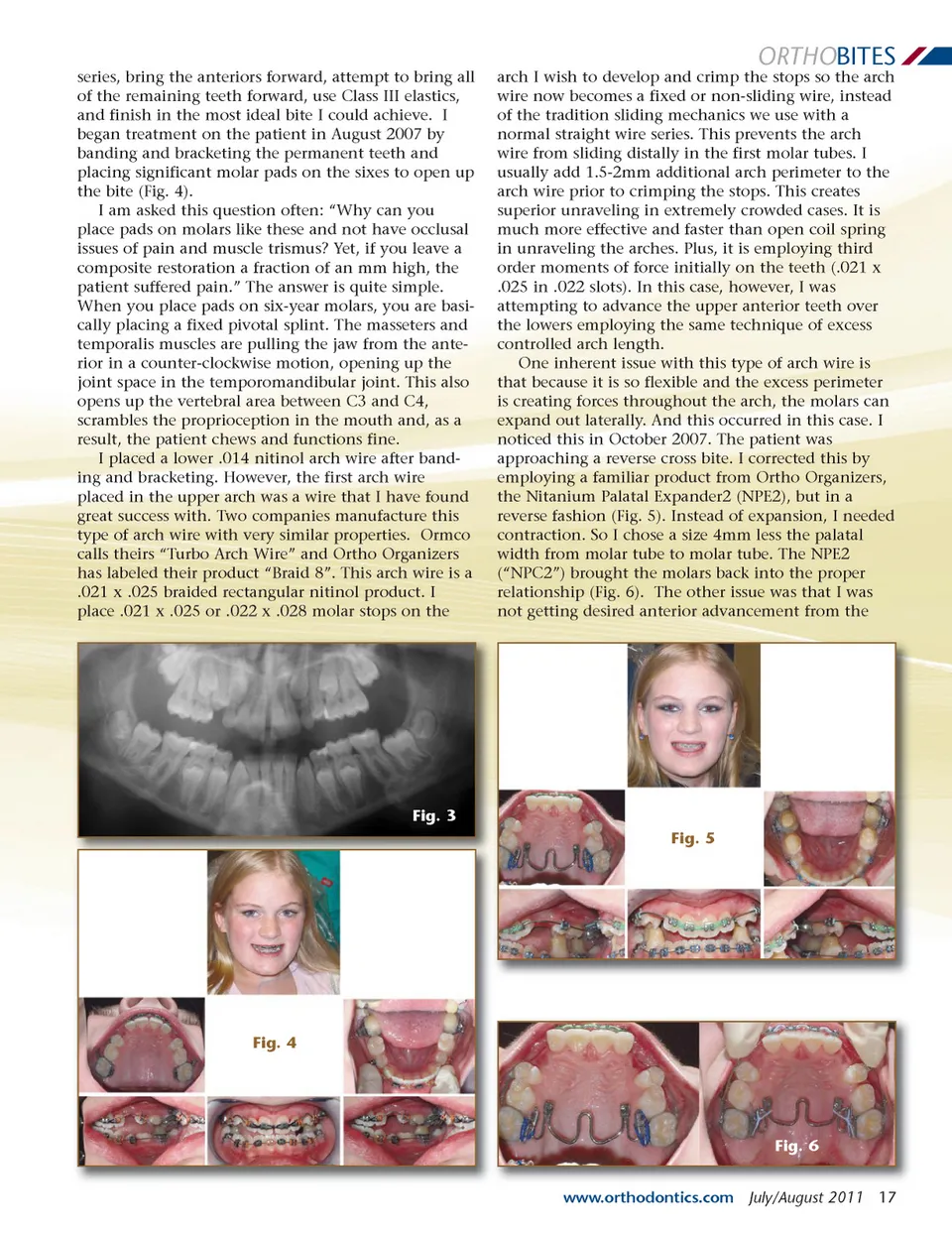
series, bring the anteriors forward, attempt to bring all of the remaining teeth forward, use Class III elastics, and finish in the most ideal bite I could achieve. I began treatment on the patient in August 2007 by banding and bracketing the permanent teeth and placing significant molar pads on the sixes to open up the bite (Fig. 4). I am asked this question often: “Why can you place pads on molars like these and not have occlusal issues of pain and muscle trismus? Yet, if you leave a composite restoration a fraction of an mm high, the patient suffered pain.” The answer is quite simple. When you place pads on six-year molars, you are basi-cally placing a fixed pivotal splint. The masseters and temporalis muscles are pulling the jaw from the ante-rior in a counter-clockwise motion, opening up the joint space in the temporomandibular joint. This also opens up the vertebral area between C3 and C4, scrambles the proprioception in the mouth and, as a result, the patient chews and functions fine. I placed a lower .014 nitinol arch wire after band-ing and bracketing. However, the first arch wire placed in the upper arch was a wire that I have found great success with. Two companies manufacture this type of arch wire with very similar properties. Ormco calls theirs “Turbo Arch Wire” and Ortho Organizers has labeled their product “Braid 8”. This arch wire is a .021 x .025 braided rectangular nitinol product. I place .021 x .025 or .022 x .028 molar stops on the arch I wish to develop and crimp the stops so the arch wire now becomes a fixed or non-sliding wire, instead of the tradition sliding mechanics we use with a normal straight wire series. This prevents the arch wire from sliding distally in the first molar tubes. I usually add 1.5-2mm additional arch perimeter to the arch wire prior to crimping the stops. This creates superior unraveling in extremely crowded cases. It is much more effective and faster than open coil spring in unraveling the arches. Plus, it is employing third order moments of force initially on the teeth (.021 x .025 in .022 slots). In this case, however, I was attempting to advance the upper anterior teeth over the lowers employing the same technique of excess controlled arch length. One inherent issue with this type of arch wire is that because it is so flexible and the excess perimeter is creating forces throughout the arch, the molars can expand out laterally. And this occurred in this case. I noticed this in October 2007. The patient was approaching a reverse cross bite. I corrected this by employing a familiar product from Ortho Organizers, the Nitanium Palatal Expander2 (NPE2), but in a reverse fashion (Fig. 5). Instead of expansion, I needed contraction. So I chose a size 4mm less the palatal width from molar tube to molar tube. The NPE2 (“NPC2”) brought the molars back into the proper relationship (Fig. 6). The other issue was that I was not getting desired anterior advancement from the ORTHO BITES Fig. 3 Fig. 5 Fig. 4 Fig. 6 www.orthodontics.com July/August 2011 17
Journal of the American Orthodontic Society July-August 2011-Buyer's Guide: Page 17