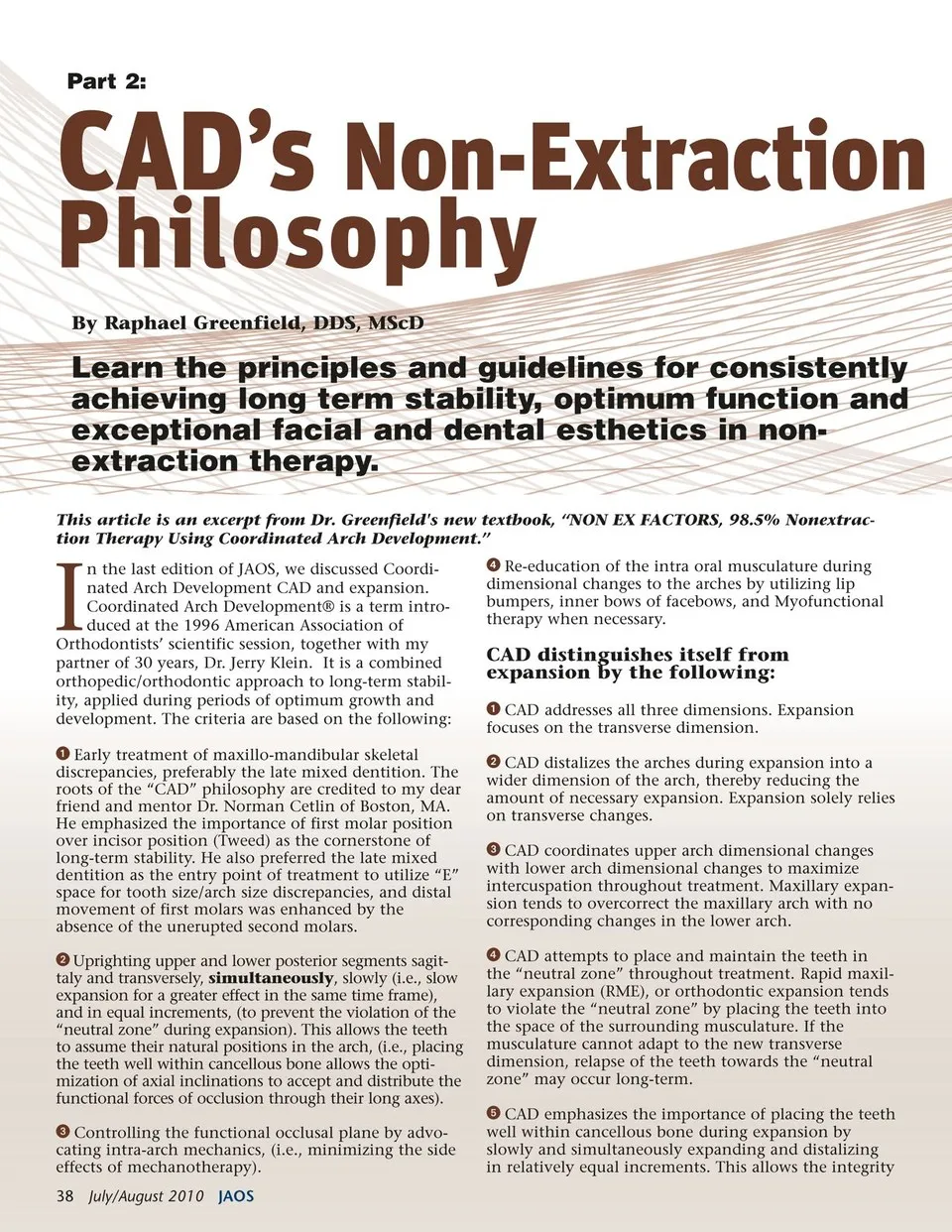
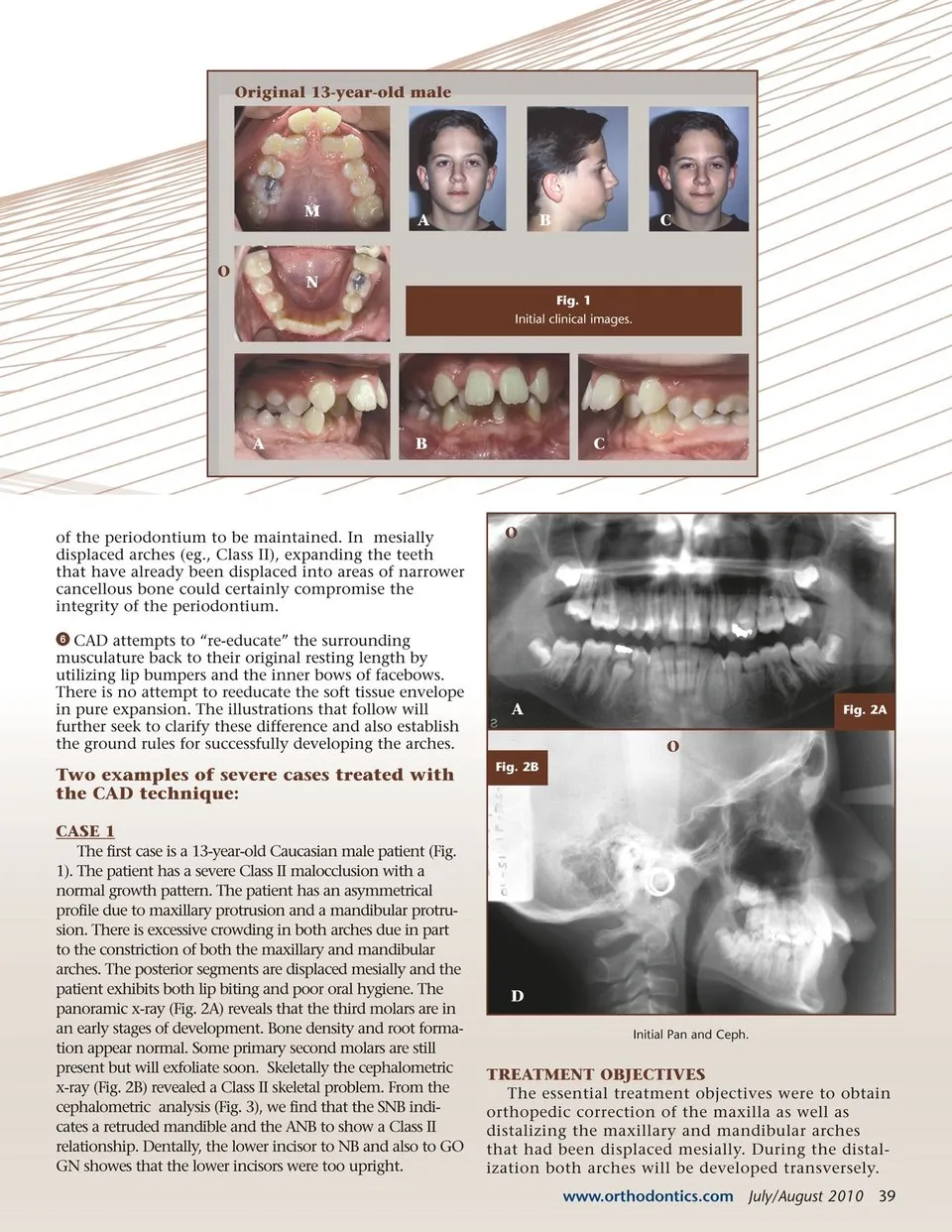
Original 13-year-old male M O N Fig. 1 Initial clinical images. AB C AB C of the periodontium to be maintained. In mesially displaced arches (eg., Class II), expanding the teeth that have already been displaced into areas of narrower cancellous bone could certainly compromise the integrity of the periodontium. CAD attempts to “re-educate” the surrounding musculature back to their original resting length by utilizing lip bumpers and the inner bows of facebows. There is no attempt to reeducate the soft tissue envelope in pure expansion. The illustrations that follow will further seek to clarify these difference and also establish the ground rules for successfully developing the arches. Two examples of severe cases treated with the CAD technique: CASE 1 The first case is a 13-year-old Caucasian male patient (Fig. 1). The patient has a severe Class II malocclusion with a normal growth pattern. The patient has an asymmetrical profile due to maxillary protrusion and a mandibular protru-sion. There is excessive crowding in both arches due in part to the constriction of both the maxillary and mandibular arches. The posterior segments are displaced mesially and the patient exhibits both lip biting and poor oral hygiene. The panoramic x-ray (Fig. 2A) reveals that the third molars are in an early stages of development. Bone density and root forma-tion appear normal. Some primary second molars are still present but will exfoliate soon. Skeletally the cephalometric x-ray (Fig. 2B) revealed a Class II skeletal problem. From the cephalometric analysis (Fig. 3), we find that the SNB indi-cates a retruded mandible and the ANB to show a Class II relationship. Dentally, the lower incisor to NB and also to GO GN showes that the lower incisors were too upright. O A O Fig. 2B Fig. 2A D Initial Pan and Ceph. TREATMENT OBJECTIVES The essential treatment objectives were to obtain orthopedic correction of the maxilla as well as distalizing the maxillary and mandibular arches that had been displaced mesially. During the distal-ization both arches will be developed transversely. www.orthodontics.com July/August 2010 39
Journal of the American Orthodontic Society July-August 2010/Buyer's Guide: Page 39