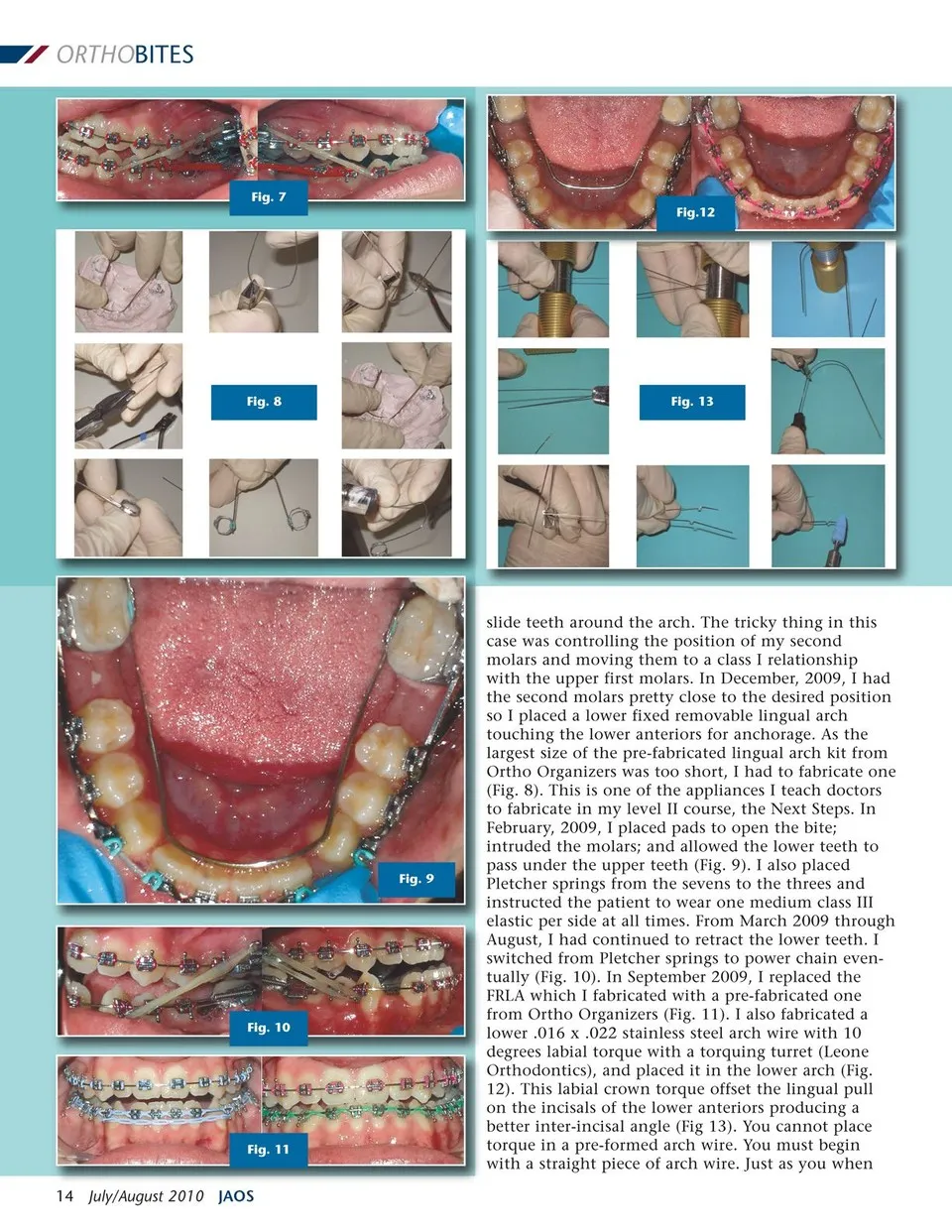
ORTHOBITES Fig. 7 Fig.12 Fig. 8 Fig. 13 Fig. 9 Fig. 10 Fig. 11 14 July/August 2010 JAOS slide teeth around the arch. The tricky thing in this case was controlling the position of my second molars and moving them to a class I relationship with the upper first molars. In December, 2009, I had the second molars pretty close to the desired position so I placed a lower fixed removable lingual arch touching the lower anteriors for anchorage. As the largest size of the pre-fabricated lingual arch kit from Ortho Organizers was too short, I had to fabricate one (Fig. 8). This is one of the appliances I teach doctors to fabricate in my level II course, the Next Steps. In February, 2009, I placed pads to open the bite; intruded the molars; and allowed the lower teeth to pass under the upper teeth (Fig. 9). I also placed Pletcher springs from the sevens to the threes and instructed the patient to wear one medium class III elastic per side at all times. From March 2009 through August, I had continued to retract the lower teeth. I switched from Pletcher springs to power chain even-tually (Fig. 10). In September 20 09, I replaced the FRLA which I fabricated with a pre-fabricated one from Ortho Organizers (Fig. 11). I also fabricated a lower .016 x .022 stainless steel arch wire with 10 degrees labial torque with a torquing turret (Leone Orthodontics), and placed it in the lower arch (Fig. 12). This labial crown torque offset the lingual pull on the incisals of the lower anteriors producing a better inter-incisal angle (Fig 13). You cannot place torque in a pre-formed arch wire. You must begin with a straight piece of arch wire. Just as you when
Journal of the American Orthodontic Society July-August 2010/Buyer's Guide: Page 14