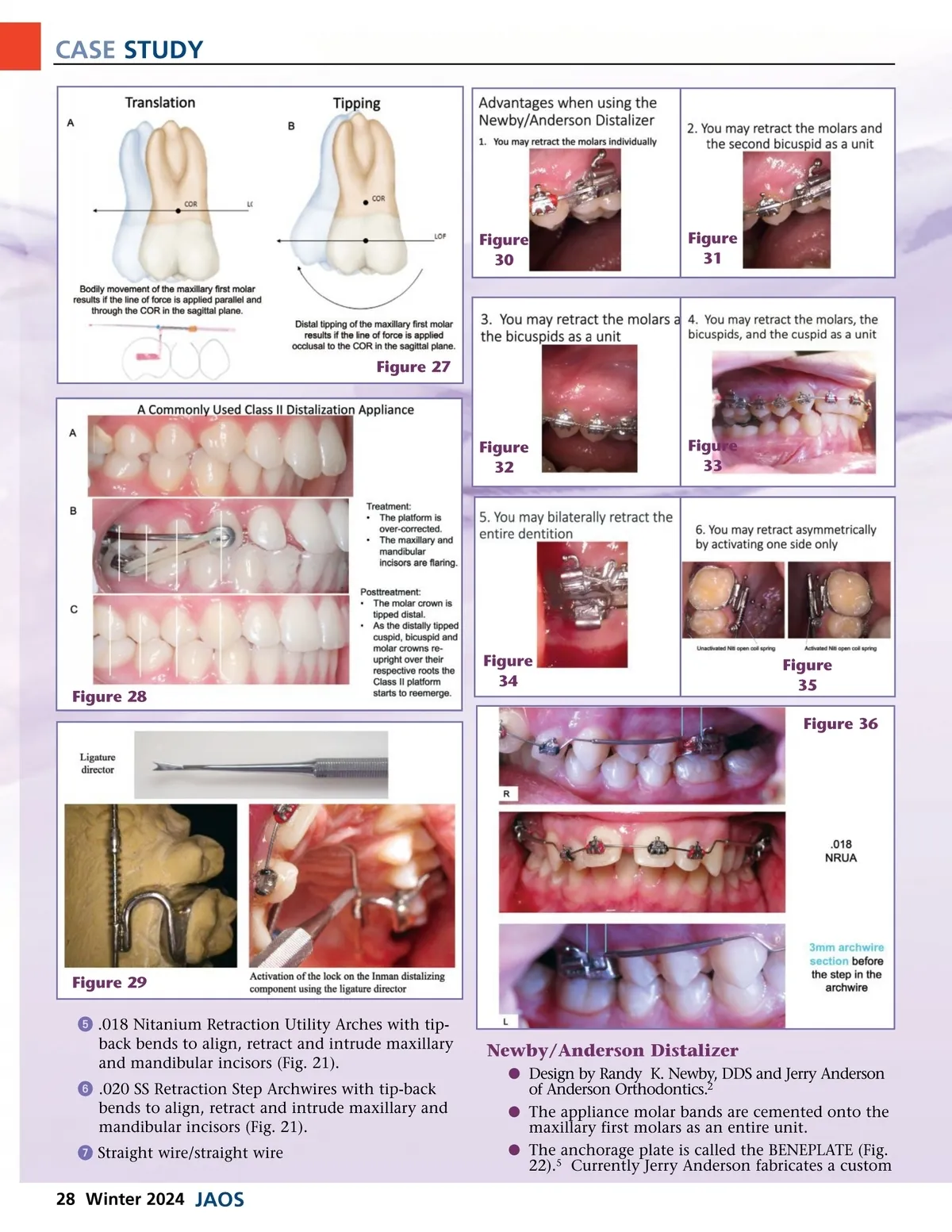
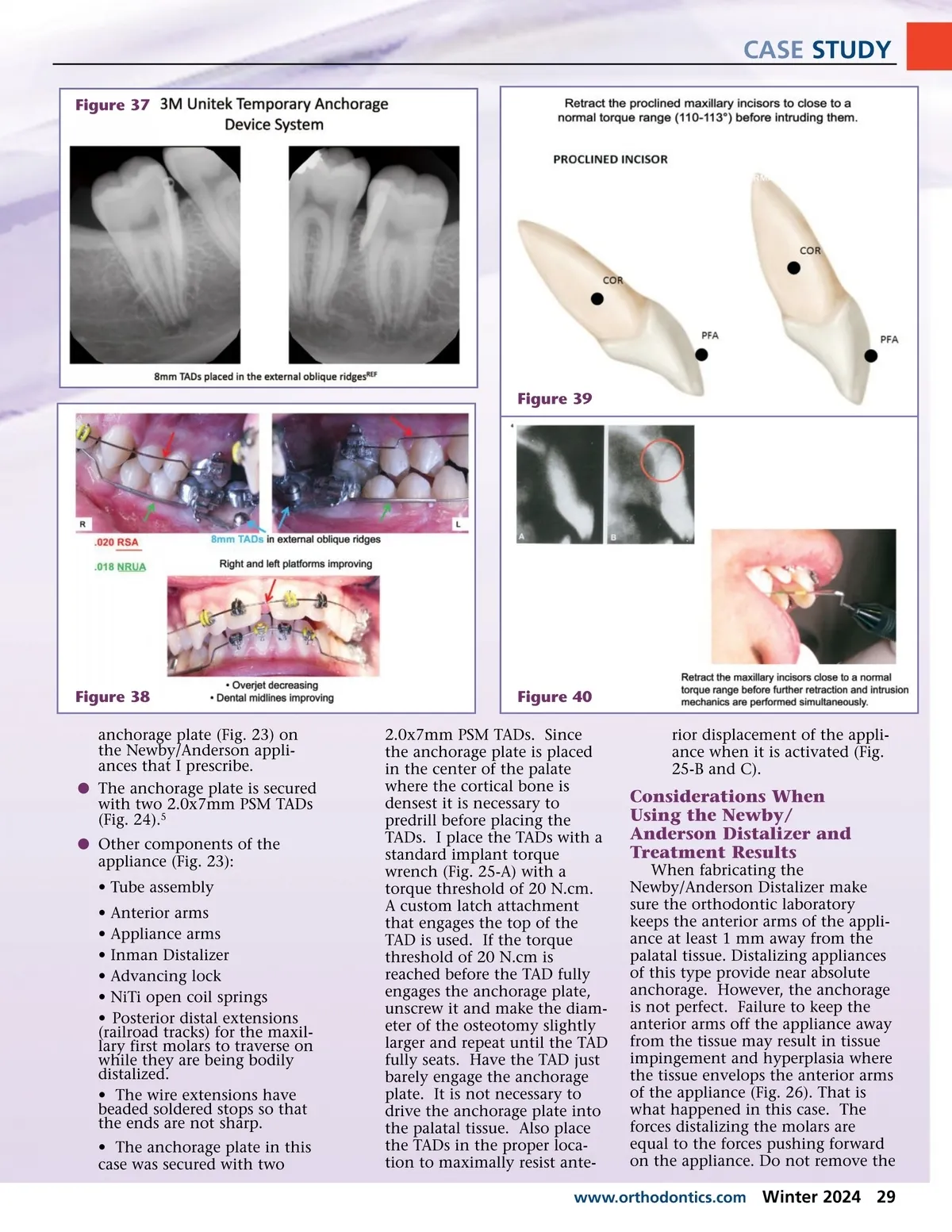
CASE STUDY Figure 37 Figure 39 Figure 38 anchorage plate (Fig. 23) on the Newby/Anderson appli-ances that I prescribe. b The anchorage plate is secured with two 2.0x7mm PSM TADs (Fig. 24). 5 b Other components of the appliance (Fig. 23): • Tube assembly • Anterior arms • Appliance arms • Inman Distalizer • Advancing lock • NiTi open coil springs • Posterior distal extensions (railroad tracks) for the maxil-lary first molars to traverse on while they are being bodily distalized. • The wire extensions have beaded soldered stops so that the ends are not sharp. • The anchorage plate in this case was secured with two Figure 40 2.0x7mm PSM TADs. Since the anchorage plate is placed in the center of the palate where the cortical bone is densest it is necessary to predrill before placing the TADs. I place the TADs with a standard implant torque wrench (Fig. 25-A) with a torque threshold of 20 N.cm. A custom latch attachment that engages the top of the TAD is used. If the torque threshold of 20 N.cm is reached before the TAD fully engages the anchorage plate, unscrew it and make the diam-eter of the osteotomy slightly larger and repeat until the TAD fully seats. Have the TAD just barely engage the anchorage plate. It is not necessary to drive the anchorage plate into the palatal tissue. Also place the TADs in the proper loca-tion to maximally resist ante-rior displacement of the appli-ance when it is activated (Fig. 25-B and C). Considerations When Using the Newby/ Anderson Distalizer and Treatment Results When fabricating the Newby/Anderson Distalizer make sure the orthodontic laboratory keeps the anterior arms of the appli-ance at least 1 mm away from the palatal tissue. Distalizing appliances of this type provide near absolute anchorage. However, the anchorage is not perfect. Failure to keep the anterior arms off the appliance away from the tissue may result in tissue impingement and hyperplasia where the tissue envelops the anterior arms of the appliance (Fig. 26). That is what happened in this case. The forces distalizing the molars are equal to the forces pushing forward on the appliance. Do not remove the www.orthodontics.com Winter 2024 29
Journal of the American Orthodontic Society JAOS Winter 2024: Page 29