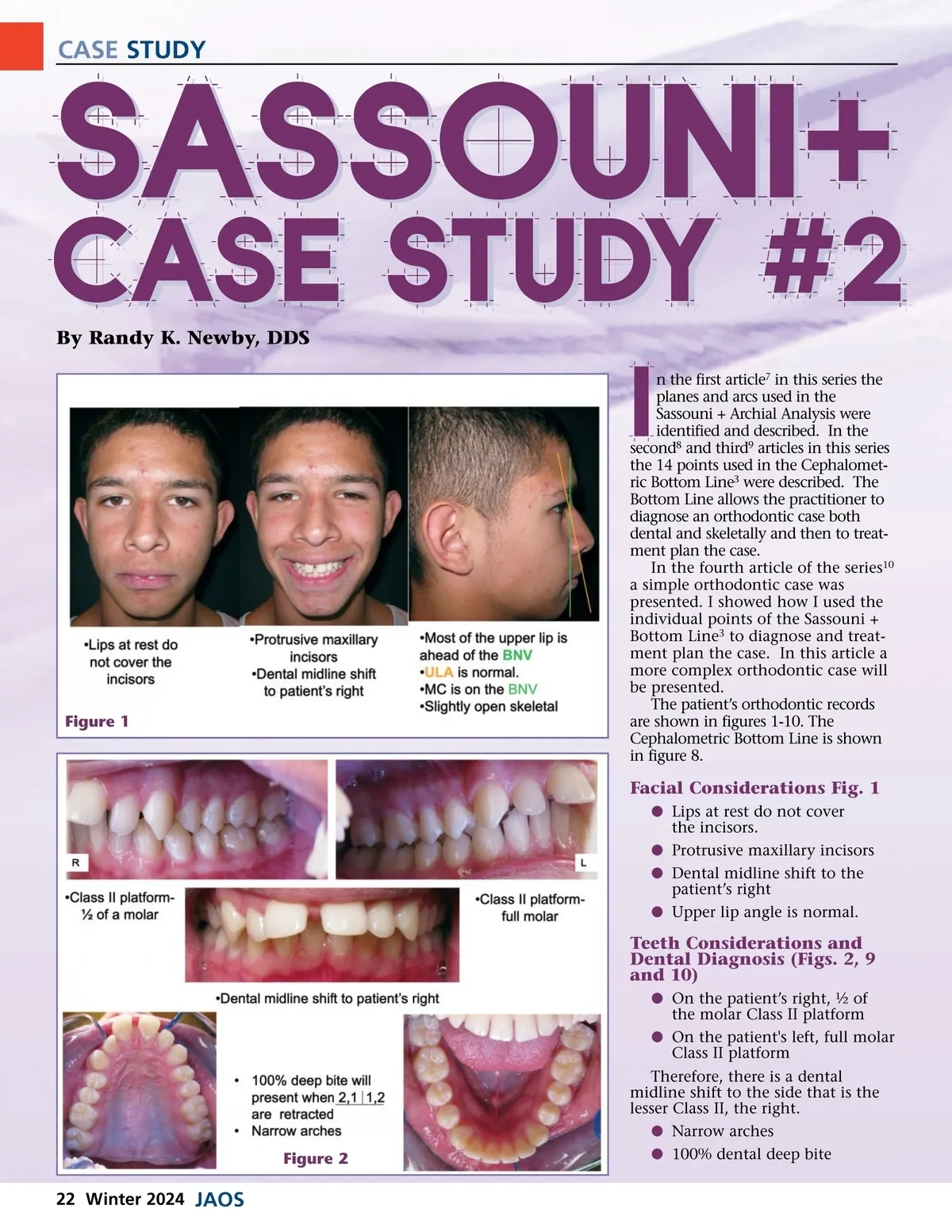
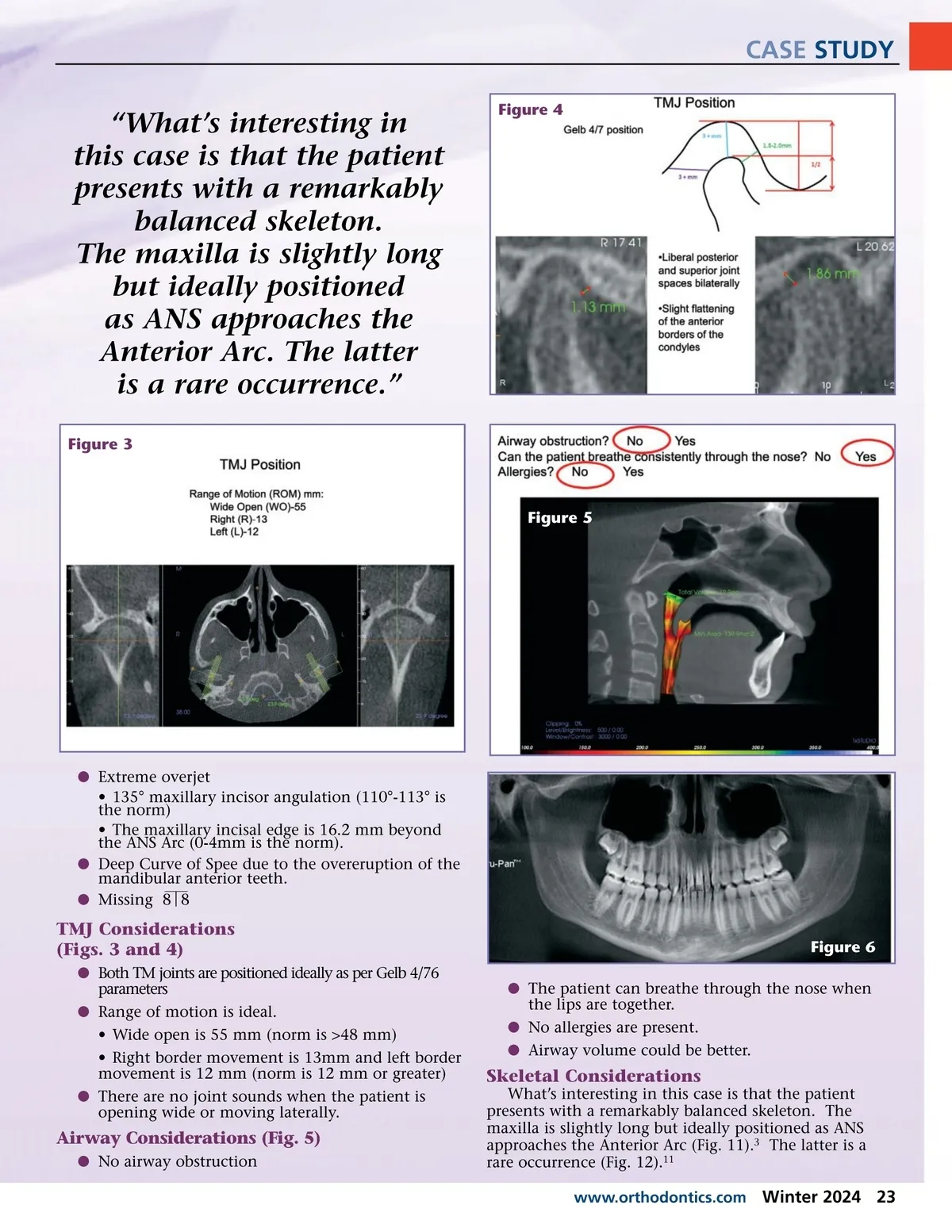
CASE STUDY “What’s interesting in this case is that the patient presents with a remarkably balanced skeleton. The maxilla is slightly long but ideally positioned as ANS approaches the Anterior Arc. The latter is a rare occurrence.” Figure 3 Figure 4 Figure 5 b Extreme overjet • 135° maxillary incisor angulation (110°-113° is the norm) • The maxillary incisal edge is 16.2 mm beyond the ANS Arc (0-4mm is the norm). b Deep Curve of Spee due to the overeruption of the mandibular anterior teeth. b Missing 8 8 TMJ Considerations (Figs. 3 and 4) b Both TM joints are positioned ideally as per Gelb 4/76 parameters b Range of motion is ideal. • Wide open is 55 mm (norm is >48 mm) • Right border movement is 13mm and left border movement is 12 mm (norm is 12 mm or greater) b There are no joint sounds when the patient is opening wide or moving laterally. Figure 6 b The patient can breathe through the nose when the lips are together. b No allergies are present. b Airway volume could be better. Skeletal Considerations What’s interesting in this case is that the patient presents with a remarkably balanced skeleton. The maxilla is slightly long but ideally positioned as ANS approaches the Anterior Arc (Fig. 11). 3 The latter is a rare occurrence (Fig. 12). 11 www.orthodontics.com Airway Considerations (Fig. 5) b No airway obstruction Winter 2024 23
Journal of the American Orthodontic Society JAOS Winter 2024: Page 23