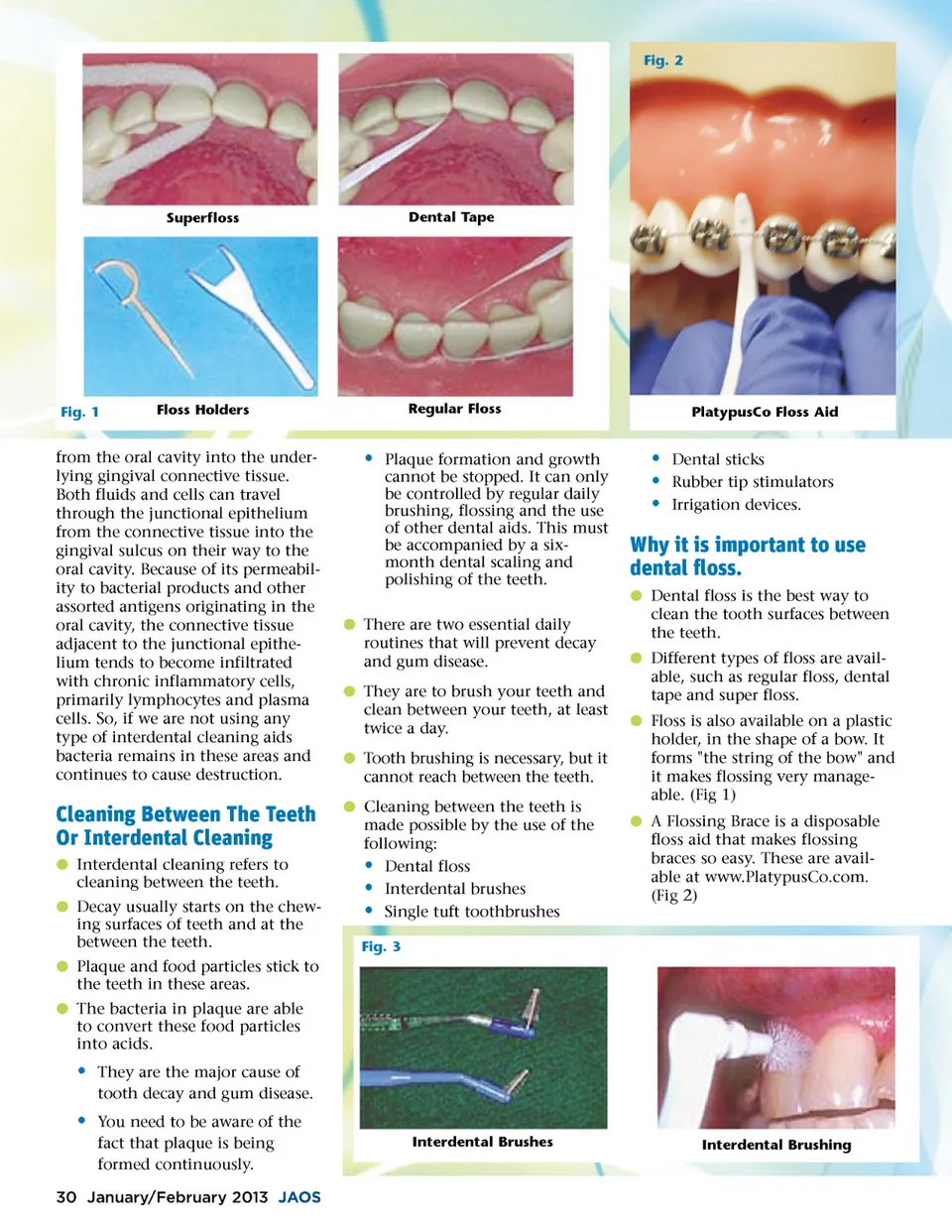
Fig. 2 Superfloss Dental Tape Fig. 1 Floss Holders Regular Floss PlatypusCo Floss Aid from the oral cavity into the under-lying gingival connective tissue. Both fluids and cells can travel through the junctional epithelium from the connective tissue into the gingival sulcus on their way to the oral cavity. Because of its permeabil-ity to bacterial products and other assorted antigens originating in the oral cavity, the connective tissue adjacent to the junctional epithe-lium tends to become infiltrated with chronic inflammatory cells, primarily lymphocytes and plasma cells. So, if we are not using any type of interdental cleaning aids bacteria remains in these areas and continues to cause destruction. • Plaque formation and growth cannot be stopped. It can only be controlled by regular daily brushing, flossing and the use of other dental aids. This must be accompanied by a six-month dental scaling and polishing of the teeth. b There are two essential daily routines that will prevent decay and gum disease. b They are to brush your teeth and clean between your teeth, at least twice a day. b Tooth brushing is necessary, but it cannot reach between the teeth. b Cleaning between the teeth is made possible by the use of the following: • Dental floss • Interdental brushes • Single tuft toothbrushes Fig. 3 • Dental sticks • Rubber tip stimulators • Irrigation devices. Why it is important to use dental floss. b Dental floss is the best way to clean the tooth surfaces between the teeth. b Different types of floss are avail-able, such as regular floss, dental tape and super floss. b Floss is also available on a plastic holder, in the shape of a bow. It forms "the string of the bow" and it makes flossing very manage-able. (Fig 1) b A Flossing Brace is a disposable floss aid that makes flossing braces so easy. These are avail-able at www.PlatypusCo.com. (Fig 2) Cleaning Between The Teeth Or Interdental Cleaning b Interdental cleaning refers to cleaning between the teeth. b Decay usually starts on the chew-ing surfaces of teeth and at the between the teeth. b Plaque and food particles stick to the teeth in these areas. b The bacteria in plaque are able to convert these food particles into acids. • They are the major cause of tooth decay and gum disease. • You need to be aware of the fact that plaque is being formed continuously. 30 January/February 2013 JAOS Interdental Brushes Interdental Brushing
Journal of the American Orthodontic Society January-February 2013: Page 30