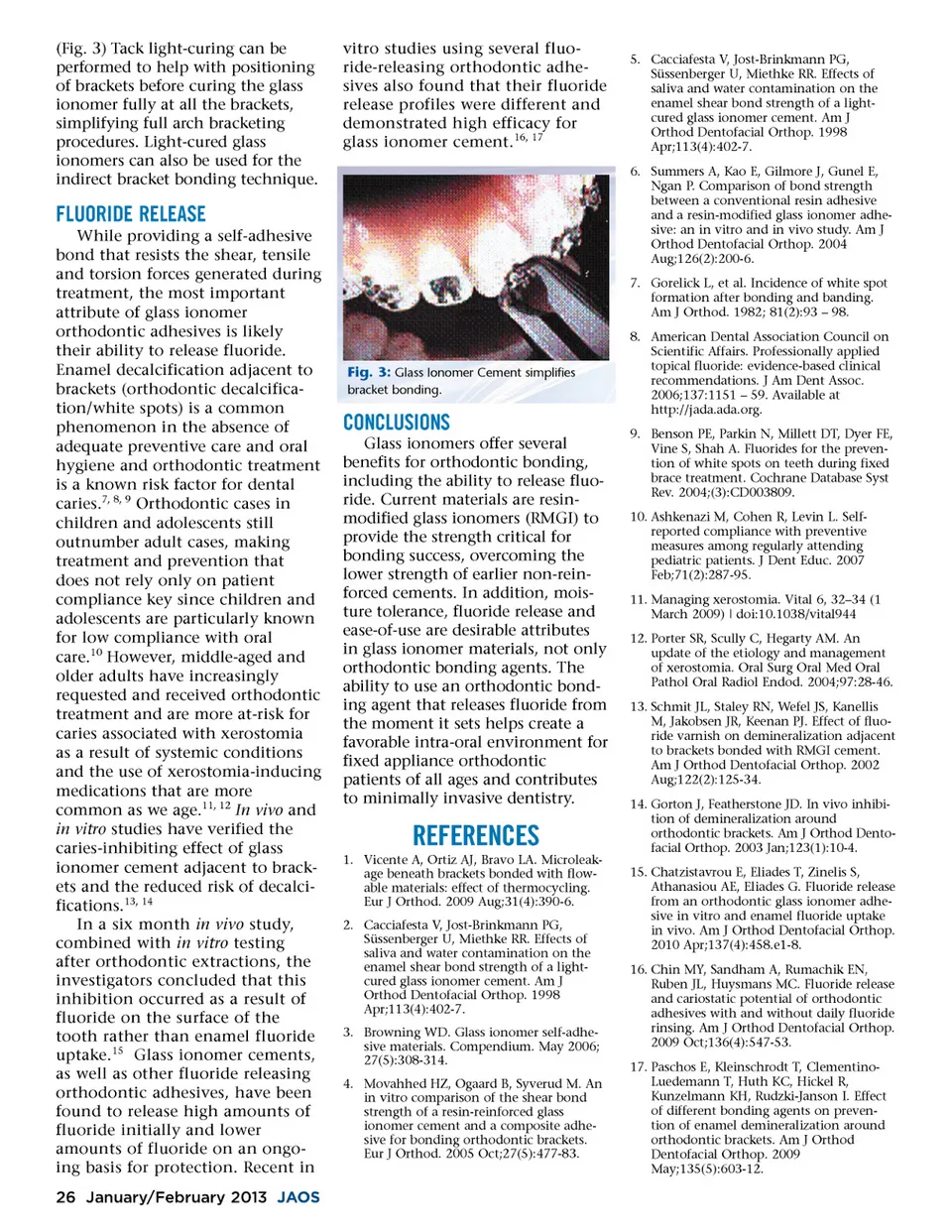
(Fig. 3) Tack light-curing can be performed to help with positioning of brackets before curing the glass ionomer fully at all the brackets, simplifying full arch bracketing procedures. Light-cured glass ionomers can also be used for the indirect bracket bonding technique. vitro studies using several fluo-ride-releasing orthodontic adhe-sives also found that their fluoride release profiles were different and demonstrated high efficacy for glass ionomer cement. 16, 17 5. Cacciafesta V, Jost-Brinkmann PG, Süssenberger U, Miethke RR. Effects of saliva and water contamination on the enamel shear bond strength of a light-cured glass ionomer cement. Am J Orthod Dentofacial Orthop. 1998 Apr;113(4):402-7. 6. Summers A, Kao E, Gilmore J, Gunel E, Ngan P. Comparison of bond strength between a conventional resin adhesive and a resin-modified glass ionomer adhe-sive: an in vitro and in vivo study. Am J Orthod Dentofacial Orthop. 2004 Aug;126(2):200-6. 7. Gorelick L, et al. Incidence of white spot formation after bonding and banding. Am J Orthod. 1982; 81(2):93 – 98. 8. American Dental Association Council on Scientific Affairs. Professionally applied topical fluoride: evidence-based clinical recommendations. J Am Dent Assoc. 2006;137:1151 – 59. Available at http://jada.ada.org. 9. Benson PE, Parkin N, Millett DT, Dyer FE, Vine S, Shah A. Fluorides for the preven-tion of white spots on teeth during fixed brace treatment. Cochrane Database Syst Rev. 2004;(3):CD003809. 10. Ashkenazi M, Cohen R, Levin L. Self-reported compliance with preventive measures among regularly attending pediatric patients. J Dent Educ. 2007 Feb;71(2):287-95. 11. Managing xerostomia. Vital 6, 32–34 (1 March 2009) | doi:10.1038/vital944 12. Porter SR, Scully C, Hegarty AM. An update of the etiology and management of xerostomia. Oral Surg Oral Med Oral Pathol Oral Radiol Endod. 2004;97:28-46. 13. Schmit JL, Staley RN, Wefel JS, Kanellis M, Jakobsen JR, Keenan PJ. Effect of fluo-ride varnish on demineralization adjacent to brackets bonded with RMGI cement. Am J Orthod Dentofacial Orthop. 2002 Aug;122(2):125-34. 14. Gorton J, Featherstone JD. In vivo inhibi-tion of demineralization around orthodontic brackets. Am J Orthod Dento-facial Orthop. 2003 Jan;123(1):10-4. 15. Chatzistavrou E, Eliades T, Zinelis S, Athanasiou AE, Eliades G. Fluoride release from an orthodontic glass ionomer adhe-sive in vitro and enamel fluoride uptake in vivo. Am J Orthod Dentofacial Orthop. 2010 Apr;137(4):458.e1-8. 16. Chin MY, Sandham A, Rumachik EN, Ruben JL, Huysmans MC. Fluoride release and cariostatic potential of orthodontic adhesives with and without daily fluoride rinsing. Am J Orthod Dentofacial Orthop. 2009 Oct;136(4):547-53. 17. Paschos E, Kleinschrodt T, Clementino-Luedemann T, Huth KC, Hickel R, Kunzelmann KH, Rudzki-Janson I. Effect of different bonding agents on preven-tion of enamel demineralization around orthodontic brackets. Am J Orthod Dentofacial Orthop. 2009 May;135(5):603-12. FLUORIDE RELEASE While providing a self-adhesive bond that resists the shear, tensile and torsion forces generated during treatment, the most important attribute of glass ionomer orthodontic adhesives is likely their ability to release fluoride. Enamel decalcification adjacent to brackets (orthodontic decalcifica-tion/white spots) is a common phenomenon in the absence of adequate preventive care and oral hygiene and orthodontic treatment is a known risk factor for dental caries. 7, 8, 9 Orthodontic cases in children and adolescents still outnumber adult cases, making treatment and prevention that does not rely only on patient compliance key since children and adolescents are particularly known for low compliance with oral care. 10 However, middle-aged and older adults have increasingly requested and received orthodontic treatment and are more at-risk for caries associated with xerostomia as a result of systemic conditions and the use of xerostomia-inducing medications that are more common as we age. 11, 12 In vivo and in vitro studies have verified the caries-inhibiting effect of glass ionomer cement adjacent to brack-ets and the reduced risk of decalci-fications. 13, 14 In a six month in vivo study, combined with in vitro testing after orthodontic extractions, the investigators concluded that this inhibition occurred as a result of fluoride on the surface of the tooth rather than enamel fluoride uptake. 15 Glass ionomer cements, as well as other fluoride releasing orthodontic adhesives, have been found to release high amounts of fluoride initially and lower amounts of fluoride on an ongo-ing basis for protection. Recent in 26 January/February 2013 JAOS Fig. 3: Glass Ionomer Cement simplifies bracket bonding. CONCLUSIONS Glass ionomers offer several benefits for orthodontic bonding, including the ability to release fluo-ride. Current materials are resin-modified glass ionomers (RMGI) to provide the strength critical for bonding success, overcoming the lower strength of earlier non-rein-forced cements. In addition, mois-ture tolerance, fluoride release and ease-of-use are desirable attributes in glass ionomer materials, not only orthodontic bonding agents. The ability to use an orthodontic bond-ing agent that releases fluoride from the moment it sets helps create a favorable intra-oral environment for fixed appliance orthodontic patients of all ages and contributes to minimally invasive dentistry. REFERENCES 1. Vicente A, Ortiz AJ, Bravo LA. Microleak-age beneath brackets bonded with flow-able materials: effect of thermocycling. Eur J Orthod. 2009 Aug;31(4):390-6. 2. Cacciafesta V, Jost-Brinkmann PG, Süssenberger U, Miethke RR. Effects of saliva and water contamination on the enamel shear bond strength of a light-cured glass ionomer cement. Am J Orthod Dentofacial Orthop. 1998 Apr;113(4):402-7. 3. Browning WD. Glass ionomer self-adhe-sive materials. Compendium. May 2006; 27(5):308-314. 4. Movahhed HZ, Ogaard B, Syverud M. An in vitro comparison of the shear bond strength of a resin-reinforced glass ionomer cement and a composite adhe-sive for bonding orthodontic brackets. Eur J Orthod. 2005 Oct;27(5):477-83.
Journal of the American Orthodontic Society January-February 2013: Page 26