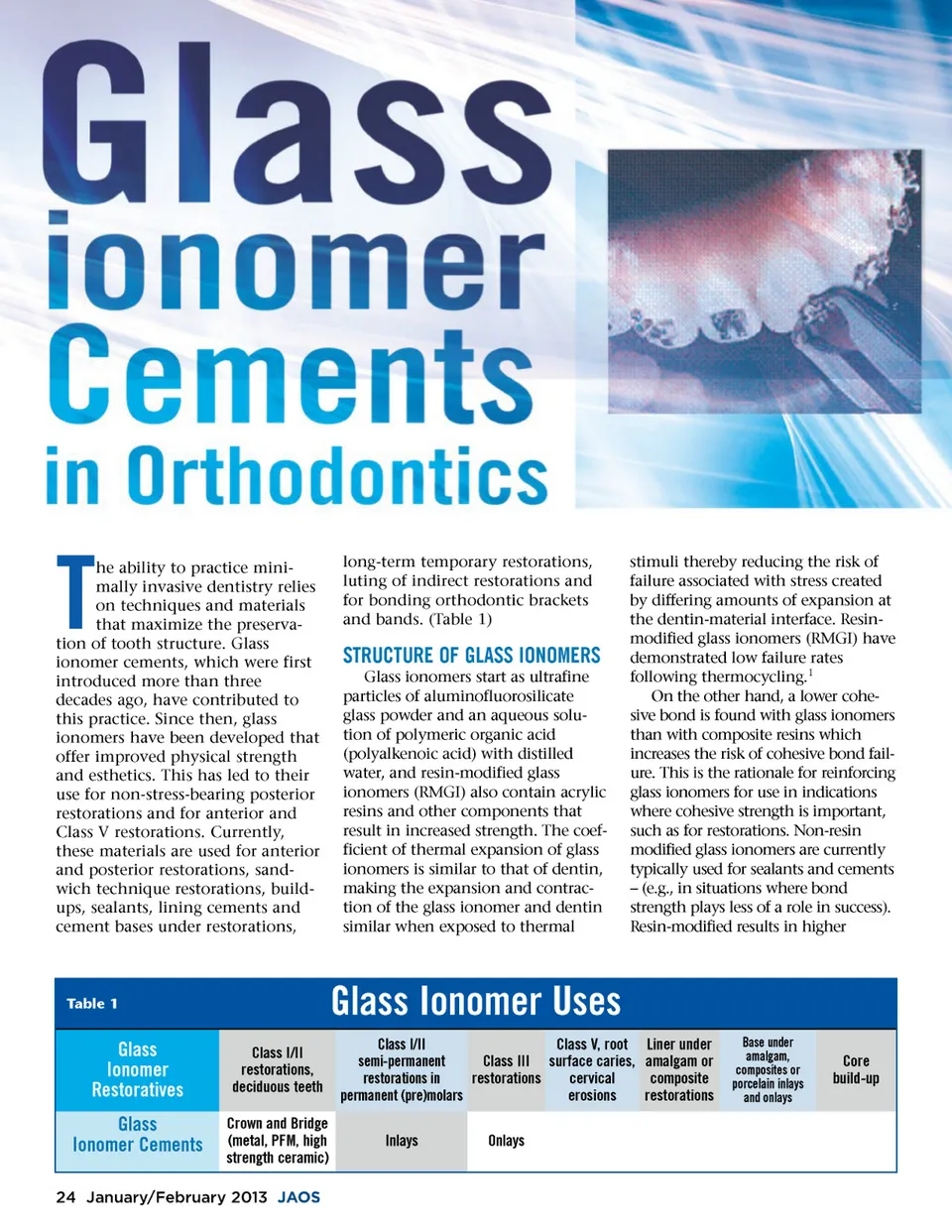
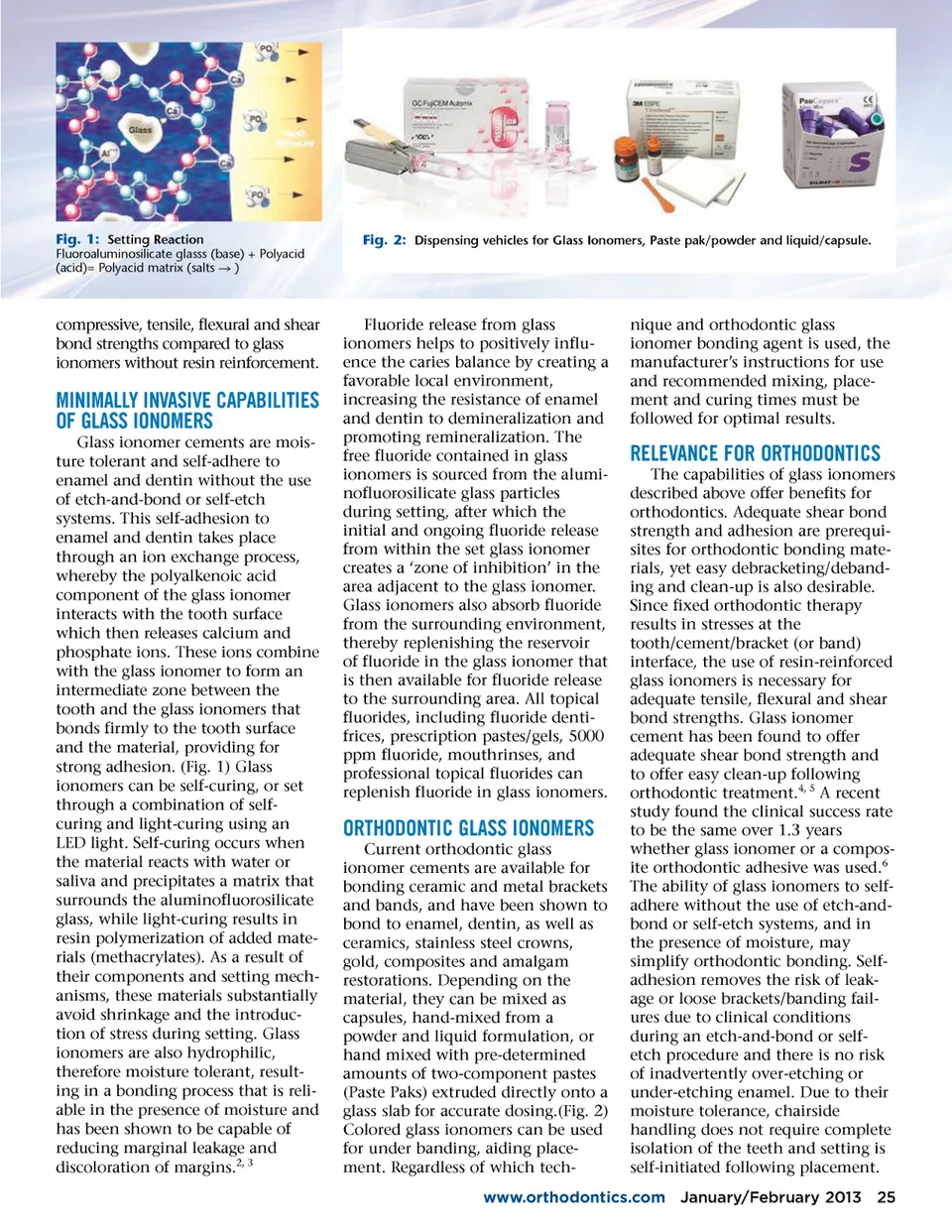
Fig. 1: Setting Reaction Fluoroaluminosilicate glasss (base) + Polyacid (acid)= Polyacid matrix (salts Ǟ ) Fig. 2: Dispensing vehicles for Glass Ionomers, Paste pak/powder and liquid/capsule. compressive, tensile, flexural and shear bond strengths compared to glass ionomers without resin reinforcement. MINIMALLY INVASIVE CAPABILITIES OF GLASS IONOMERS Glass ionomer cements are mois-ture tolerant and self-adhere to enamel and dentin without the use of etch-and-bond or self-etch systems. This self-adhesion to enamel and dentin takes place through an ion exchange process, whereby the polyalkenoic acid component of the glass ionomer interacts with the tooth surface which then releases calcium and phosphate ions. These ions combine with the glass ionomer to form an intermediate zone between the tooth and the glass ionomers that bonds firmly to the tooth surface and the material, providing for strong adhesion. (Fig. 1) Glass ionomers can be self-curing, or set through a combination of self-curing and light-curing using an LED light. Self-curing occurs when the material reacts with water or saliva and precipitates a matrix that surrounds the aluminofluorosilicate glass, while light-curing results in resin polymerization of added mate-rials (methacrylates). As a result of their components and setting mech-anisms, these materials substantially avoid shrinkage and the introduc-tion of stress during setting. Glass ionomers are also hydrophilic, therefore moisture tolerant, result-ing in a bonding process that is reli-able in the presence of moisture and has been shown to be capable of reducing marginal leakage and discoloration of margins. 2, 3 Fluoride release from glass ionomers helps to positively influ-ence the caries balance by creating a favorable local environment, increasing the resistance of enamel and dentin to demineralization and promoting remineralization. The free fluoride contained in glass ionomers is sourced from the alumi-nofluorosilicate glass particles during setting, after which the initial and ongoing fluoride release from within the set glass ionomer creates a ‘zone of inhibition’ in the area adjacent to the glass ionomer. Glass ionomers also absorb fluoride from the surrounding environment, thereby replenishing the reservoir of fluoride in the glass ionomer that is then available for fluoride release to the surrounding area. All topical fluorides, including fluoride denti-frices, prescription pastes/gels, 5000 ppm fluoride, mouthrinses, and professional topical fluorides can replenish fluoride in glass ionomers. nique and orthodontic glass ionomer bonding agent is used, the manufacturer’s instructions for use and recommended mixing, place-ment and curing times must be followed for optimal results. RELEVANCE FOR ORTHODONTICS The capabilities of glass ionomers described above offer benefits for orthodontics. Adequate shear bond strength and adhesion are prerequi-sites for orthodontic bonding mate-rials, yet easy debracketing/deband-ing and clean-up is also desirable. Since fixed orthodontic therapy results in stresses at the tooth/cement/bracket (or band) interface, the use of resin-reinforced glass ionomers is necessary for adequate tensile, flexural and shear bond strengths. Glass ionomer cement has been found to offer adequate shear bond strength and to offer easy clean-up following orthodontic treatment. 4, 5 A recent study found the clinical success rate to be the same over 1.3 years whether glass ionomer or a compos-ite orthodontic adhesive was used. 6 The ability of glass ionomers to self-adhere without the use of etch-and-bond or self-etch systems, and in the presence of moisture, may simplify orthodontic bonding. Self-adhesion removes the risk of leak-age or loose brackets/banding fail-ures due to clinical conditions during an etch-and-bond or self-etch procedure and there is no risk of inadvertently over-etching or under-etching enamel. Due to their moisture tolerance, chairside handling does not require complete isolation of the teeth and setting is self-initiated following placement. ORTHODONTIC GLASS IONOMERS Current orthodontic glass ionomer cements are available for bonding ceramic and metal brackets and bands, and have been shown to bond to enamel, dentin, as well as ceramics, stainless steel crowns, gold, composites and amalgam restorations. Depending on the material, they can be mixed as capsules, hand-mixed from a powder and liquid formulation, or hand mixed with pre-determined amounts of two-component pastes (Paste Paks) extruded directly onto a glass slab for accurate dosing.(Fig. 2) Colored glass ionomers can be used for under banding, aiding place-ment. Regardless of which tech-www.orthodontics.com January/February 2013 25
Journal of the American Orthodontic Society January-February 2013: Page 25