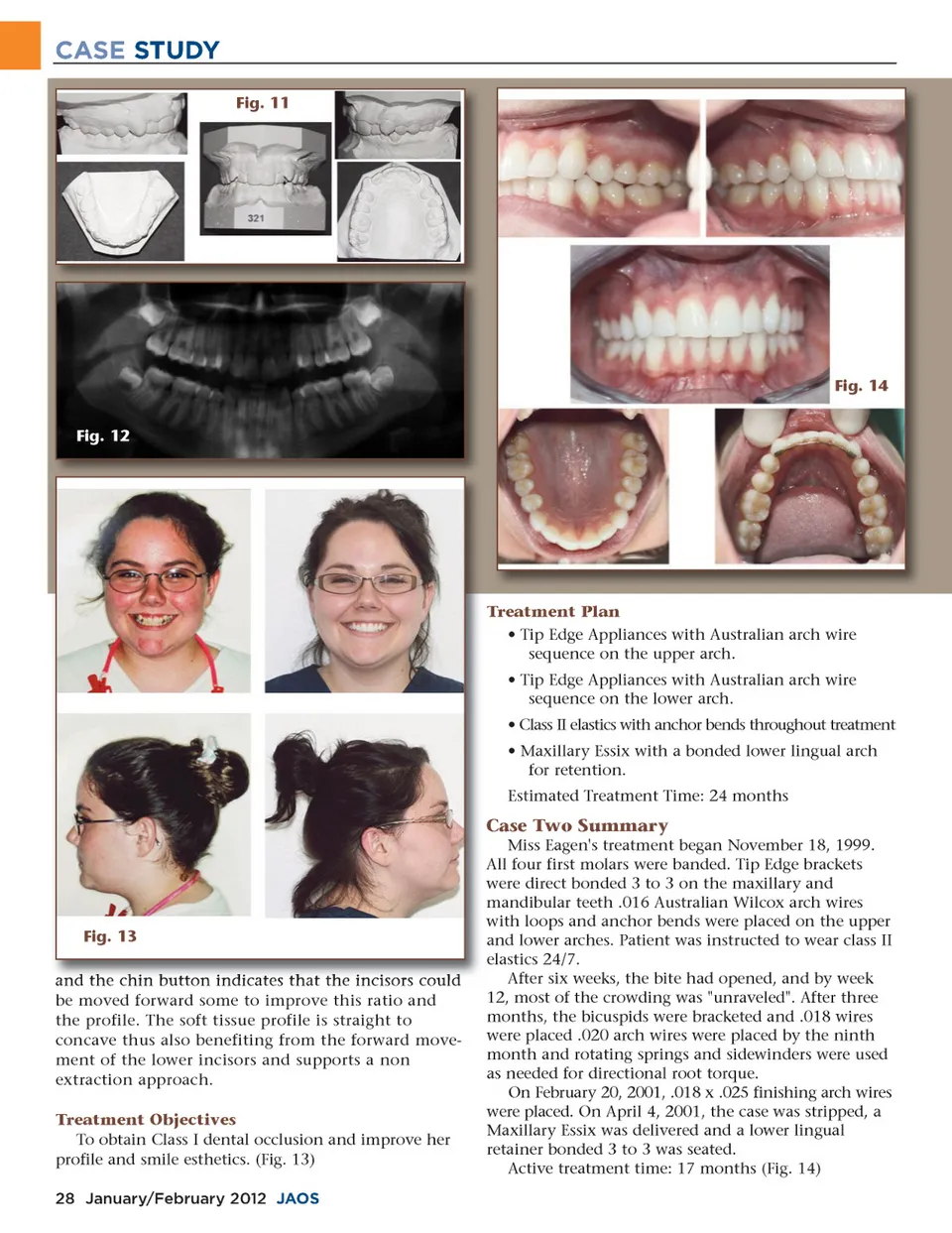
CASE STUDY Fig. 11 Fig. 14 Fig. 12 Treatment Plan • Tip Edge Appliances with Australian arch wire sequence on the upper arch. • Tip Edge Appliances with Australian arch wire sequence on the lower arch. • Class II elastics with anchor bends throughout treatment • Maxillary Essix with a bonded lower lingual arch for retention. Estimated Treatment Time: 24 months Case Two Summary Miss Eagen's treatment began November 18, 1999. All four first molars were banded. Tip Edge brackets were direct bonded 3 to 3 on the maxillary and mandibular teeth .016 Australian Wilcox arch wires with loops and anchor bends were placed on the upper and lower arches. Patient was instructed to wear class II elastics 24/7. After six weeks, the bite had opened, and by week 12, most of the crowding was "unraveled". After three months, the bicuspids were bracketed and .018 wires were placed .020 arch wires were placed by the ninth month and rotating springs and sidewinders were used as needed for directional root torque. On February 20, 2001, .018 x .025 finishing arch wires were placed. On April 4, 2001, the case was stripped, a Maxillary Essix was delivered and a lower lingual retainer bonded 3 to 3 was seated. Active treatment time: 17 months (Fig. 14) Fig. 13 and the chin button indicates that the incisors could be moved forward some to improve this ratio and the profile. The soft tissue profile is straight to concave thus also benefiting from the forward move-ment of the lower incisors and supports a non extraction approach. Treatment Objectives To obtain Class I dental occlusion and improve her profile and smile esthetics. (Fig. 13) 28 January/February 2012 JAOS
Journal of the American Orthodontic Society January-February 2012: Page 28