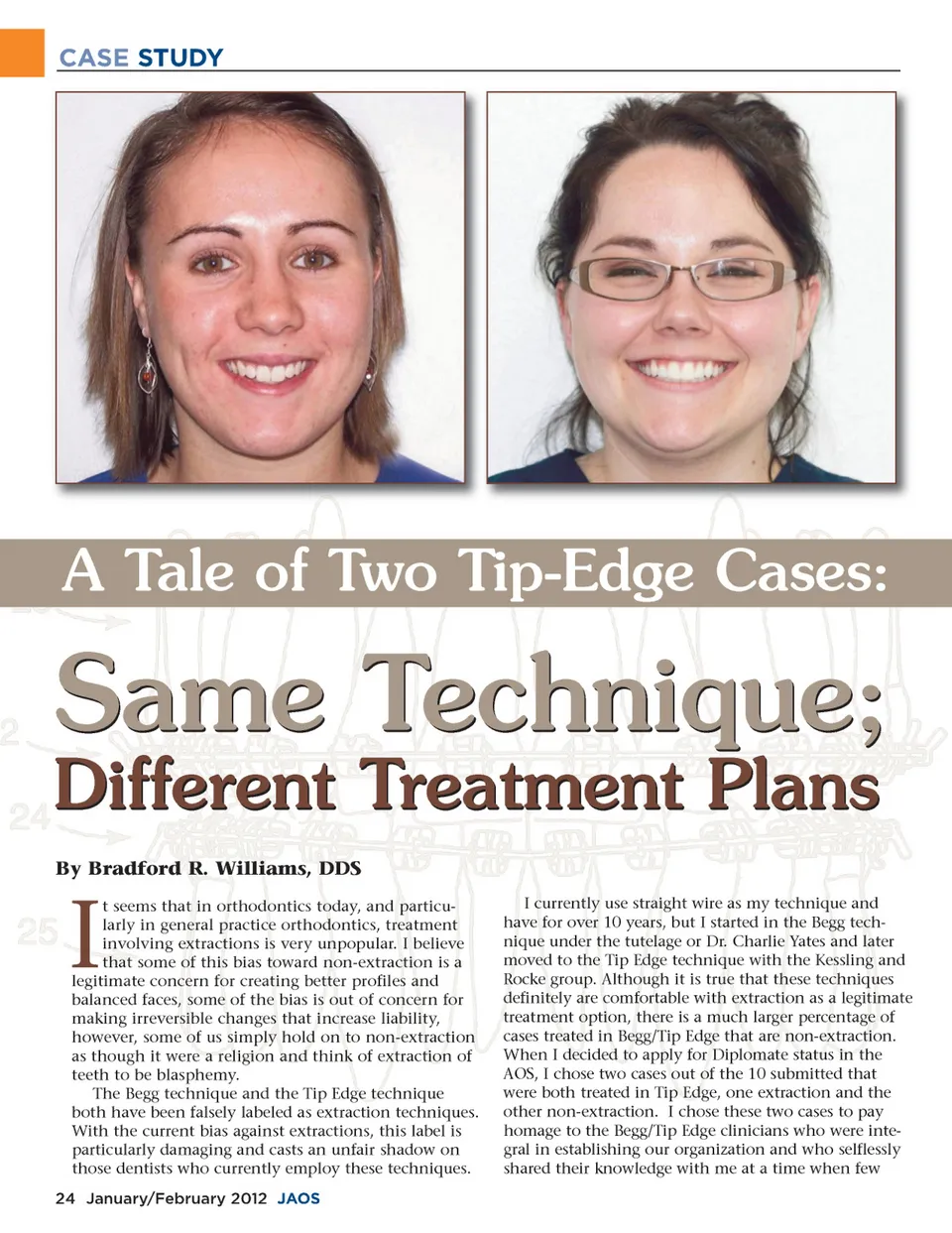
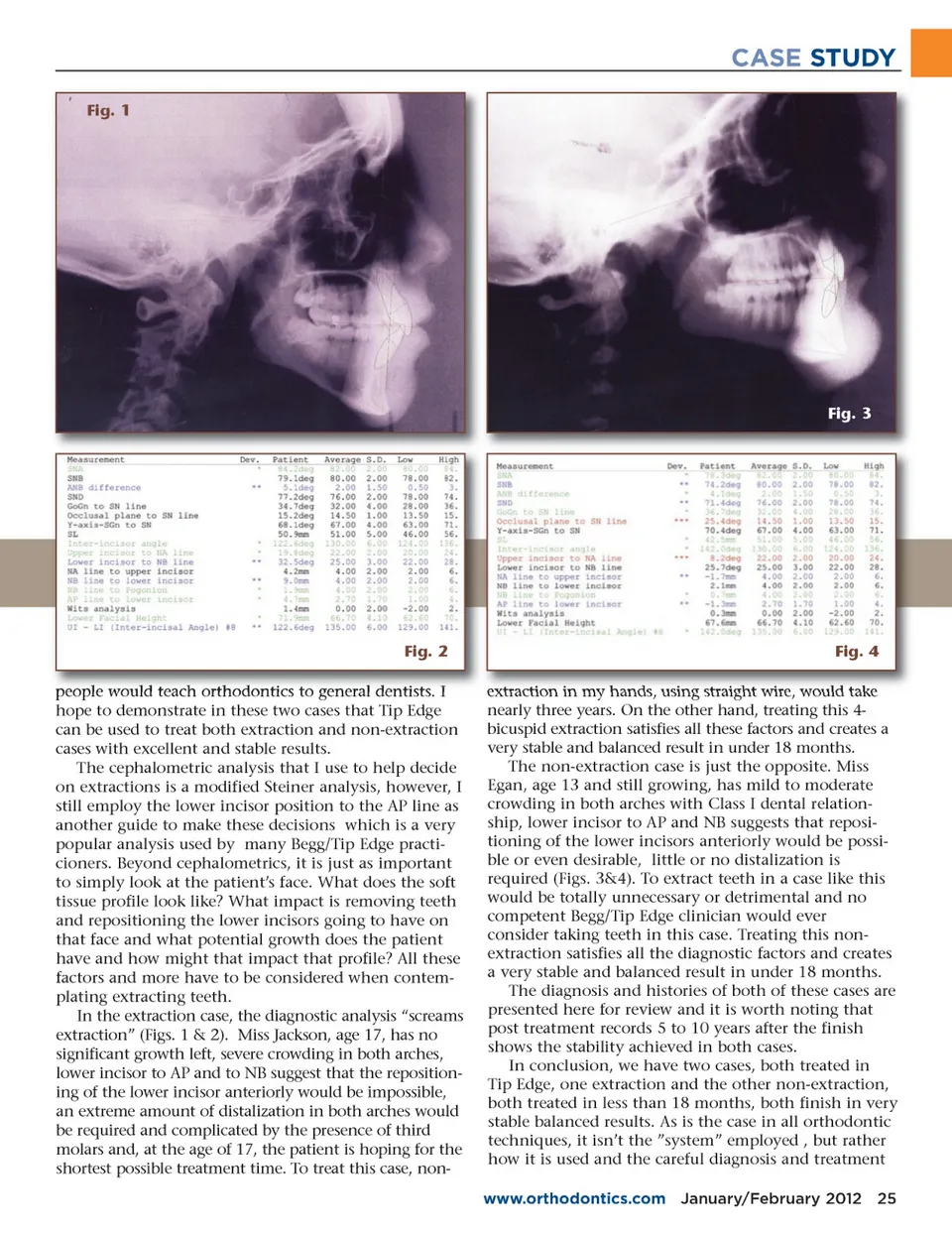
CASE STUDY Fig. 1 Fig. 3 Fig. 2 people would teach orthodontics to general dentists. I hope to demonstrate in these two cases that Tip Edge can be used to treat both extraction and non-extraction cases with excellent and stable results. The cephalometric analysis that I use to help decide on extractions is a modified Steiner analysis, however, I still employ the lower incisor position to the AP line as another guide to make these decisions which is a very popular analysis used by many Begg/Tip Edge practi-cioners. Beyond cephalometrics, it is just as important to simply look at the patient’s face. What does the soft tissue profile look like? What impact is removing teeth and repositioning the lower incisors going to have on that face and what potential growth does the patient have and how might that impact that profile? All these factors and more have to be considered when contem-plating extracting teeth. In the extraction case, the diagnostic analysis “screams extraction” (Figs. 1 & 2). Miss Jackson, age 17, has no significant growth left, severe crowding in both arches, lower incisor to AP and to NB suggest that the reposition-ing of the lower incisor anteriorly would be impossible, an extreme amount of distalization in both arches would be required and complicated by the presence of third molars and, at the age of 17, the patient is hoping for the shortest possible treatment time. To treat this case, non-Fig. 4 extraction in my hands, using straight wire, would take nearly three years. On the other hand, treating this 4-bicuspid extraction satisfies all these factors and creates a very stable and balanced result in under 18 months. The non-extraction case is just the opposite. Miss Egan, age 13 and still growing, has mild to moderate crowding in both arches with Class I dental relation-ship, lower incisor to AP and NB suggests that reposi-tioning of the lower incisors anteriorly would be possi-ble or even desirable, little or no distalization is required (Figs. 3&4). To extract teeth in a case like this would be totally unnecessary or detrimental and no competent Begg/Tip Edge clinician would ever consider taking teeth in this case. Treating this non-extraction satisfies all the diagnostic factors and creates a very stable and balanced result in under 18 months. The diagnosis and histories of both of these cases are presented here for review and it is worth noting that post treatment records 5 to 10 years after the finish shows the stability achieved in both cases. In conclusion, we have two cases, both treated in Tip Edge, one extraction and the other non-extraction, both treated in less than 18 months, both finish in very stable balanced results. As is the case in all orthodontic techniques, it isn’t the ”system” employed , but rather how it is used and the careful diagnosis and treatment www.orthodontics.com January/February 2012 25
Journal of the American Orthodontic Society January-February 2012: Page 25