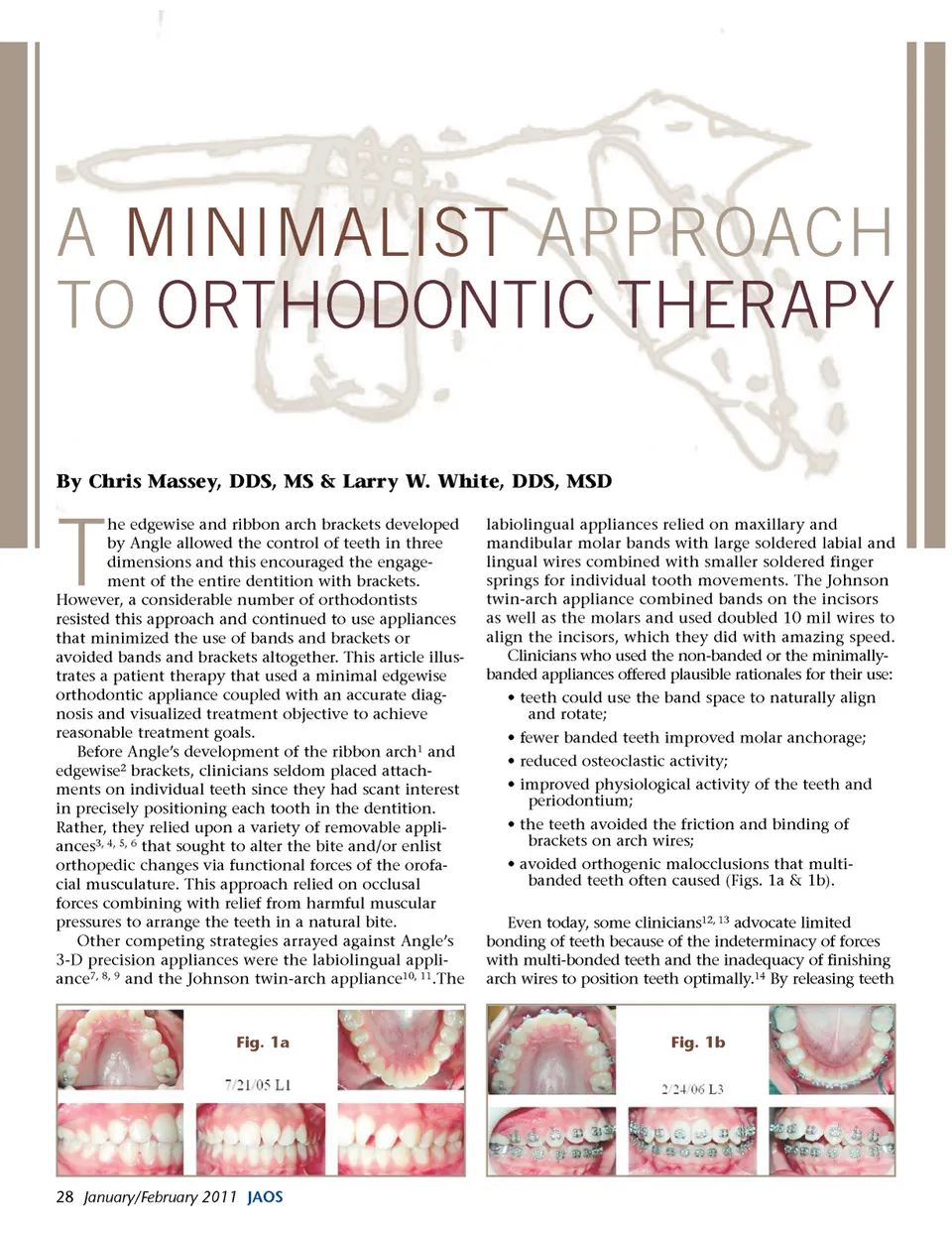
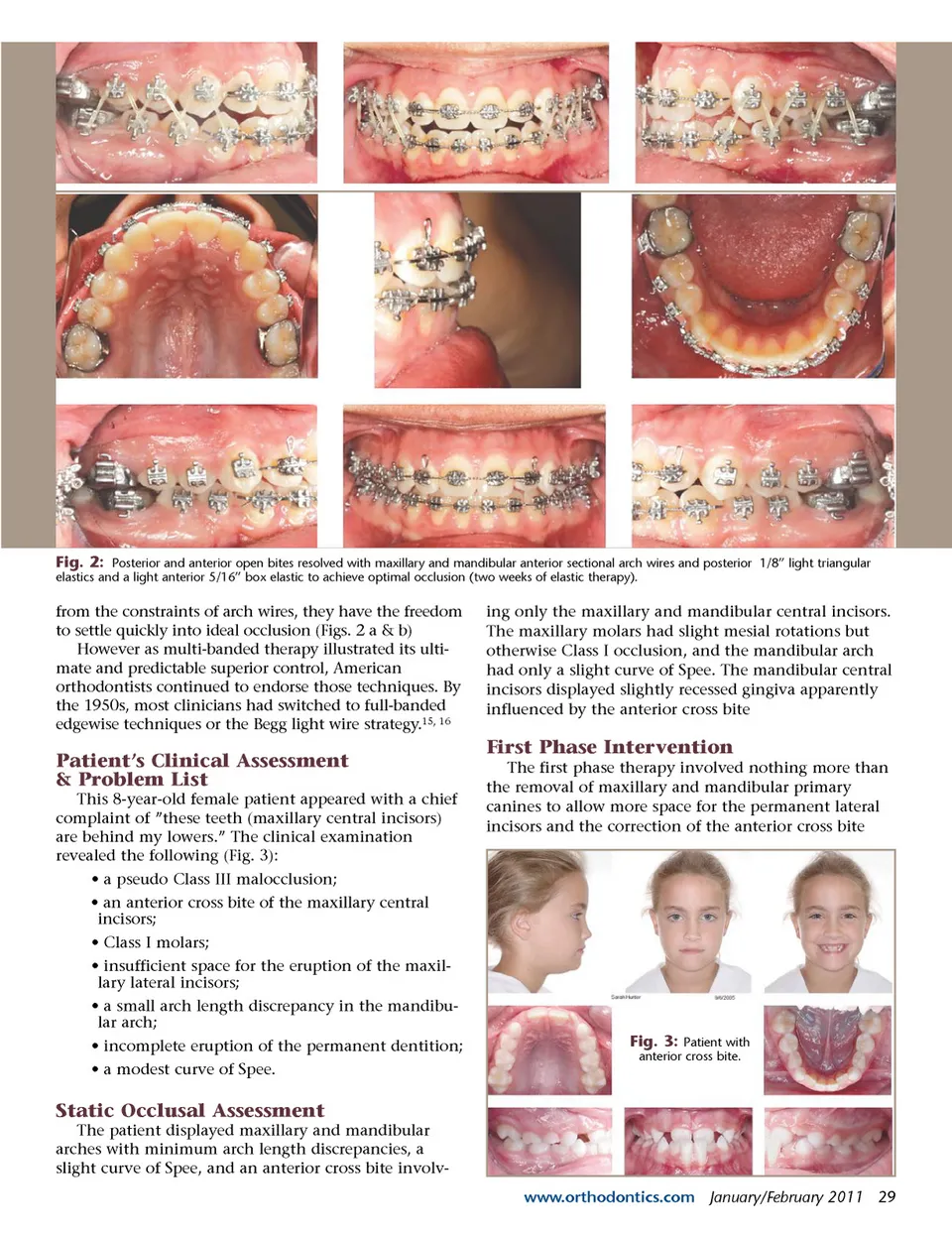
A MINIMALIST APPROACH TO ORTHODONTIC THERAPY By Chris Massey, DDS, MS & Larry W. White, DDS, MSD he edgewise and ribbon arch brackets developed by Angle allowed the control of teeth in three dimensions and this encouraged the engage-ment of the entire dentition with brackets. However, a considerable number of orthodontists resisted this approach and continued to use appliances that minimized the use of bands and brackets or avoided bands and brackets altogether. This article illus-trates a patient therapy that used a minimal edgewise orthodontic appliance coupled with an accurate diag-nosis and visualized treatment objective to achieve reasonable treatment goals. Before Angle’s development of the ribbon arch 1 and edgewise 2 brackets, clinicians seldom placed attach-ments on individual teeth since they had scant interest in precisely positioning each tooth in the dentition. Rather, they relied upon a variety of removable appli-ances 3, 4, 5, 6 that sought to alter the bite and/or enlist orthopedic changes via functional forces of the orofa-cial musculature. This approach relied on occlusal forces combining with relief from harmful muscular pressures to arrange the teeth in a natural bite. Other competing strategies arrayed against Angle’s 3-D precision appliances were the labiolingual appli-ance 7, 8, 9 and the Johnson twin-arch appliance 10, 11 .The T labiolingual appliances relied on maxillary and mandibular molar bands with large soldered labial and lingual wires combined with smaller soldered finger springs for individual tooth movements. The Johnson twin-arch appliance combined bands on the incisors as well as the molars and used doubled 10 mil wires to align the incisors, which they did with amazing speed. Clinicians who used the non-banded or the minimally-banded appliances offered plausible rationales for their use: • teeth could use the band space to naturally align and rotate; • fewer banded teeth improved molar anchorage; • reduced osteoclastic activity; • improved physiological activity of the teeth and periodontium; • the teeth avoided the friction and binding of brackets on arch wires; • avoided orthogenic malocclusions that multi-banded teeth often caused (Figs. 1a & 1b). Even today, some clinicians 12, 13 advocate limited bonding of teeth because of the indeterminacy of forces with multi-bonded teeth and the inadequacy of finishing arch wires to position teeth optimally. 14 By releasing teeth Fig. 1a Fig. 1b 28 January/February 2011 JAOS
Journal of the American Orthodontic Society January - February 2011: Page 28