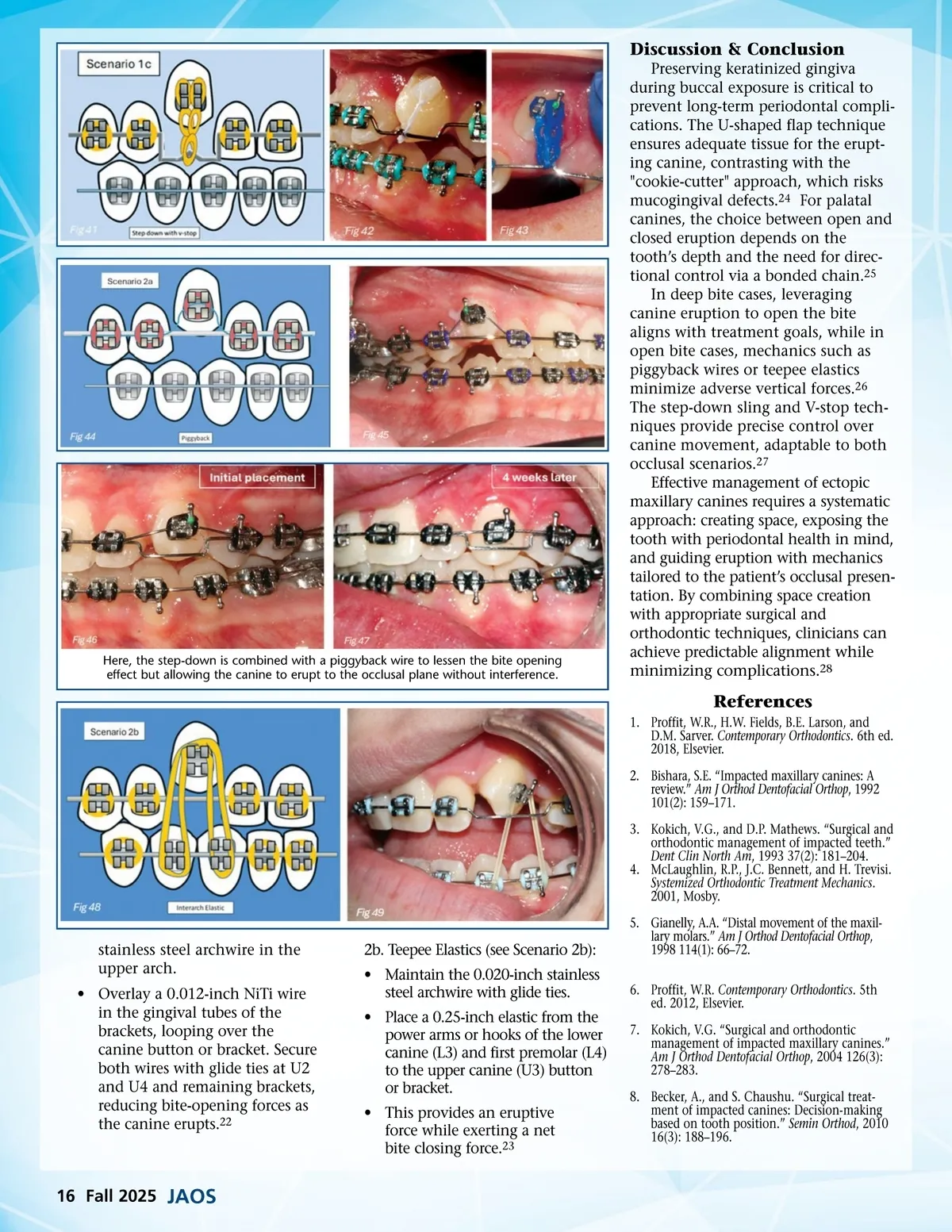
Discussion & Conclusion Preserving keratinized gingiva during buccal exposure is critical to prevent long-term periodontal compli-cations. The U-shaped flap technique ensures adequate tissue for the erupt-ing canine, contrasting with the "cookie-cutter" approach, which risks mucogingival defects. 24 For palatal canines, the choice between open and closed eruption depends on the tooth’s depth and the need for direc-tional control via a bonded chain. 25 In deep bite cases, leveraging canine eruption to open the bite aligns with treatment goals, while in open bite cases, mechanics such as piggyback wires or teepee elastics minimize adverse vertical forces. 26 The step-down sling and V-stop tech-niques provide precise control over canine movement, adaptable to both occlusal scenarios. 27 Effective management of ectopic maxillary canines requires a systematic approach: creating space, exposing the tooth with periodontal health in mind, and guiding eruption with mechanics tailored to the patient’s occlusal presen-tation. By combining space creation with appropriate surgical and orthodontic techniques, clinicians can achieve predictable alignment while minimizing complications. 28 Here, the step-down is combined with a piggyback wire to lessen the bite opening effect but allowing the canine to erupt to the occlusal plane without interference. References 1. Proffit, W.R., H.W. Fields, B.E. Larson, and D.M. Sarver. Contemporary Orthodontics . 6th ed. 2018, Elsevier. 2. Bishara, S.E. “Impacted maxillary canines: A review.” Am J Orthod Dentofacial Orthop , 1992 101(2): 159–171. 3. Kokich, V.G., and D.P. Mathews. “Surgical and orthodontic management of impacted teeth.” Dent Clin North Am , 1993 37(2): 181–204. 4. McLaughlin, R.P., J.C. Bennett, and H. Trevisi. Systemized Orthodontic Treatment Mechanics . 2001, Mosby. 5. Gianelly, A.A. “Distal movement of the maxil-lary molars.” Am J Orthod Dentofacial Orthop , 1998 114(1): 66–72. 6. Proffit, W.R. Contemporary Orthodontics. 5th ed. 2012, Elsevier. 7. Kokich, V.G. “Surgical and orthodontic management of impacted maxillary canines.” Am J Orthod Dentofacial Orthop , 2004 126(3): 278–283. 8. Becker, A., and S. Chaushu. “Surgical treat-ment of impacted canines: Decision-making based on tooth position.” Semin Orthod , 2010 16(3): 188–196. stainless steel archwire in the upper arch. • Overlay a 0.012-inch NiTi wire in the gingival tubes of the brackets, looping over the canine button or bracket. Secure both wires with glide ties at U2 and U4 and remaining brackets, reducing bite-opening forces as the canine erupts. 22 2b. Teepee Elastics (see Scenario 2b): • Maintain the 0.020-inch stainless steel archwire with glide ties. • Place a 0.25-inch elastic from the power arms or hooks of the lower canine (L3) and first premolar (L4) to the upper canine (U3) button or bracket. • This provides an eruptive force while exerting a net bite closing force. 23 16 Fall 2025 JAOS
Journal of the American Orthodontic Society Fall 2025: Page 16