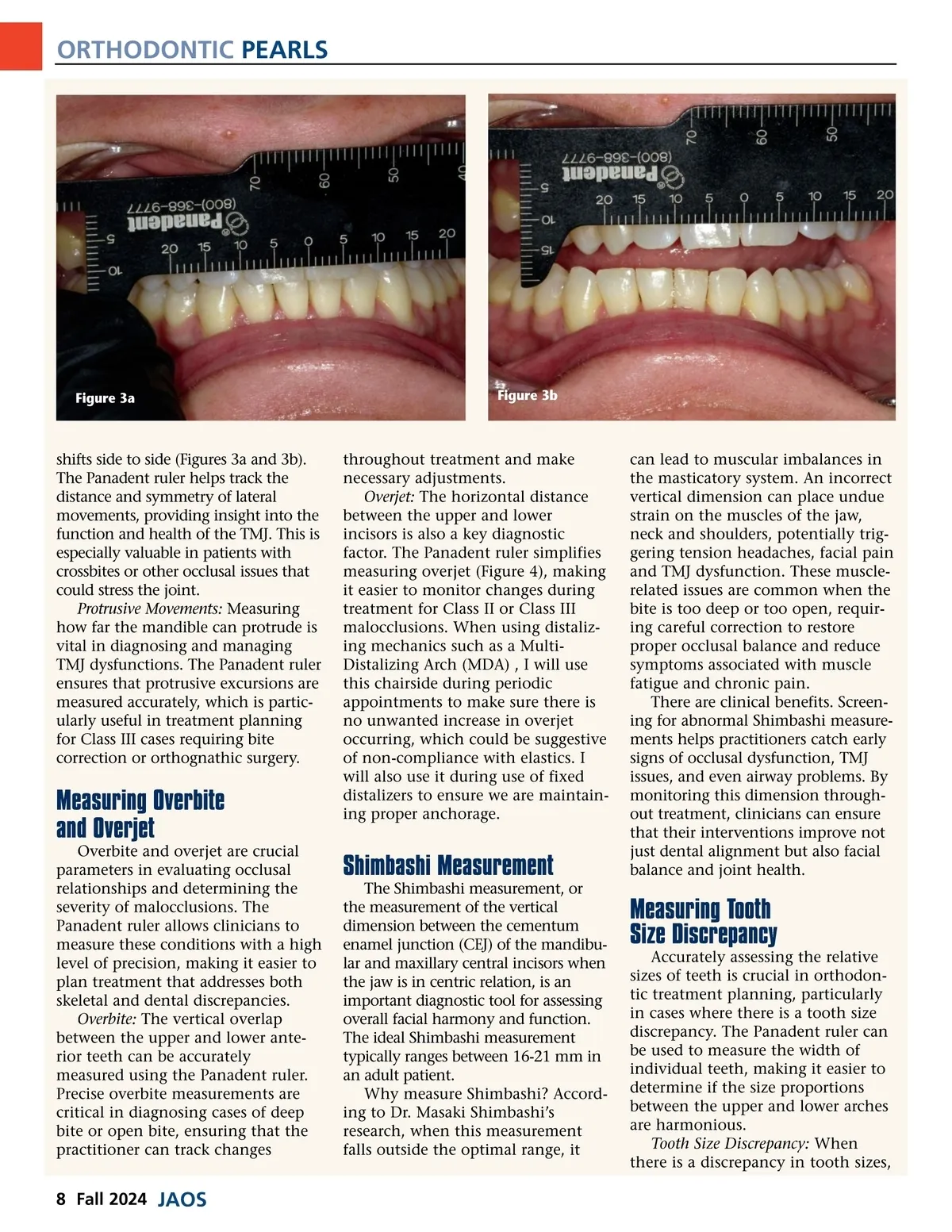
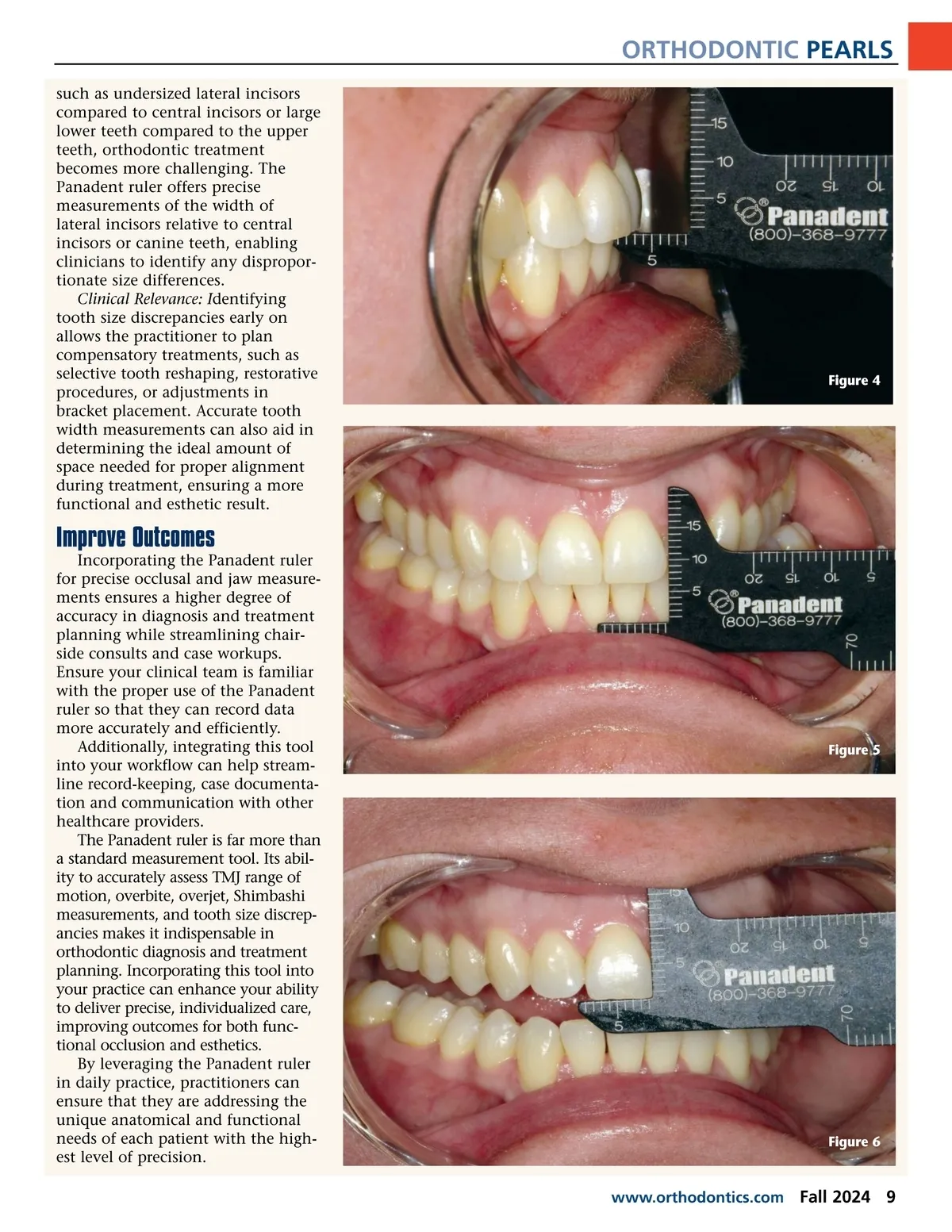
ORTHODONTIC PEARLS Figure 3a Figure 3b shifts side to side (Figures 3a and 3b). The Panadent ruler helps track the distance and symmetry of lateral movements, providing insight into the function and health of the TMJ. This is especially valuable in patients with crossbites or other occlusal issues that could stress the joint. Protrusive Movements: Measuring how far the mandible can protrude is vital in diagnosing and managing TMJ dysfunctions. The Panadent ruler ensures that protrusive excursions are measured accurately, which is partic-ularly useful in treatment planning for Class III cases requiring bite correction or orthognathic surgery. Measuring Overbite and Overjet Overbite and overjet are crucial parameters in evaluating occlusal relationships and determining the severity of malocclusions. The Panadent ruler allows clinicians to measure these conditions with a high level of precision, making it easier to plan treatment that addresses both skeletal and dental discrepancies. Overbite: The vertical overlap between the upper and lower ante-rior teeth can be accurately measured using the Panadent ruler. Precise overbite measurements are critical in diagnosing cases of deep bite or open bite, ensuring that the practitioner can track changes throughout treatment and make necessary adjustments. Overjet: The horizontal distance between the upper and lower incisors is also a key diagnostic factor. The Panadent ruler simplifies measuring overjet (Figure 4), making it easier to monitor changes during treatment for Class II or Class III malocclusions. When using distaliz-ing mechanics such as a Multi-Distalizing Arch (MDA) , I will use this chairside during periodic appointments to make sure there is no unwanted increase in overjet occurring, which could be suggestive of non-compliance with elastics. I will also use it during use of fixed distalizers to ensure we are maintain-ing proper anchorage. Shimbashi Measurement The Shimbashi measurement, or the measurement of the vertical dimension between the cementum enamel junction (CEJ) of the mandibu-lar and maxillary central incisors when the jaw is in centric relation, is an important diagnostic tool for assessing overall facial harmony and function. The ideal Shimbashi measurement typically ranges between 16-21 mm in an adult patient. Why measure Shimbashi? Accord-ing to Dr. Masaki Shimbashi’s research, when this measurement falls outside the optimal range, it can lead to muscular imbalances in the masticatory system. An incorrect vertical dimension can place undue strain on the muscles of the jaw, neck and shoulders, potentially trig-gering tension headaches, facial pain and TMJ dysfunction. These muscle-related issues are common when the bite is too deep or too open, requir-ing careful correction to restore proper occlusal balance and reduce symptoms associated with muscle fatigue and chronic pain. There are clinical benefits. Screen-ing for abnormal Shimbashi measure-ments helps practitioners catch early signs of occlusal dysfunction, TMJ issues, and even airway problems. By monitoring this dimension through-out treatment, clinicians can ensure that their interventions improve not just dental alignment but also facial balance and joint health. Measuring Tooth Size Discrepancy Accurately assessing the relative sizes of teeth is crucial in orthodon-tic treatment planning, particularly in cases where there is a tooth size discrepancy. The Panadent ruler can be used to measure the width of individual teeth, making it easier to determine if the size proportions between the upper and lower arches are harmonious. Tooth Size Discrepancy: When there is a discrepancy in tooth sizes, 8 Fall 2024 JAOS
Journal of the American Orthodontic Society Fall 2024: Page 8