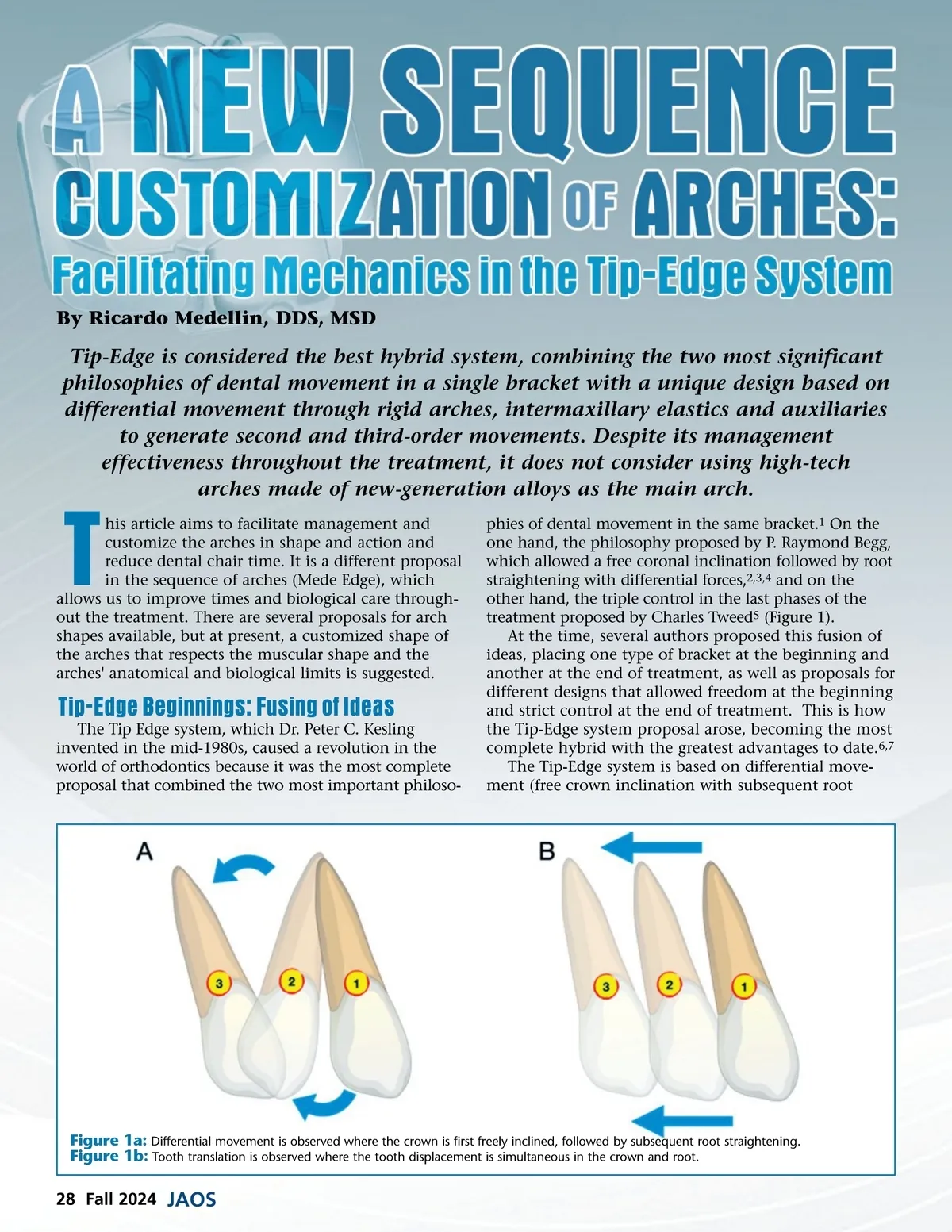
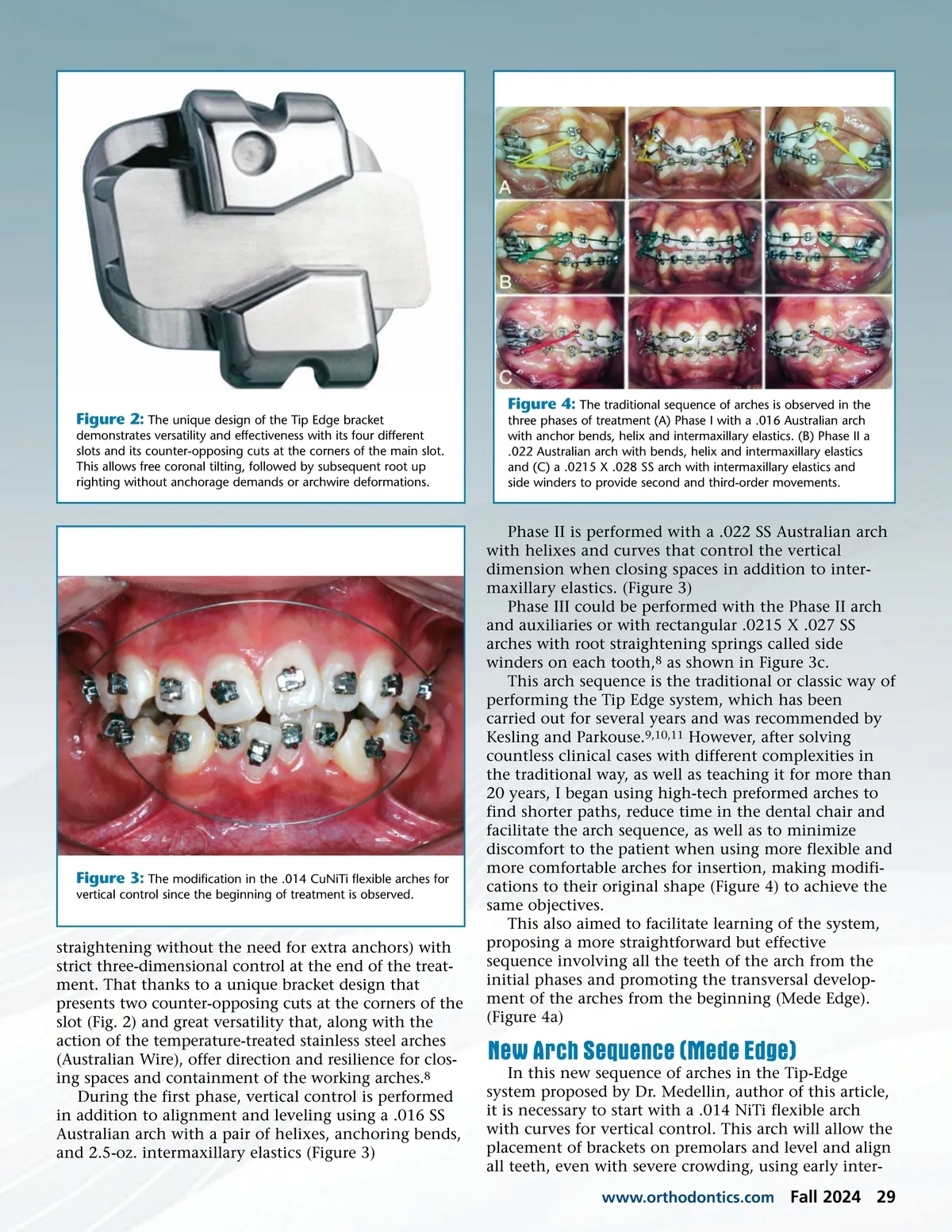
By Ricardo Medellin, DDS, MSD Tip-Edge is considered the best hybrid system, combining the two most significant philosophies of dental movement in a single bracket with a unique design based on differential movement through rigid arches, intermaxillary elastics and auxiliaries to generate second and third-order movements. Despite its management effectiveness throughout the treatment, it does not consider using high-tech arches made of new-generation alloys as the main arch. T his article aims to facilitate management and customize the arches in shape and action and reduce dental chair time. It is a different proposal in the sequence of arches (Mede Edge), which allows us to improve times and biological care through-out the treatment. There are several proposals for arch shapes available, but at present, a customized shape of the arches that respects the muscular shape and the arches' anatomical and biological limits is suggested. Tip-Edge Beginnings: Fusing of Ideas The Tip Edge system, which Dr. Peter C. Kesling invented in the mid-1980s, caused a revolution in the world of orthodontics because it was the most complete proposal that combined the two most important philoso-phies of dental movement in the same bracket. 1 On the one hand, the philosophy proposed by P. Raymond Begg, which allowed a free coronal inclination followed by root straightening with differential forces, 2,3,4 and on the other hand, the triple control in the last phases of the treatment proposed by Charles Tweed 5 (Figure 1). At the time, several authors proposed this fusion of ideas, placing one type of bracket at the beginning and another at the end of treatment, as well as proposals for different designs that allowed freedom at the beginning and strict control at the end of treatment. This is how the Tip-Edge system proposal arose, becoming the most complete hybrid with the greatest advantages to date. 6,7 The Tip-Edge system is based on differential move-ment (free crown inclination with subsequent root Figure 1a: Differential movement is observed where the crown is first freely inclined, followed by subsequent root straightening. Figure 1b: Tooth translation is observed where the tooth displacement is simultaneous in the crown and root. 28 Fall 2024 JAOS
Journal of the American Orthodontic Society Fall 2024: Page 28