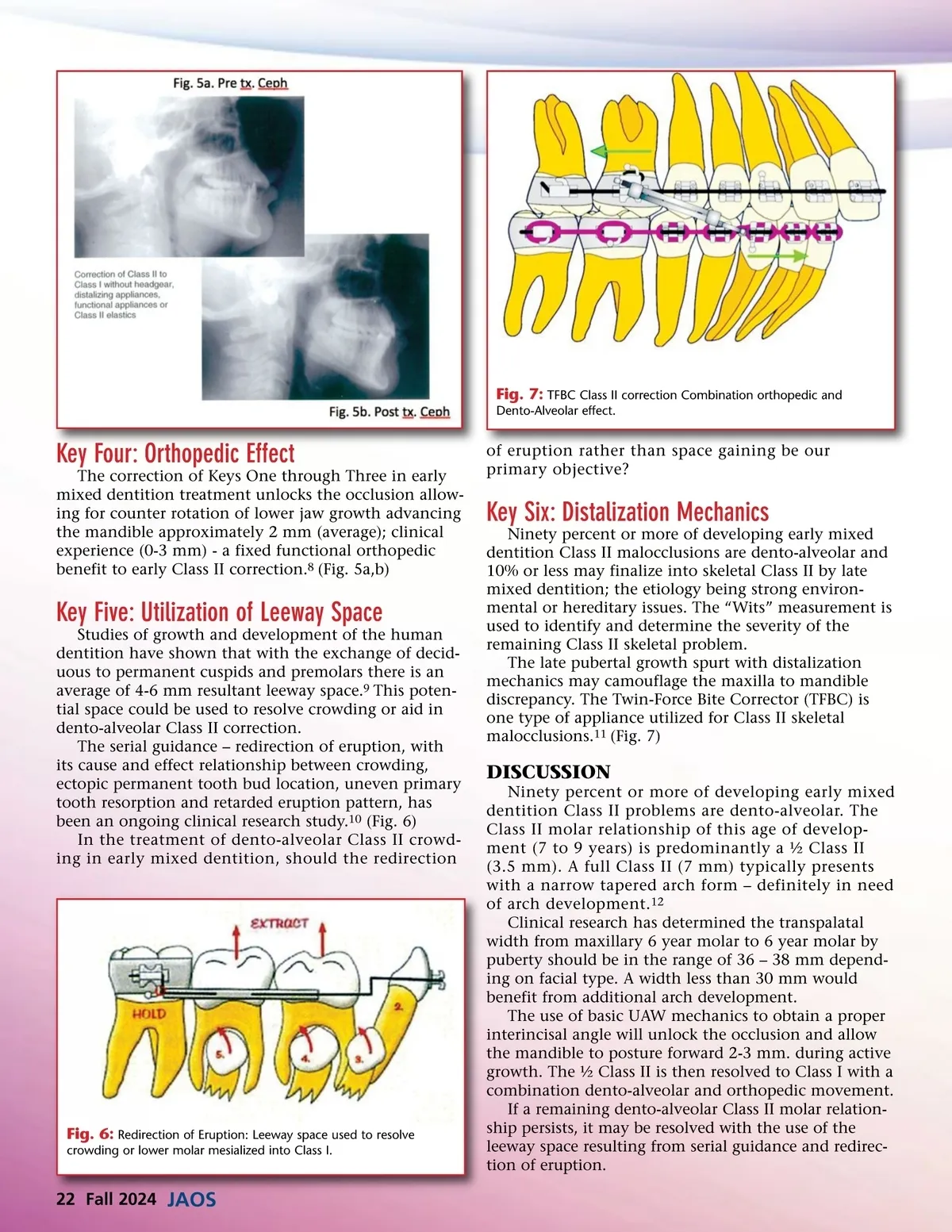
SIX KEYS TO CLASS DIV. I TABLE 2. Dx. Tx. I. Maxillary Arch Development II. Mesio-Lingual Rotated 6+6 Distal Rotation-Expansion III. Unlocking the Occlusion OB./O.J. IV. 0-3 mm. Forward Movement of Mandible V. Use of Leeway Space VI. Distalization Fig. 8: Updated Andrews fully programmed Straight Wire System. A small number of true skeletal Class II malocclu-sions (less than 10%) identified in the late mixed or early adolescent permanent dentition can be camou-flaged by the use of orthopedic type appliances (TFBC). All cases are transitioned into a fully-programmed updated Straight-Wire Bracket System. The finishing goals are The Andrews’ Six Keys plus functional occlu-sion. 13 (Fig. 8) REFERENCES 1. Jacobsen A. The “Wits” appraisal of jaw disharmony, Am J Orthod 1975; 67: 125. 2. McNamara J A Jr. Maxillary transverse deficiency, Am J Orthod Dentofacial Orthop 2000; 117: 567-70. 3. Gandreault, Hendrocks, Korn. (An unpublished study of frequency of variables) Tufts University School of Dental Medicine May 2003. 4. Corbett M C. Slow and continuous maxillary expansion, molar rotation and molar distalization, J Clin Orthod 1997; 31: 253-263. 5. Carapezza, L J. Early treatment of malocclusion: Cephalometric chevrons. J Amer Orthod Soc 2004; 4: 31-33. 6. Bjork A. Prediction of mandibular growth rotation. Am J Orthod, June 1969. 7. Brehm W, Carapezza L J. Space age pedodontics: the use of the utility arch wire appliance. J Pedod 1987; 11: 201-209. 8. Carapezza L J. Early treatment versus late treatment Class II closed bite malocclusion. J Acad Gen Dent Vol. 51 No.5 Sept-Oct 2003. 9. Moorrees C. The dentition of the growing child, a longitudinal study of dental development between 3 and 18 years of age. Cambridge: Harvard University Press: 1956. 10. Carapezza L.J. Early treatment of malocclusion serial guidance. J Amer Orthod Soc 2004; 4: 31-33. 11. Rothberg J, Campbell E S, Nanda R. Class II correction with the twin force bite corrector. J. Clin Orthod. April 2004. 12. Brehm W, Carapezza L J. The Nitanium palatal expander2 Straight Wire Seminars, Inc. 1822 Aston Avenue Carlsbad, CA 92008. 13. Andrews, L F. The straight-wire appliance explained and compared. J Clin Orthod 1976; 10: 179. 14. Proffit W R, Tulloch, J F. Preadolescent Class II problems: treat now or wait? Am J Orthod Dentofacial Orthop 2002; 121: 552-3. 15. Gianelly, A A, One-phase versus two-phases, Am J Orthod 1995; 108: 556-9. 16. Johnston L E. Answers in search of questions, Am J Orthod Dentofacial Orthop 2002; 121: 552-3. CONCLUSION A starting point in early mixed dentition Class II diag-nosis and treatment is the establishment of a properly developed maxillary arch form after neuromuscular prob-lems have been addressed (ex. Airway, oral habits, etc.). The early treatment prioritization of crowding, deep overbite and molar rotation followed by secondarily managing the Class II problem has eliminated the use of conventional retrusive mechanics. Conventional mechanics at this age level is counterproductive to normal growth and development. The goals of early treatment: proper overbite, proper overjet, molar relationship, jaw relationship, serial guidance and lip seal can be accomplished with less than 5% permanent teeth extracted. The strategy and protocol proposed supports better long term facial form, stability and a healthy TMJ. Early treatment of the Class II problem with this Growth Modification approach to diagnosis and treatment lessens the degree of difficulty of this common malocclusion. (Table 2). Commonly this approach gives early correction of Class II to Class I without headgear, distalizing appliances, func-tional appliances or Class II elastics. Most clini-cians agree that dento-alveolar problems that are not allowed to transcend into Class II skeletal problems that need Camouflage Orthodontics are easier to treat effectively and efficiently in a pedi-atric or general dental practice. The timing of Class II treatment remains a topic of interest in the orthodontic community. 14, 15, 16 www.orthodontics.com Fall 2024 23
Journal of the American Orthodontic Society Fall 2024: Page 23