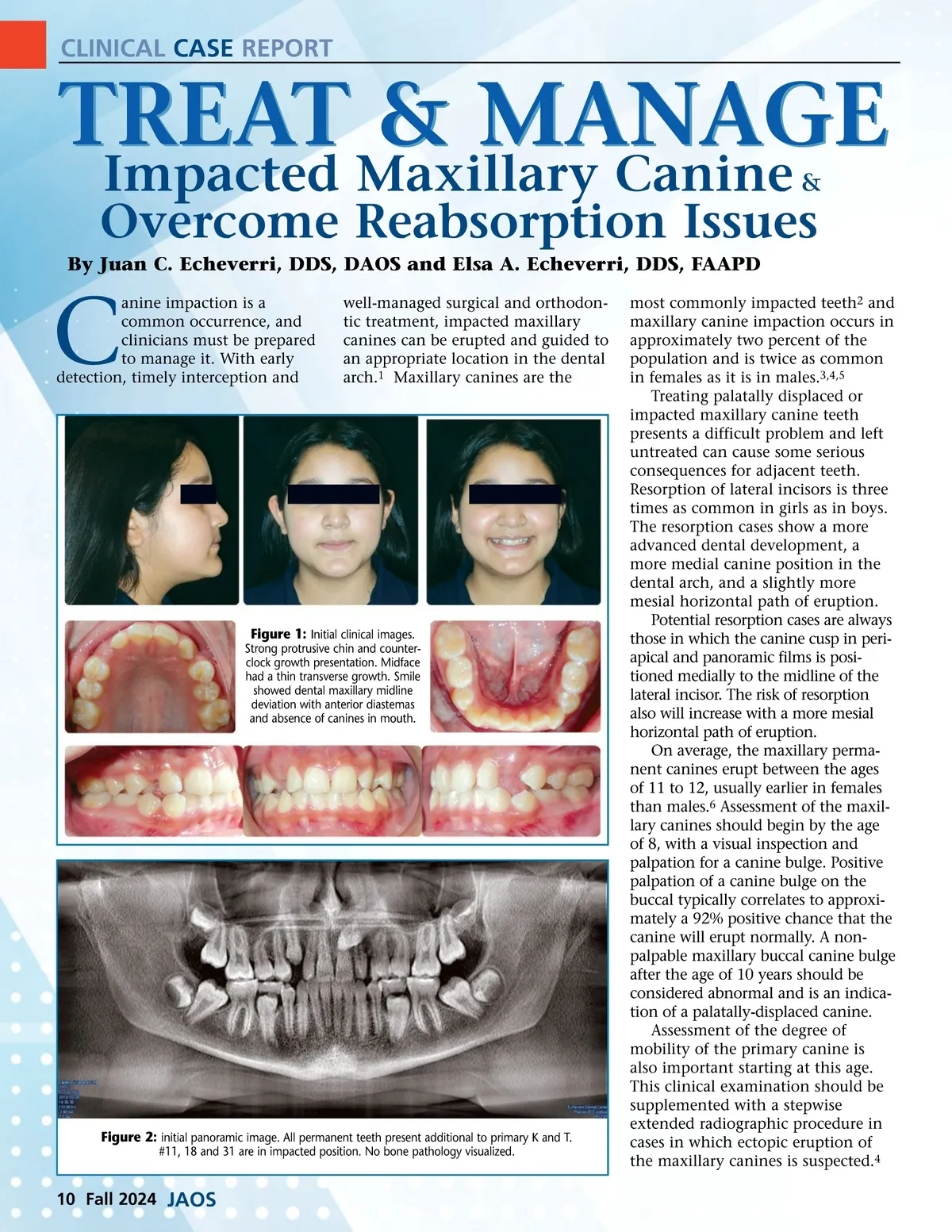
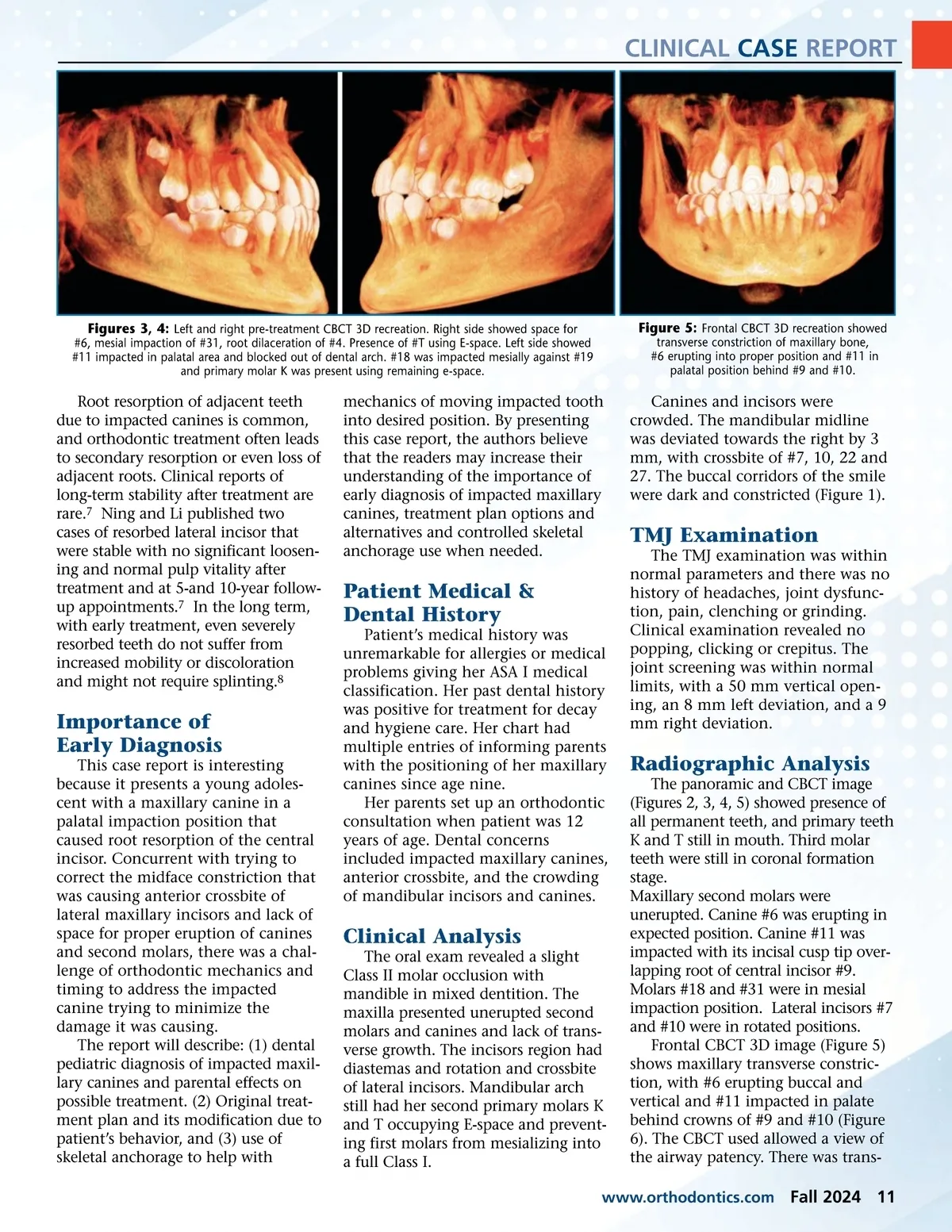
CLINICAL CASE REPORT TREAT & MANAGE Overcome Reabsorption Issues By Juan C. Echeverri, DDS, DAOS and Elsa A. Echeverri, DDS, FAAPD Impacted Maxillary Canine & well-managed surgical and orthodon-tic treatment, impacted maxillary canines can be erupted and guided to an appropriate location in the dental arch. 1 Maxillary canines are the C anine impaction is a common occurrence, and clinicians must be prepared to manage it. With early detection, timely interception and Figure 1: Initial clinical images. Strong protrusive chin and counter-clock growth presentation. Midface had a thin transverse growth. Smile showed dental maxillary midline deviation with anterior diastemas and absence of canines in mouth. Figure 2: initial panoramic image. All permanent teeth present additional to primary K and T. #11, 18 and 31 are in impacted position. No bone pathology visualized. most commonly impacted teeth 2 and maxillary canine impaction occurs in approximately two percent of the population and is twice as common in females as it is in males. 3,4,5 Treating palatally displaced or impacted maxillary canine teeth presents a difficult problem and left untreated can cause some serious consequences for adjacent teeth. Resorption of lateral incisors is three times as common in girls as in boys. The resorption cases show a more advanced dental development, a more medial canine position in the dental arch, and a slightly more mesial horizontal path of eruption. Potential resorption cases are always those in which the canine cusp in peri-apical and panoramic films is posi-tioned medially to the midline of the lateral incisor. The risk of resorption also will increase with a more mesial horizontal path of eruption. On average, the maxillary perma-nent canines erupt between the ages of 11 to 12, usually earlier in females than males. 6 Assessment of the maxil-lary canines should begin by the age of 8, with a visual inspection and palpation for a canine bulge. Positive palpation of a canine bulge on the buccal typically correlates to approxi-mately a 92% positive chance that the canine will erupt normally. A non-palpable maxillary buccal canine bulge after the age of 10 years should be considered abnormal and is an indica-tion of a palatally-displaced canine. Assessment of the degree of mobility of the primary canine is also important starting at this age. This clinical examination should be supplemented with a stepwise extended radiographic procedure in cases in which ectopic eruption of the maxillary canines is suspected. 4 10 Fall 2024 JAOS
Journal of the American Orthodontic Society Fall 2024: Page 10