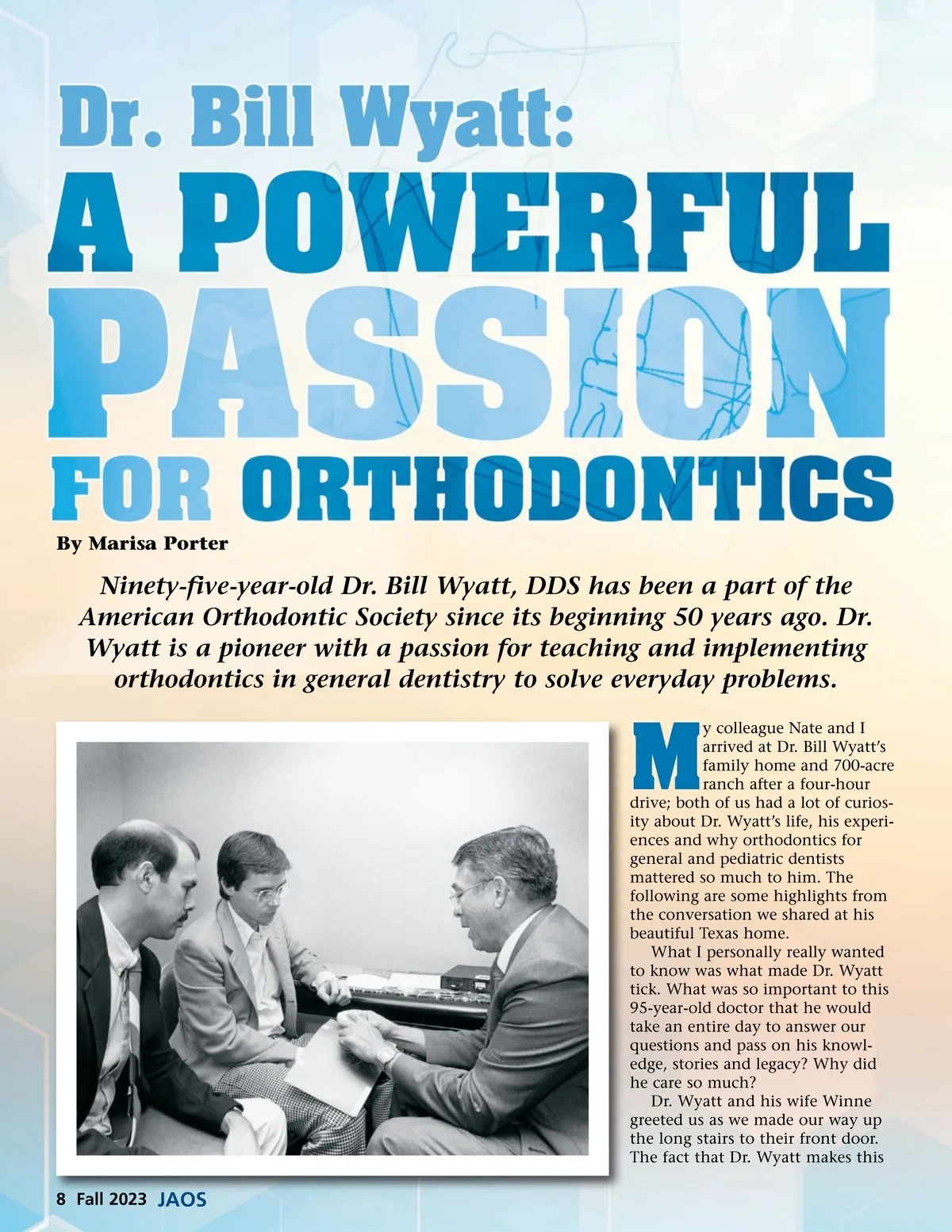
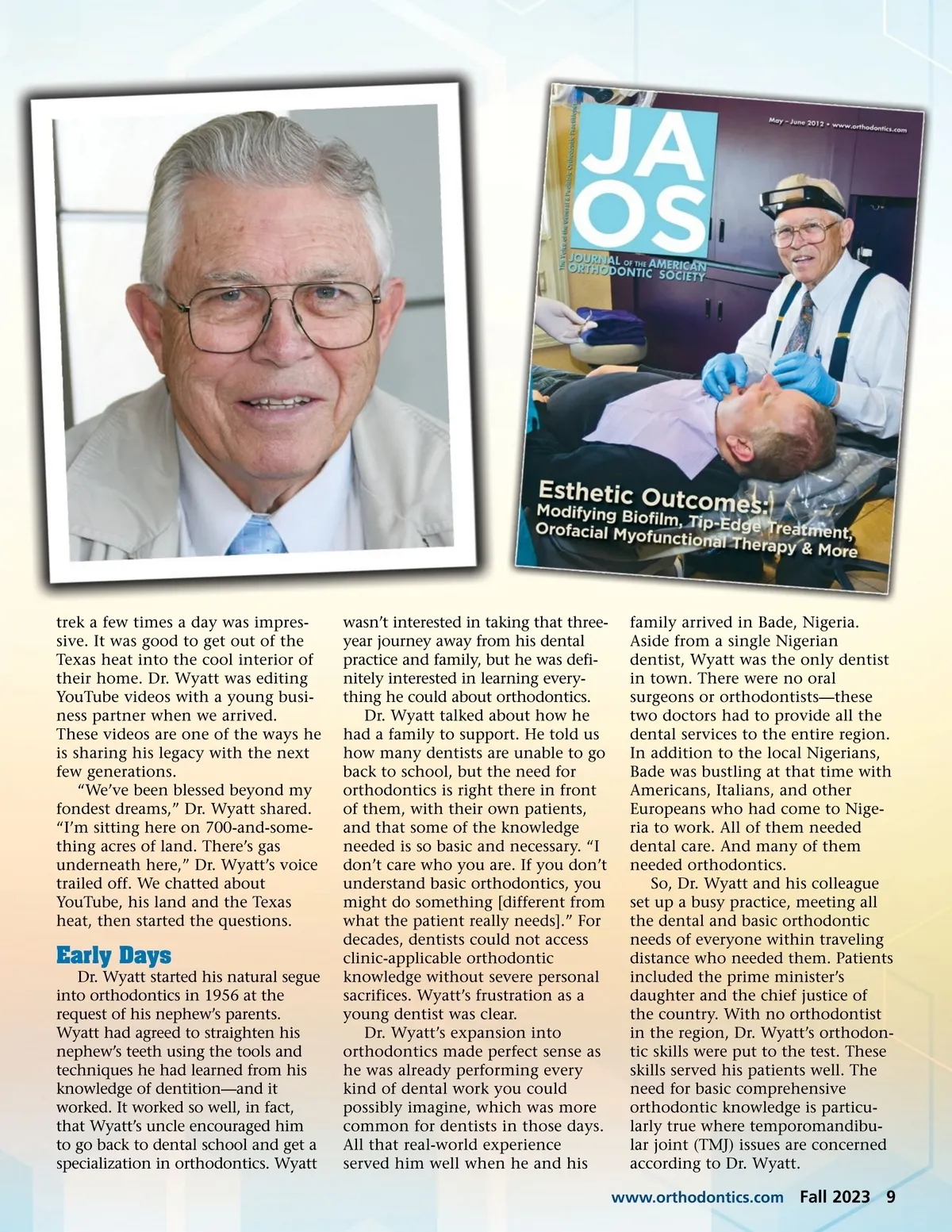
trek a few times a day was impres-sive. It was good to get out of the Texas heat into the cool interior of their home. Dr. Wyatt was editing YouTube videos with a young busi-ness partner when we arrived. These videos are one of the ways he is sharing his legacy with the next few generations. “We’ve been blessed beyond my fondest dreams,” Dr. Wyatt shared. “I’m sitting here on 700-and-some-thing acres of land. There’s gas underneath here,” Dr. Wyatt’s voice trailed off. We chatted about YouTube, his land and the Texas heat, then started the questions. Early Days Dr. Wyatt started his natural segue into orthodontics in 1956 at the request of his nephew’s parents. Wyatt had agreed to straighten his nephew’s teeth using the tools and techniques he had learned from his knowledge of dentition—and it worked. It worked so well, in fact, that Wyatt’s uncle encouraged him to go back to dental school and get a specialization in orthodontics. Wyatt wasn’t interested in taking that three-year journey away from his dental practice and family, but he was defi-nitely interested in learning every-thing he could about orthodontics. Dr. Wyatt talked about how he had a family to support. He told us how many dentists are unable to go back to school, but the need for orthodontics is right there in front of them, with their own patients, and that some of the knowledge needed is so basic and necessary. “I don’t care who you are. If you don’t understand basic orthodontics, you might do something [different from what the patient really needs].” For decades, dentists could not access clinic-applicable orthodontic knowledge without severe personal sacrifices. Wyatt’s frustration as a young dentist was clear. Dr. Wyatt’s expansion into orthodontics made perfect sense as he was already performing every kind of dental work you could possibly imagine, which was more common for dentists in those days. All that real-world experience served him well when he and his family arrived in Bade, Nigeria. Aside from a single Nigerian dentist, Wyatt was the only dentist in town. There were no oral surgeons or orthodontists—these two doctors had to provide all the dental services to the entire region. In addition to the local Nigerians, Bade was bustling at that time with Americans, Italians, and other Europeans who had come to Nige-ria to work. All of them needed dental care. And many of them needed orthodontics. So, Dr. Wyatt and his colleague set up a busy practice, meeting all the dental and basic orthodontic needs of everyone within traveling distance who needed them. Patients included the prime minister’s daughter and the chief justice of the country. With no orthodontist in the region, Dr. Wyatt’s orthodon-tic skills were put to the test. These skills served his patients well. The need for basic comprehensive orthodontic knowledge is particu-larly true where temporomandibu-lar joint (TMJ) issues are concerned according to Dr. Wyatt. www.orthodontics.com Fall 2023 9
Journal of the American Orthodontic Society Fall 2023: Page 9