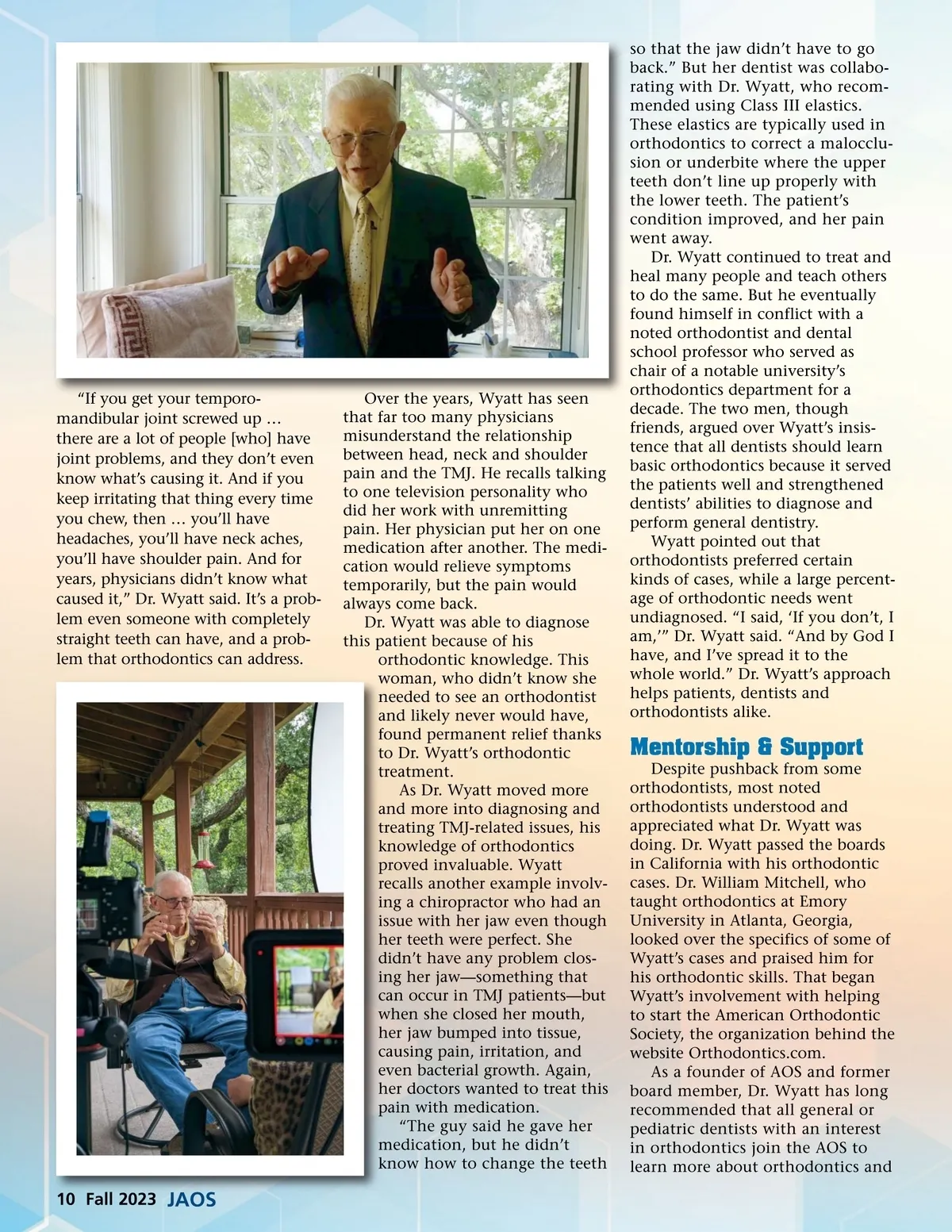
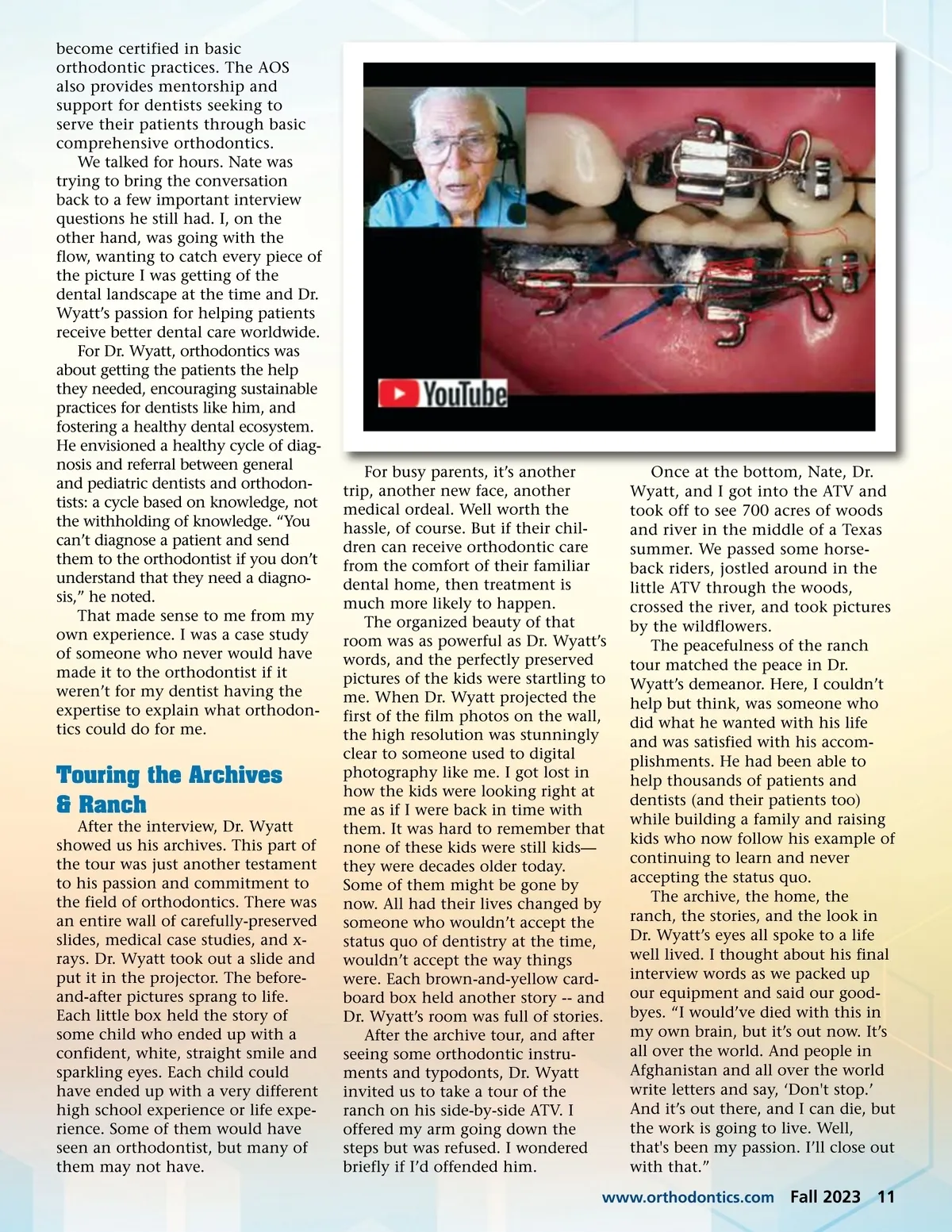
“If you get your temporo-mandibular joint screwed up … there are a lot of people [who] have joint problems, and they don’t even know what’s causing it. And if you keep irritating that thing every time you chew, then … you’ll have headaches, you’ll have neck aches, you’ll have shoulder pain. And for years, physicians didn’t know what caused it,” Dr. Wyatt said. It’s a prob-lem even someone with completely straight teeth can have, and a prob-lem that orthodontics can address. Over the years, Wyatt has seen that far too many physicians misunderstand the relationship between head, neck and shoulder pain and the TMJ. He recalls talking to one television personality who did her work with unremitting pain. Her physician put her on one medication after another. The medi-cation would relieve symptoms temporarily, but the pain would always come back. Dr. Wyatt was able to diagnose this patient because of his orthodontic knowledge. This woman, who didn’t know she needed to see an orthodontist and likely never would have, found permanent relief thanks to Dr. Wyatt’s orthodontic treatment. As Dr. Wyatt moved more and more into diagnosing and treating TMJ-related issues, his knowledge of orthodontics proved invaluable. Wyatt recalls another example involv-ing a chiropractor who had an issue with her jaw even though her teeth were perfect. She didn’t have any problem clos-ing her jaw—something that can occur in TMJ patients—but when she closed her mouth, her jaw bumped into tissue, causing pain, irritation, and even bacterial growth. Again, her doctors wanted to treat this pain with medication. “The guy said he gave her medication, but he didn’t know how to change the teeth so that the jaw didn’t have to go back.” But her dentist was collabo-rating with Dr. Wyatt, who recom-mended using Class III elastics. These elastics are typically used in orthodontics to correct a malocclu-sion or underbite where the upper teeth don’t line up properly with the lower teeth. The patient’s condition improved, and her pain went away. Dr. Wyatt continued to treat and heal many people and teach others to do the same. But he eventually found himself in conflict with a noted orthodontist and dental school professor who served as chair of a notable university’s orthodontics department for a decade. The two men, though friends, argued over Wyatt’s insis-tence that all dentists should learn basic orthodontics because it served the patients well and strengthened dentists’ abilities to diagnose and perform general dentistry. Wyatt pointed out that orthodontists preferred certain kinds of cases, while a large percent-age of orthodontic needs went undiagnosed. “I said, ‘If you don’t, I am,’” Dr. Wyatt said. “And by God I have, and I’ve spread it to the whole world.” Dr. Wyatt’s approach helps patients, dentists and orthodontists alike. Mentorship & Support Despite pushback from some orthodontists, most noted orthodontists understood and appreciated what Dr. Wyatt was doing. Dr. Wyatt passed the boards in California with his orthodontic cases. Dr. William Mitchell, who taught orthodontics at Emory University in Atlanta, Georgia, looked over the specifics of some of Wyatt’s cases and praised him for his orthodontic skills. That began Wyatt’s involvement with helping to start the American Orthodontic Society, the organization behind the website Orthodontics.com. As a founder of AOS and former board member, Dr. Wyatt has long recommended that all general or pediatric dentists with an interest in orthodontics join the AOS to learn more about orthodontics and 10 Fall 2023 JAOS
Journal of the American Orthodontic Society Fall 2023: Page 10