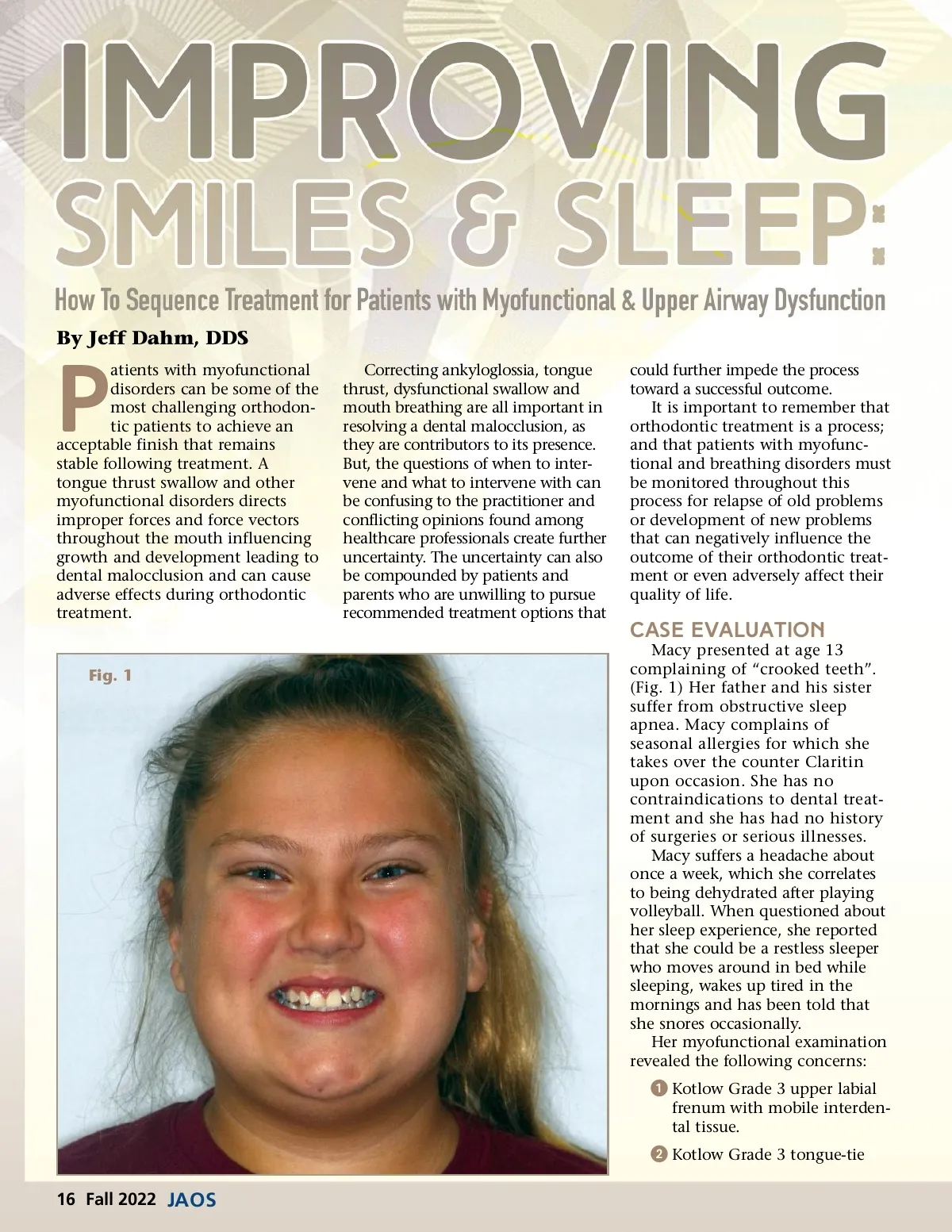
P By Jeff Dahm, DDS Correcting ankyloglossia, tongue thrust, dysfunctional swallow and mouth breathing are all important in resolving a dental malocclusion, as they are contributors to its presence. But, the questions of when to inter-vene and what to intervene with can be confusing to the practitioner and conflicting opinions found among healthcare professionals create further uncertainty. The uncertainty can also be compounded by patients and parents who are unwilling to pursue recommended treatment options that could further impede the process toward a successful outcome. It is important to remember that orthodontic treatment is a process; and that patients with myofunc-tional and breathing disorders must be monitored throughout this process for relapse of old problems or development of new problems that can negatively influence the outcome of their orthodontic treat-ment or even adversely affect their quality of life. atients with myofunctional disorders can be some of the most challenging orthodon-tic patients to achieve an acceptable finish that remains stable following treatment. A tongue thrust swallow and other myofunctional disorders directs improper forces and force vectors throughout the mouth influencing growth and development leading to dental malocclusion and can cause adverse effects during orthodontic treatment. Case Evaluation Fig. 1 Macy presented at age 13 complaining of “crooked teeth”. (Fig. 1) Her father and his sister suffer from obstructive sleep apnea. Macy complains of seasonal allergies for which she takes over the counter Claritin upon occasion. She has no contraindications to dental treat-ment and she has had no history of surgeries or serious illnesses. Macy suffers a headache about once a week, which she correlates to being dehydrated after playing volleyball. When questioned about her sleep experience, she reported that she could be a restless sleeper who moves around in bed while sleeping, wakes up tired in the mornings and has been told that she snores occasionally. Her myofunctional examination revealed the following concerns: ᕡ Kotlow Grade 3 upper labial frenum with mobile interden-tal tissue. ᕢ Kotlow Grade 3 tongue-tie 16 Fall 2022 JAOS
Journal of the American Orthodontic Society Fall 2022: Page 16