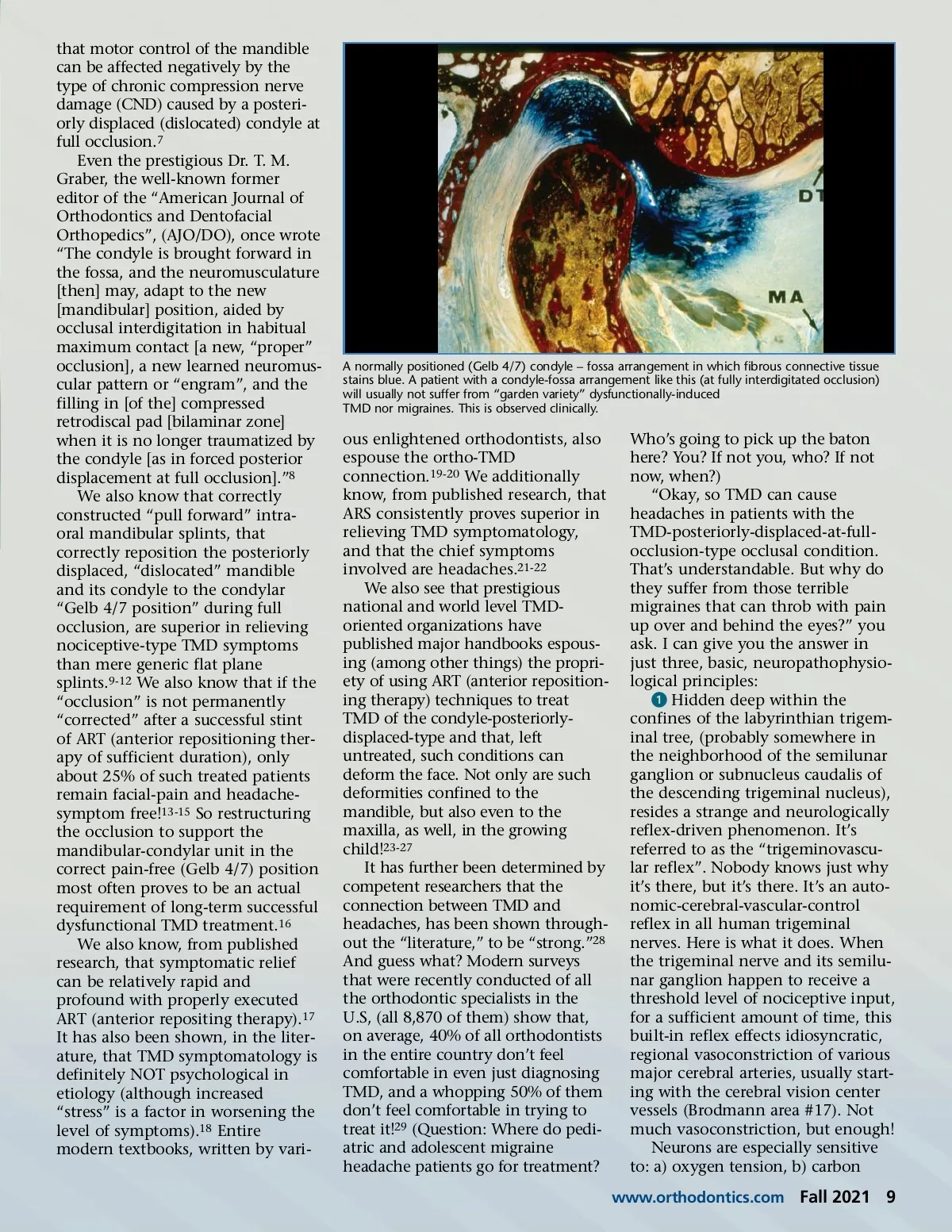
By Terrance J. Spahl M igraines start with your teeth?” “What?” “Ridiculous!” you say. Well, now wait just a minute ---migraines, and most all other primary headaches, don’t actually come from your teeth, but actually come from the way your teeth fit together. Dentists call that “occlusion”. But that’s a misnomer. It’s not actually the way the occlusion fits when the upper and lower dental arches fully interdigitate at full-force occlusion, or closure, that counts. It’s the way the occlusion makes the upper and lower jaws fit that counts. When the so-called “occlusion” of the teeth, through the fit of its particular cuspal interdigitation, forces the upper and lower jaws, hinged to each other back in the temporo-mandibular joint, to fit together improperly, against the particular design intents of Nature, there can be trouble! The migraine family of headaches (and the tension-type headaches which are their imme-diate predecessors) is a TMD “epiphenomenon”. Here’s why. “Migraines start with the fit of your teeth. Dentistry must now learn how to deal with this, Functional jaw orthopedic techniques provide the answer!” We now know that “garden vari-ety” TMD is a matter of an occlu-sion-driven (actually a malocclu-sion-driven) and maintained anatomically dysfunctional state whereby the mandibular condyle, at full habitual occlusion, is seated off the intra-articular disc and on the highly innervated, retro-discal, bilaminar zone at full force, completely interdigitating dental closure (full occlusion). 1-4 This can, under just the right (or more correctly, “just the wrong”) set of untoward physical and neuropatho-physiological circumstances result in the eventual appearance of an intra-capsular, reactive condition, (that is reflex-driven) that neurolo-gists generally lump into the cate-gory of what they call “a chronic compression nerve damage model” in the joint’s highly inverted retro-discal bilaminar zone. Not good! We also know, from published research, that surgically removed human TMJ articular discs, that were removed from patients who had suffered with TMD, showed certain histopathological changes that were a direct result of the type of posterior condylar displacement that was forced into existence by the fit of a posterior-driving occlusion (maloc-clusion). 5 (Some call it a state of “orthopedic instability” between the mandible and the cranium.) We also know that other research showed that when cast gold distal-driving onlays were placed on the back teeth of monkeys, in only five weeks the surgically removed TMJ discs of these animals showed identical histologic degenerative changes simi-lar to those seen in the discs of the human TMD patients mentioned, previously, above. 6 We know, too, 8 Fall 2021 JAOS
Journal of the American Orthodontic Society Fall 2021: Page 8