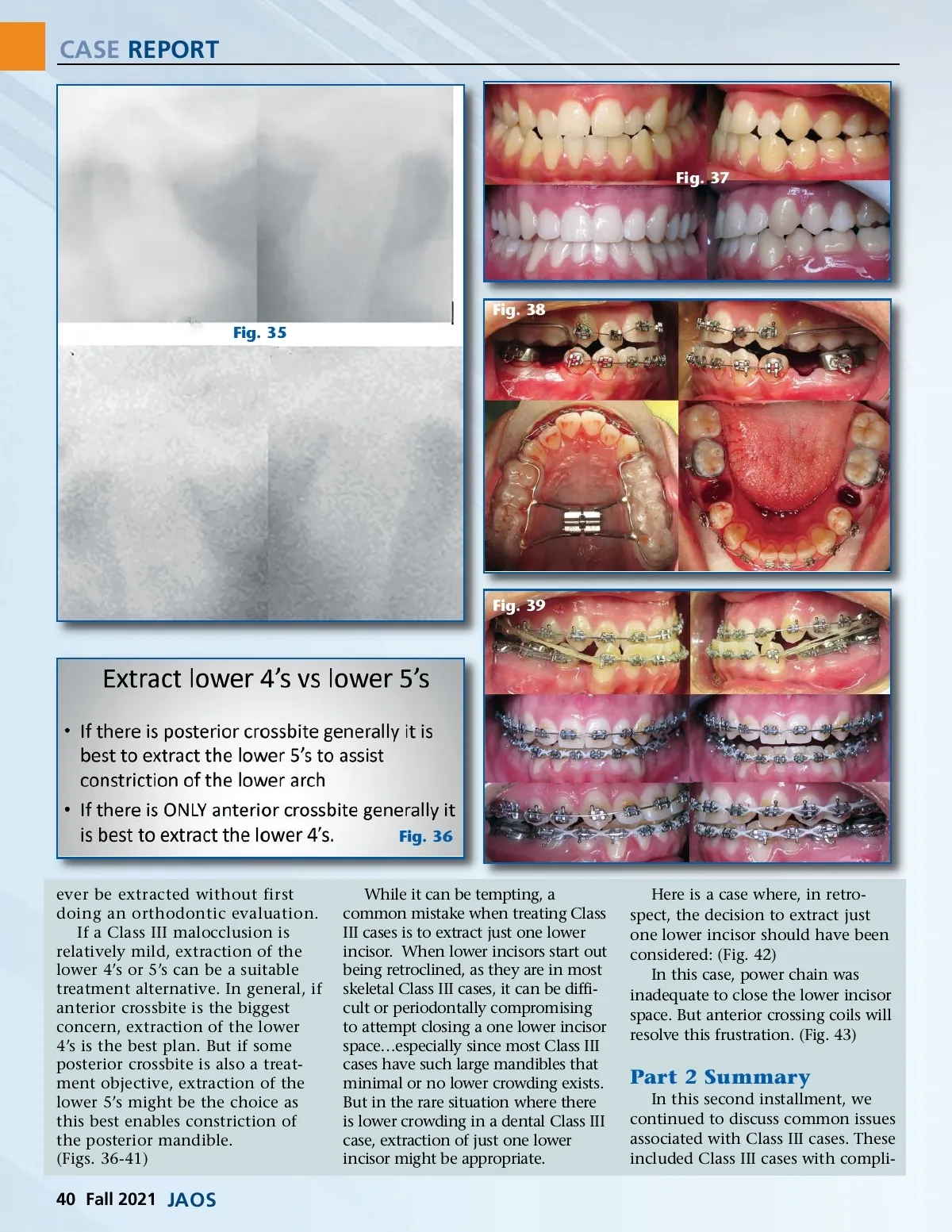
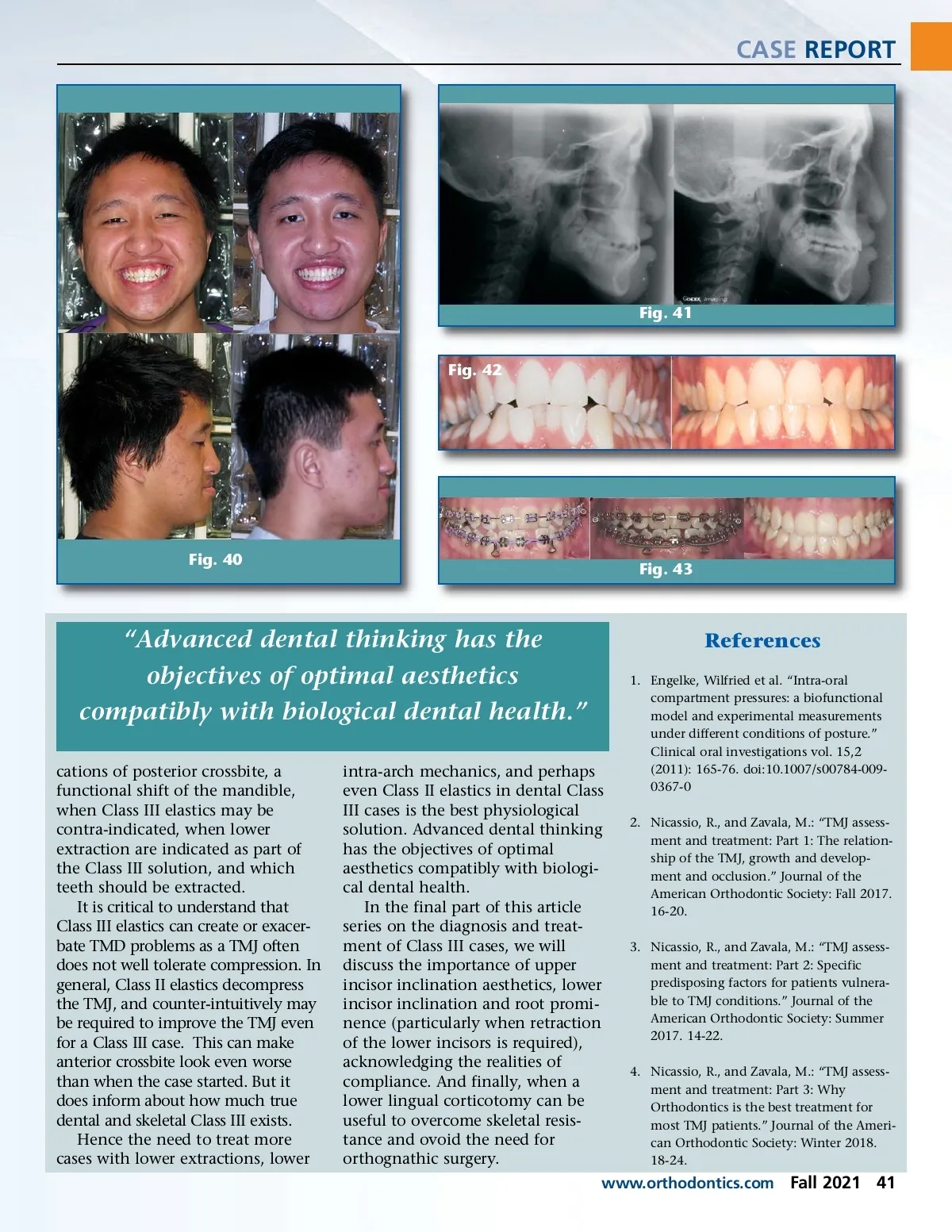
CASE REPORT Fig. 41 Fig. 42 Fig. 40 Fig. 43 “Advanced dental thinking has the objectives of optimal aesthetics compatibly with biological dental health.” cations of posterior crossbite, a functional shift of the mandible, when Class III elastics may be contra-indicated, when lower extraction are indicated as part of the Class III solution, and which teeth should be extracted. It is critical to understand that Class III elastics can create or exacer-bate TMD problems as a TMJ often does not well tolerate compression. In general, Class II elastics decompress the TMJ, and counter-intuitively may be required to improve the TMJ even for a Class III case. This can make anterior crossbite look even worse than when the case started. But it does inform about how much true dental and skeletal Class III exists. Hence the need to treat more cases with lower extractions, lower intra-arch mechanics, and perhaps even Class II elastics in dental Class III cases is the best physiological solution. Advanced dental thinking has the objectives of optimal aesthetics compatibly with biologi-cal dental health. In the final part of this article series on the diagnosis and treat-ment of Class III cases, we will discuss the importance of upper incisor inclination aesthetics, lower incisor inclination and root promi-nence (particularly when retraction of the lower incisors is required), acknowledging the realities of compliance. And finally, when a lower lingual corticotomy can be useful to overcome skeletal resis-tance and ovoid the need for orthognathic surgery. References 1. Engelke, Wilfried et al. “Intra-oral compartment pressures: a biofunctional model and experimental measurements under different conditions of posture.” Clinical oral investigations vol. 15,2 (2011): 165-76. doi:10.1007/s00784-009-0367-0 2. Nicassio, R., and Zavala, M.: “TMJ assess-ment and treatment: Part 1: The relation-ship of the TMJ, growth and develop-ment and occlusion.” Journal of the American Orthodontic Society: Fall 2017. 16-20. 3. Nicassio, R., and Zavala, M.: “TMJ assess-ment and treatment: Part 2: Specific predisposing factors for patients vulnera-ble to TMJ conditions.” Journal of the American Orthodontic Society: Summer 2017. 14-22. 4. Nicassio, R., and Zavala, M.: “TMJ assess-ment and treatment: Part 3: Why Orthodontics is the best treatment for most TMJ patients.” Journal of the Ameri-can Orthodontic Society: Winter 2018. 18-24. www.orthodontics.com Fall 2021 41
Journal of the American Orthodontic Society Fall 2021: Page 41