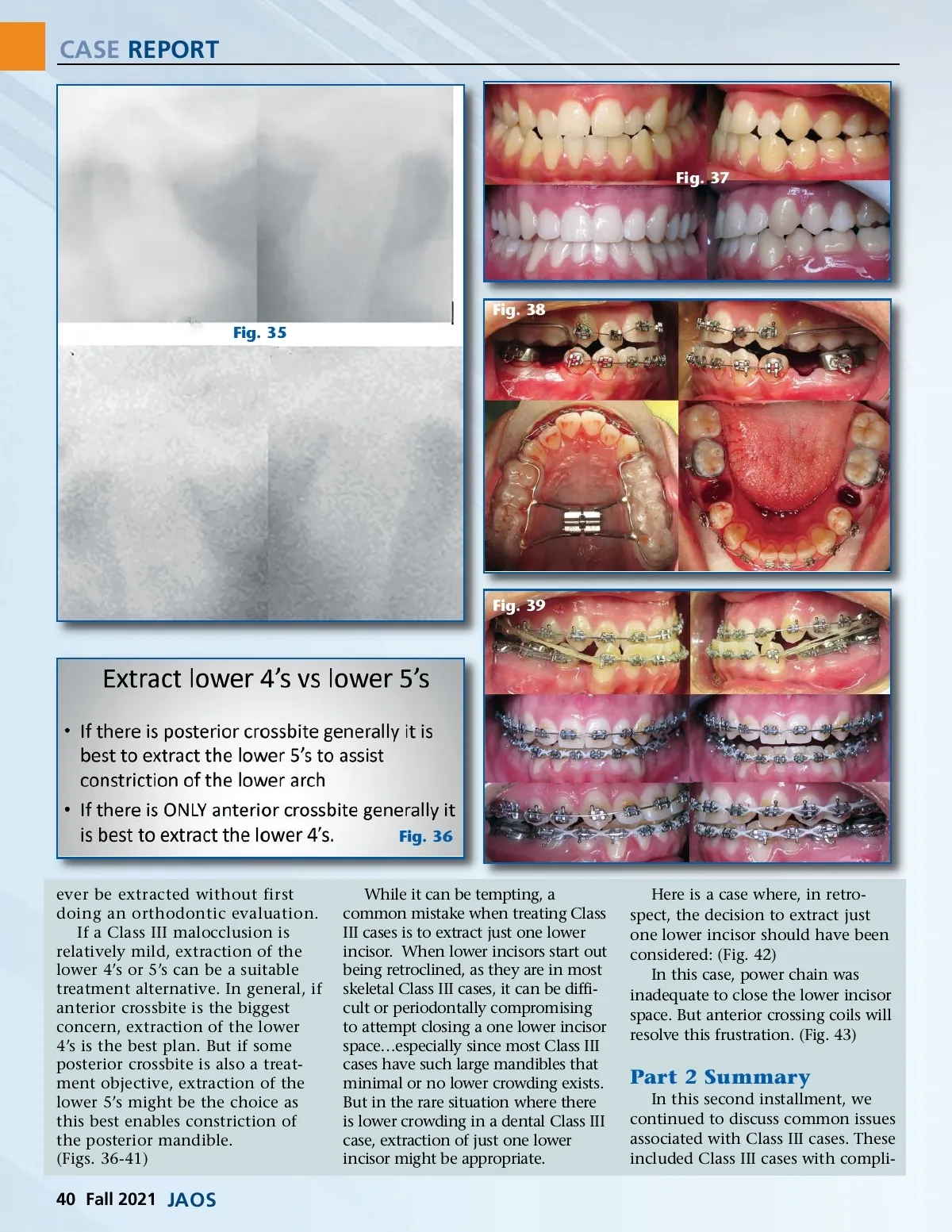
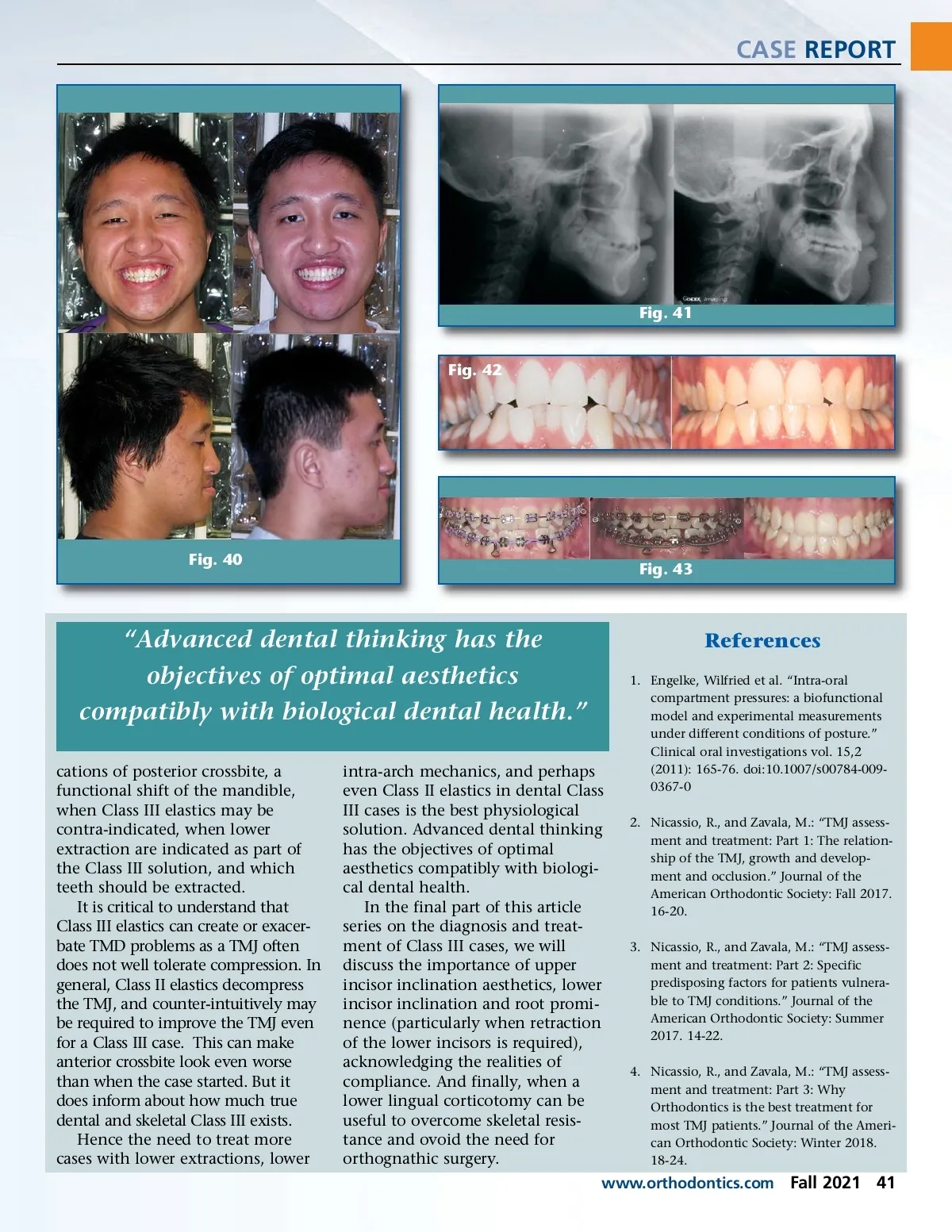
CASE REPORT Fig. 37 Fig. 38 Fig. 35 Fig. 39 Fig. 36 ever be extracted without first doing an orthodontic evaluation. If a Class III malocclusion is relatively mild, extraction of the lower 4’s or 5’s can be a suitable treatment alternative. In general, if anterior crossbite is the biggest concern, extraction of the lower 4’s is the best plan. But if some posterior crossbite is also a treat-ment objective, extraction of the lower 5’s might be the choice as this best enables constriction of the posterior mandible. (Figs. 36-41) While it can be tempting, a common mistake when treating Class III cases is to extract just one lower incisor. When lower incisors start out being retroclined, as they are in most skeletal Class III cases, it can be diffi-cult or periodontally compromising to attempt closing a one lower incisor space…especially since most Class III cases have such large mandibles that minimal or no lower crowding exists. But in the rare situation where there is lower crowding in a dental Class III case, extraction of just one lower incisor might be appropriate. Here is a case where, in retro-spect, the decision to extract just one lower incisor should have been considered: (Fig. 42) In this case, power chain was inadequate to close the lower incisor space. But anterior crossing coils will resolve this frustration. (Fig. 43) Part 2 Summary In this second installment, we continued to discuss common issues associated with Class III cases. These included Class III cases with compli-40 Fall 2021 JAOS
Journal of the American Orthodontic Society Fall 2021: Page 40