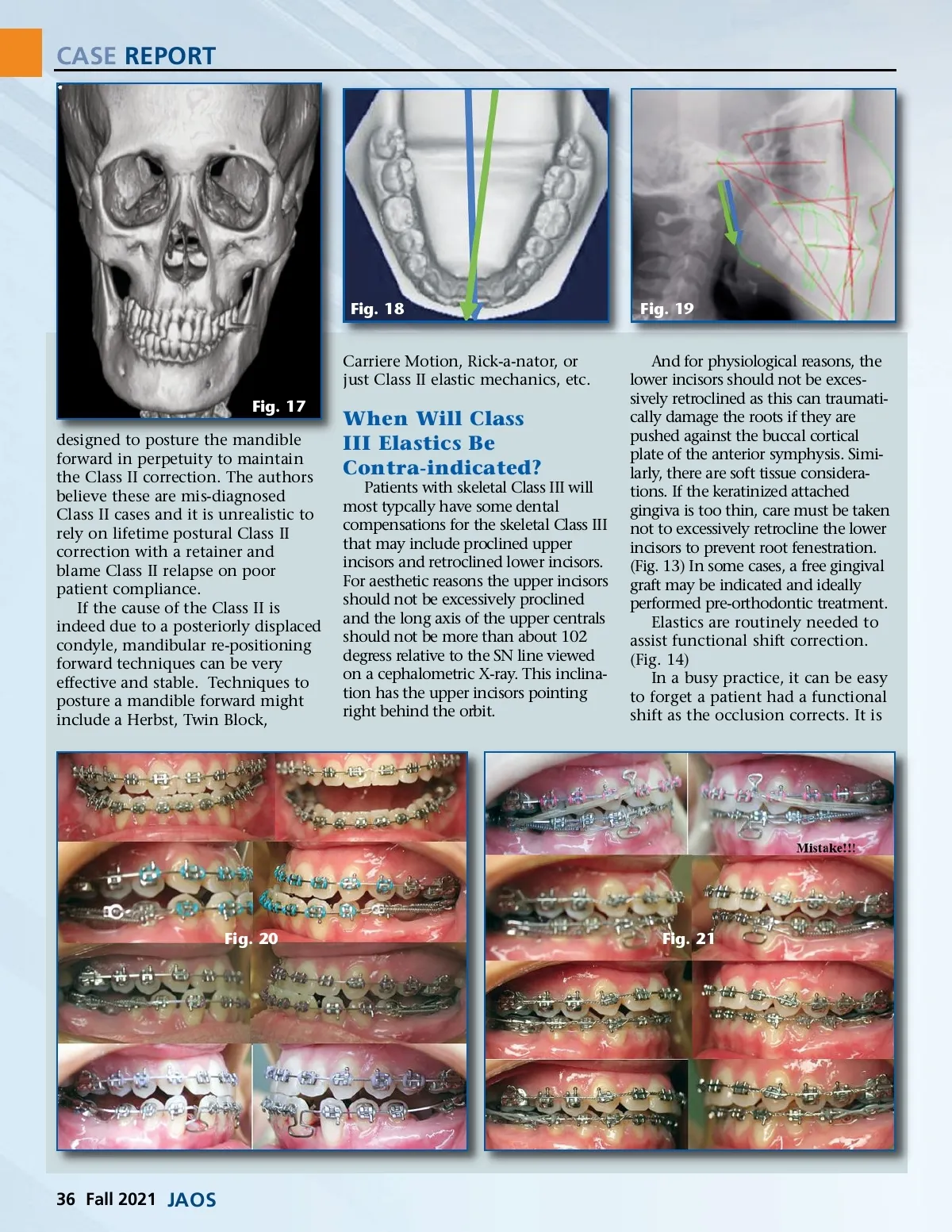
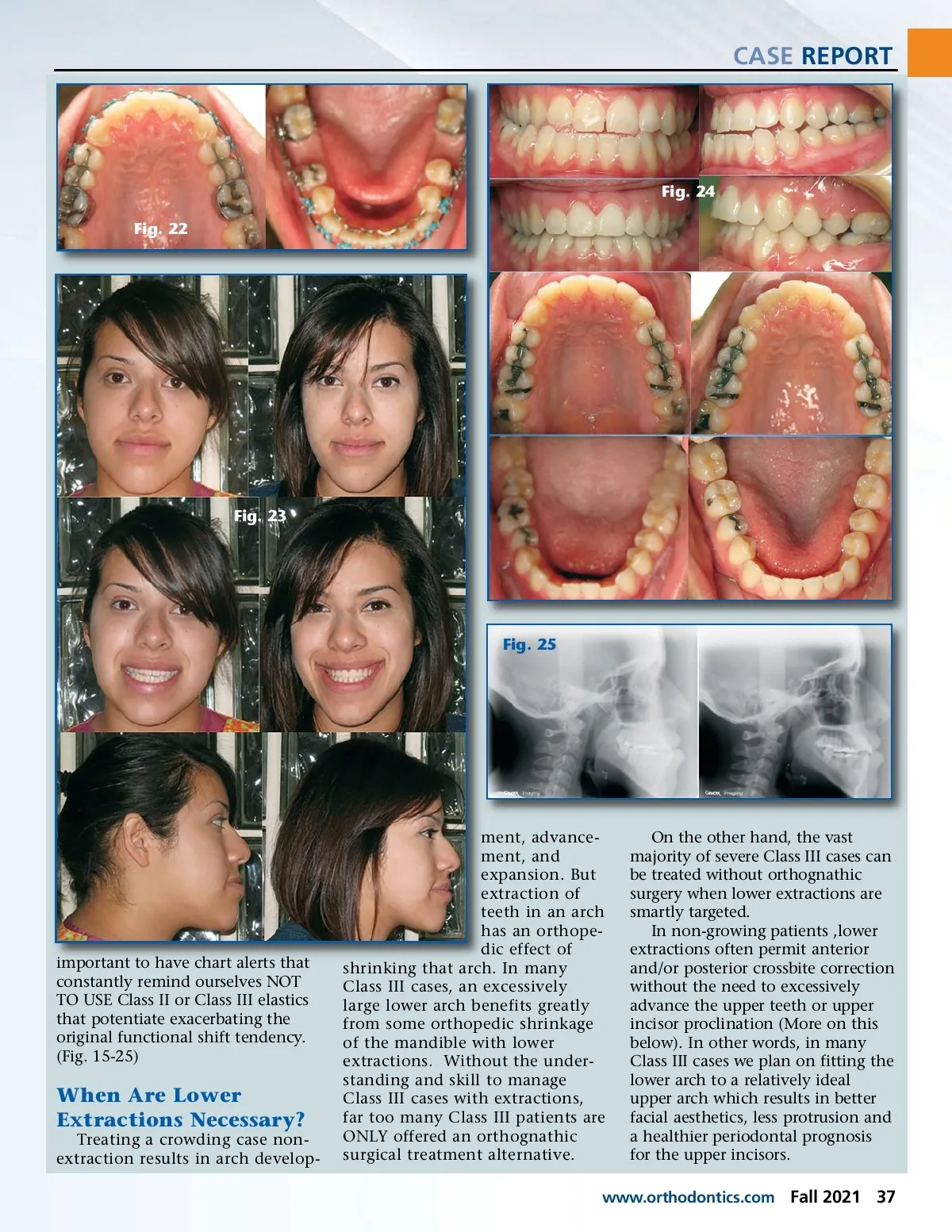
CASE REPORT Fig. 24 Fig. 22 Fig. 23 Fig. 25 important to have chart alerts that constantly remind ourselves NOT TO USE Class II or Class III elastics that potentiate exacerbating the original functional shift tendency. (Fig. 15-25) When Are Lower Extractions Necessary? Treating a crowding case non-extraction results in arch develop-ment, advance-ment, and expansion. But extraction of teeth in an arch has an orthope-dic effect of shrinking that arch. In many Class III cases, an excessively large lower arch benefits greatly from some orthopedic shrinkage of the mandible with lower extractions. Without the under-standing and skill to manage Class III cases with extractions, far too many Class III patients are ONLY offered an orthognathic surgical treatment alternative. On the other hand, the vast majority of severe Class III cases can be treated without orthognathic surgery when lower extractions are smartly targeted. In non-growing patients ,lower extractions often permit anterior and/or posterior crossbite correction without the need to excessively advance the upper teeth or upper incisor proclination (More on this below). In other words, in many Class III cases we plan on fitting the lower arch to a relatively ideal upper arch which results in better facial aesthetics, less protrusion and a healthier periodontal prognosis for the upper incisors. www.orthodontics.com Fall 2021 37
Journal of the American Orthodontic Society Fall 2021: Page 37