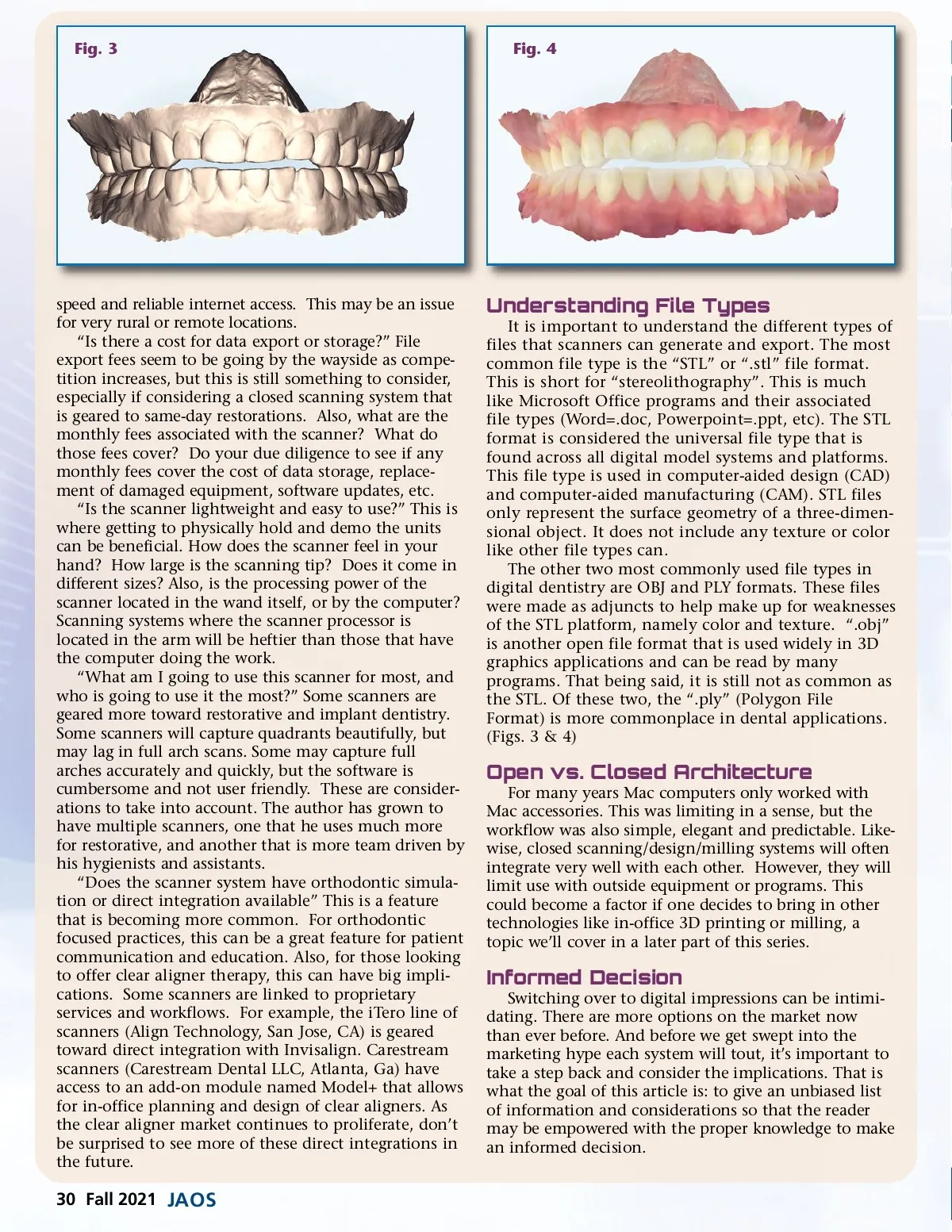
Fig. 3 Fig. 4 speed and reliable internet access. This may be an issue for very rural or remote locations. “Is there a cost for data export or storage?” File export fees seem to be going by the wayside as compe-tition increases, but this is still something to consider, especially if considering a closed scanning system that is geared to same-day restorations. Also, what are the monthly fees associated with the scanner? What do those fees cover? Do your due diligence to see if any monthly fees cover the cost of data storage, replace-ment of damaged equipment, software updates, etc. “Is the scanner lightweight and easy to use?” This is where getting to physically hold and demo the units can be beneficial. How does the scanner feel in your hand? How large is the scanning tip? Does it come in different sizes? Also, is the processing power of the scanner located in the wand itself, or by the computer? Scanning systems where the scanner processor is located in the arm will be heftier than those that have the computer doing the work. “What am I going to use this scanner for most, and who is going to use it the most?” Some scanners are geared more toward restorative and implant dentistry. Some scanners will capture quadrants beautifully, but may lag in full arch scans. Some may capture full arches accurately and quickly, but the software is cumbersome and not user friendly. These are consider-ations to take into account. The author has grown to have multiple scanners, one that he uses much more for restorative, and another that is more team driven by his hygienists and assistants. “Does the scanner system have orthodontic simula-tion or direct integration available” This is a feature that is becoming more common. For orthodontic focused practices, this can be a great feature for patient communication and education. Also, for those looking to offer clear aligner therapy, this can have big impli-cations. Some scanners are linked to proprietary services and workflows. For example, the iTero line of scanners (Align Technology, San Jose, CA) is geared toward direct integration with Invisalign. Carestream scanners (Carestream Dental LLC, Atlanta, Ga) have access to an add-on module named Model+ that allows for in-office planning and design of clear aligners. As the clear aligner market continues to proliferate, don’t be surprised to see more of these direct integrations in the future. Understanding File Types It is important to understand the different types of files that scanners can generate and export. The most common file type is the “STL” or “.stl” file format. This is short for “stereolithography”. This is much like Microsoft Office programs and their associated file types (Word=.doc, Powerpoint=.ppt, etc). The STL format is considered the universal file type that is found across all digital model systems and platforms. This file type is used in computer-aided design (CAD) and computer-aided manufacturing (CAM). STL files only represent the surface geometry of a three-dimen-sional object. It does not include any texture or color like other file types can. The other two most commonly used file types in digital dentistry are OBJ and PLY formats. These files were made as adjuncts to help make up for weaknesses of the STL platform, namely color and texture. “.obj” is another open file format that is used widely in 3D graphics applications and can be read by many programs. That being said, it is still not as common as the STL. Of these two, the “.ply” (Polygon File Format) is more commonplace in dental applications. (Figs. 3 & 4) Open vs. Closed Architecture For many years Mac computers only worked with Mac accessories. This was limiting in a sense, but the workflow was also simple, elegant and predictable. Like-wise, closed scanning/design/milling systems will often integrate very well with each other. However, they will limit use with outside equipment or programs. This could become a factor if one decides to bring in other technologies like in-office 3D printing or milling, a topic we’ll cover in a later part of this series. Informed Decision Switching over to digital impressions can be intimi-dating. There are more options on the market now than ever before. And before we get swept into the marketing hype each system will tout, it’s important to take a step back and consider the implications. That is what the goal of this article is: to give an unbiased list of information and considerations so that the reader may be empowered with the proper knowledge to make an informed decision. 30 Fall 2021 JAOS
Journal of the American Orthodontic Society Fall 2021: Page 30