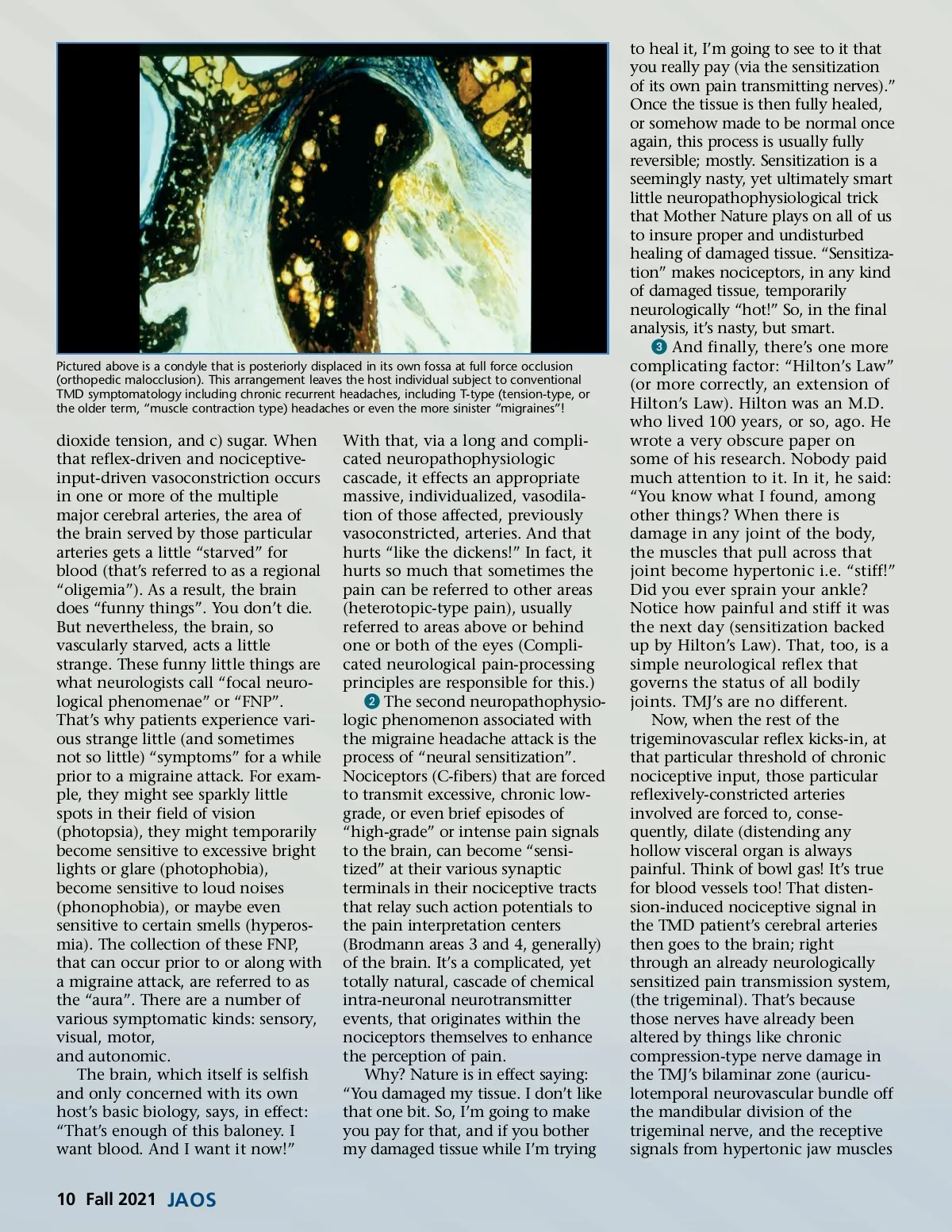
(a consequence of Hilton’s Law). The result then can be any kind of headache, including, in more extreme cases, “the vascular migraine!” The etiological source that starts it all is the CND (chronic compression nerve damage model) in the auricu-lotemporal neurovascular bundle that resides distal to the posteriorly displaced, malocclusion-driven condyle. That condyle is torn (shred-ded) loose from its tiny intra-capsu-lar ligamentous moorings by a chronically distal-driving and poste-riorly-locking occlusion (malocclu-sion). Such a sufficiently displaced condyle then “pinches” the nerves (and arteries) of the highly inner-vated bilaminar zone against the capitulum of the back of the condyle and the hard bony back wall of the fossa during full force occlusion. That occlusion, no matter what type, automatically becomes an “orthopedic” malocclusion, (disloca-tion). So, migraines, and other lesser primary headaches, start with (the fit of) your teeth. ART (anterior reposi-tioning therapy) solves those kinds of problems. It doesn’t hide them (behind a vail of drugs). Such ART is based on functional jaw orthopedic/ orthodontic treatments --functional appliances, proper splints, and active plates – that, ultimately, permanently reposition the condyles (and retain in them with a little help from night-time retainers) just that little bit forward, in their own fossae, to their correct and normal (relocated) pain-free, decompressed, new-occlusion-supported, position. Then, during function, the bilaminar zones are safe! This functional jaw muscle alter-ation (slight lengthening) helps keep the jaw in the right place. Steel (fixed appliances) can’t stretch out the sarcomeres of the jaw muscles of the Class II “neuromuscular sling” to allow for that. Steel just can’t do that. Functional jaw orthopedic techniques do it every day. Yes, fixed appliances are needed, too. But it’s a bigger and more knowledge-supported orthodontic world now. Migraines start with the fit of your teeth. Dentistry must now learn how to deal with this, Functional jaw ortho-pedic techniques provide the answer! Scientific Bibliography 1. Farrar, W.B.: Characteristics of the condy-lar path in internal derangements of the TMJ. J. Prosthet. Dent. 39:319-323, 1978 2. Weinberg, L.A.: Posterior bilateral displacement: Its diagnosis and treat-ment. J. Prosthet. Dent. 34:195, 1975 (Part I). J. Prosthet. Dent 36:426, 1976 3. Dolwick, M.F.: Normal and abnormal anatomy. In “Internal Derangements of the Temporomandibular Joints.” C.A. Helms, R.W. Katzberg, and M.F. Dolich (eds.). Radiological Research and Educa-tion Foundation, San francisco, 1983 4. Eriksson, L. and Westesson, P.L.: Clinical and radiological study of patients with anterior disk displacement of the TMJ. Swed. Dent. J. 7:55-64, 1983 5. Scapino, R.P.: Histopathology associated with malposition of the human temporo-mandibular joint disk. Oral Surg. Oral Med. Oral Path. 55:382-397,1983 6. Isberg, A.M. and Isacsson, G: Tissue reac-tions of the temporomandibular joint following retrusive guidance of the mandible. J. Craniomand. Prac. 4:143-148, 1988 15. McNiel, C.: The optimum temporo-mandibular joint condyle position in clinical practice. Int. J. Perio. Rest. Dent. 5:71-72, 1985 16. Blaustein, D.I. and Scapino, R.P.: Remod-eling of the temporomandibular joint disk and posterior attachments in disk displacement specimens in relation to glycosaminoglycans content. Plast. Reconst. Surg. 78:756-764, 1986. 17. Williamson, E.H. and Rosenzweig, B.J.: The treatment of temporomandibular disorders through repositioning splint therapy. J. Craniomand. Prac. 16:222-225, 1998 18. Wexler, G.B., and Steed, P.A.: Psychologi-cal factors and temporomandibular outcomes. J. Craniomand. Prac. 16:72-77, 1998 19. Grummons, D.: “Orthodontics for the TMJ TMD Patient”, Wright and Co. Pub. 7819 E. Greenway Rd. Suite 5, Scottsdale, Az. 1994 20. Cozzami, G.: Treating the Triad Quintessence Pub. Co, Via Ciro Menotti, 65-20017 Rho, Milan, Italy 2011. 21. Brown, D.T.and Gaudet, E.L.: Temporo-mandibular disorder treatment: Second report of a large-scale prospective study. J. Craniomand. Prac. 20:244-253, 2000. 22. Simmons, H.C. and Gibbs S.J.: Anterior repositioning appliance therapy for TMJ disorders: Specific symptoms relieved and relationship to disk status on MRI. J. Craniomand. Prac. 23: 89-99, 2005. 23. Simmons, H.C. : White Paper: Guidelines for Anterior Repositioning Therapy for the Management of Craniofacial Pain and TMD. J. Craniomand. Prac. 23: 300-306, 2005 24. Mintz, S.S. : Craniomandibular dysfunc-tion in children and adolescents: A review. J. Craniomandibular Prac. 11: 224-231, 1993. 25. Schelhas, K.P., Pollei, S.R., and Wilkes, C.H.: Pediatric internal derangements of the temporomandibular joint: Effect on facial development. Am. J. Orhod. Dento-facial Orthop. 104: 51-59, 1993 26. Ahn, S.J., Lee, S.P. and Nahm, D.S.: Rela-tionship between temporomandibular joint internal derangement and facial asymmetry in women. Am. J. Orthod. Dentofacial Orthop. 128: 583-91, 2005 27. Flores-Mir, C., Nebbe, B., Giseon H., and Major, P.W.: Longitudinal study of temporomandibular joint disc status and craniofacial growth. Am. J. Orthod. Dentofacial Orthop. 130: 324-330, 2006 28. Cooper, B.C., Kleinberg I,: Relationship of temporomandibular disorders to muscle Tension-type headaches and a neuromus-cular orthosis approach to treatment. CRANIO. 27:101-107, 2009 29. Porto, F. et al: Knowledge and beliefs regarding temporomandibular disorders among orthodontists. AJO/DO 156: 475-84, 2019 7. Isacsson, G., Isberg, A.M. and Persson, A.: Loss of directional control of lower jaw movements in persons with internal derangements of the temporomandibular joint. Oral Surg. Oral Med. Oral Path. 66:8-12, 1988 8. Graber, T.M.: Temporomandibular joint disturbances and the periodontium. Int. J. Perio. Rest. Dent. 6:33, 1984 9. Lundh, H., Westesson, P.L., Kopp, S., and Tillstrom, B.: Anterior repositioning splints in the treatment of temporo-mandibular joints with reciprocal click-ing. A comparison with flat occlusal splints and an untreated control group. Oral Surg. Oral Med. Oral Path. 60:131-136, 1985. 10. Williamson, E.H. and Sheffield, J.W.: The treatment of internal derangement of the temporomandibular joint: A survey of 300 cases. J. Craniomand. Prac. 5:120-124, 1987 11. Lundh, H., Westesson, P.L., Jisander S., and Erikson, L.: Disk-repositioning onlays in the treatment of temporomandibular joint disk displacement: Comparison with a flat occlusal splint and with no treatment. Oral Surg. Oral Med. Oral Path. 66:155-162, 1988 12. Lundh, H. and Westesson, P.L.: Long term follow up after occlusal treatment to correct abnormal temporomandibular joint disk position. Oral Surg. Oral Med. Oral Path. 67:2-10, 1989 13. Okeson, J.P.: Long term treatment of disk interference disorders of the temporo-mandibular joint with anterior reposi-tioning occlusal splints. J. Prosthet. Dent. 60:611-615, 1988 14. Farrar, W.B. and McCarty, W.L. Jr.:A Clin-ical Outline of TMJ Diagnosis and Treat-ment. 9th ed., Normandie Publications. Montgomery, Alabama, 1982 www.orthodontics.com Fall 2021 11
Journal of the American Orthodontic Society Fall 2021: Page 11