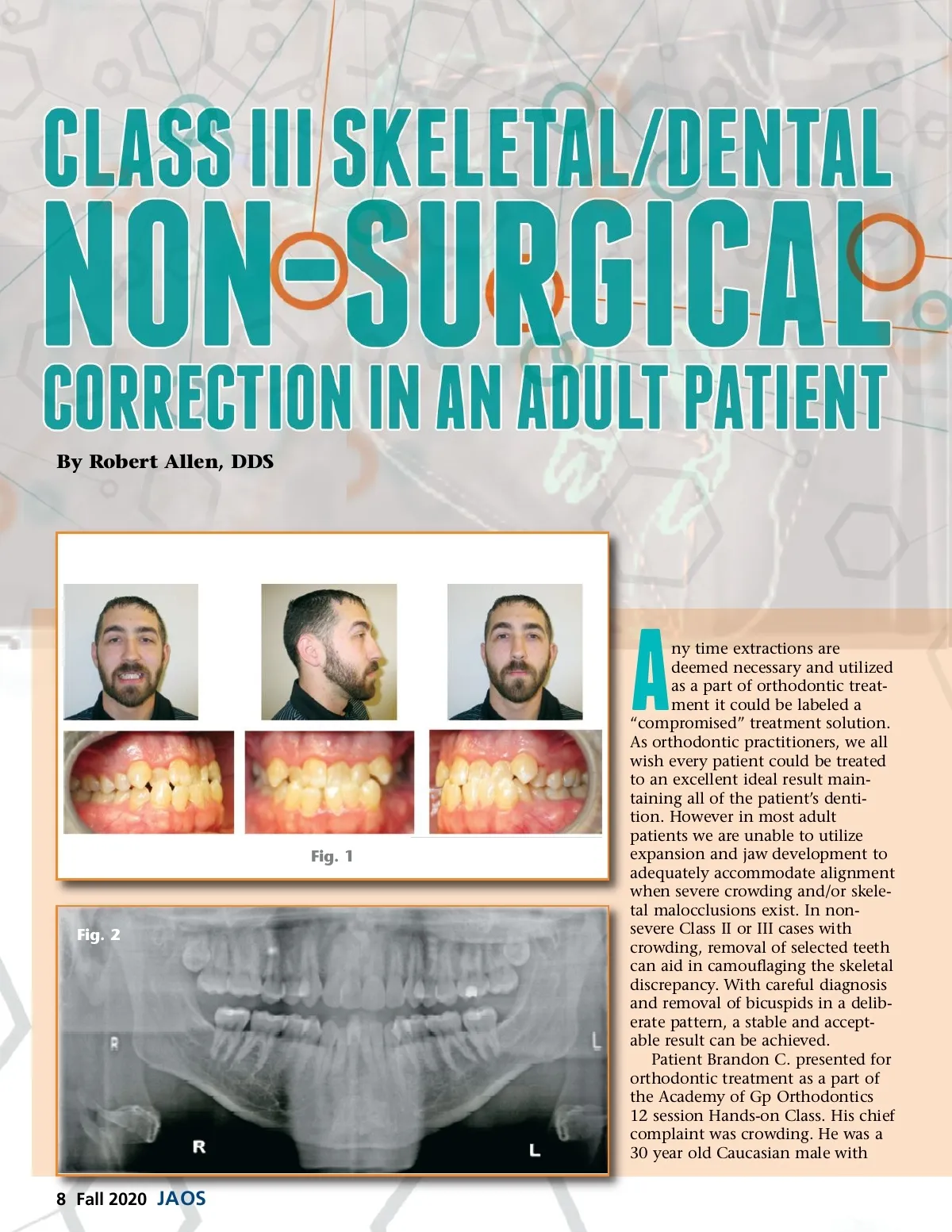
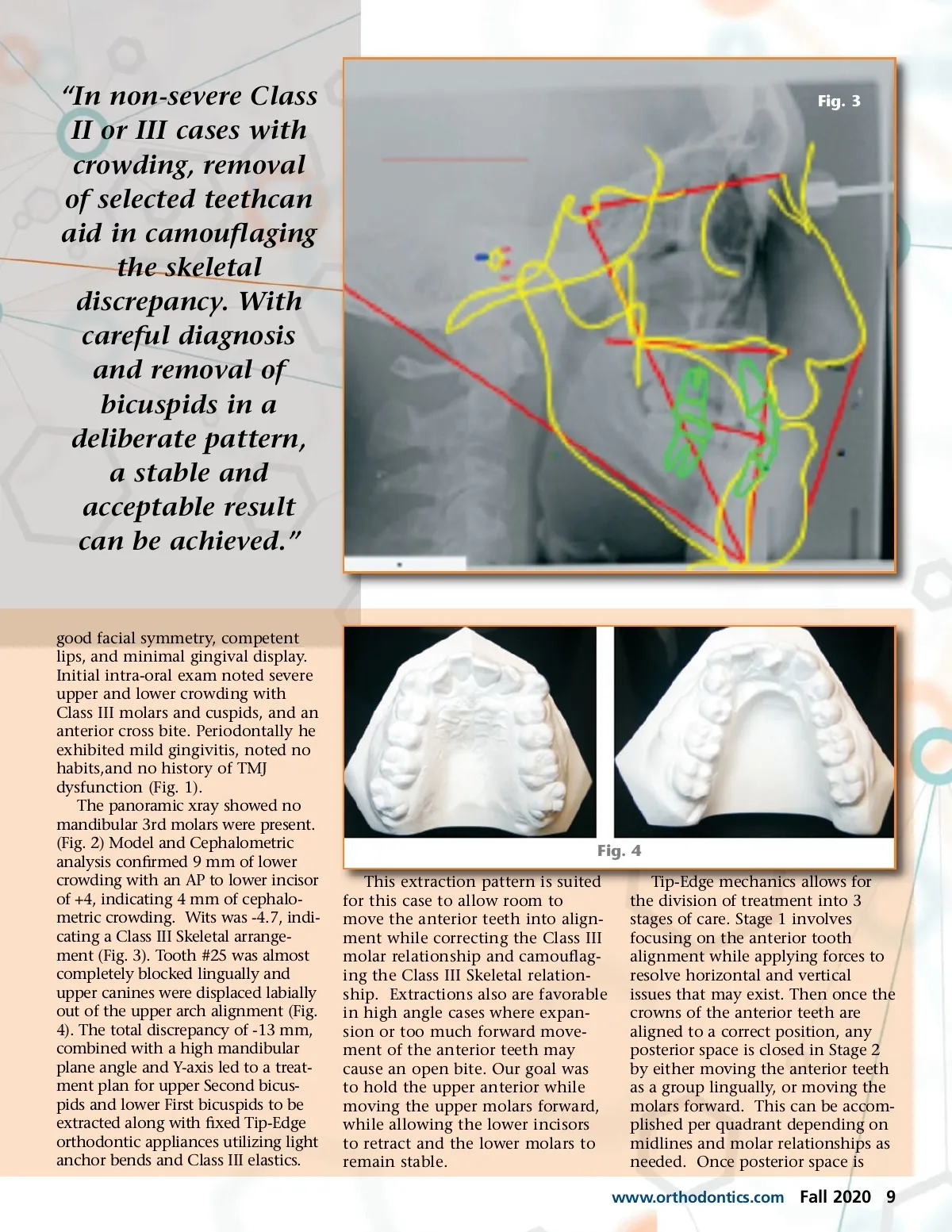
“In non-severe Class II or III cases with crowding, removal of selected teethcan aid in camouflaging the skeletal discrepancy. With careful diagnosis and removal of bicuspids in a deliberate pattern, a stable and acceptable result can be achieved.” Fig. 3 good facial symmetry, competent lips, and minimal gingival display. Initial intra-oral exam noted severe upper and lower crowding with Class III molars and cuspids, and an anterior cross bite. Periodontally he exhibited mild gingivitis, noted no habits,and no history of TMJ dysfunction (Fig. 1). The panoramic xray showed no mandibular 3rd molars were present. (Fig. 2) Model and Cephalometric analysis confirmed 9 mm of lower crowding with an AP to lower incisor of +4, indicating 4 mm of cephalo-metric crowding. Wits was -4.7, indi-cating a Class III Skeletal arrange-ment (Fig. 3). Tooth #25 was almost completely blocked lingually and upper canines were displaced labially out of the upper arch alignment (Fig. 4). The total discrepancy of -13 mm, combined with a high mandibular plane angle and Y-axis led to a treat-ment plan for upper Second bicus-pids and lower First bicuspids to be extracted along with fixed Tip-Edge orthodontic appliances utilizing light anchor bends and Class III elastics. Fig. 4 This extraction pattern is suited for this case to allow room to move the anterior teeth into align-ment while correcting the Class III molar relationship and camouflag-ing the Class III Skeletal relation-ship. Extractions also are favorable in high angle cases where expan-sion or too much forward move-ment of the anterior teeth may cause an open bite. Our goal was to hold the upper anterior while moving the upper molars forward, while allowing the lower incisors to retract and the lower molars to remain stable. Tip-Edge mechanics allows for the division of treatment into 3 stages of care. Stage 1 involves focusing on the anterior tooth alignment while applying forces to resolve horizontal and vertical issues that may exist. Then once the crowns of the anterior teeth are aligned to a correct position, any posterior space is closed in Stage 2 by either moving the anterior teeth as a group lingually, or moving the molars forward. This can be accom-plished per quadrant depending on midlines and molar relationships as needed. Once posterior space is www.orthodontics.com Fall 2020 9
Journal of the American Orthodontic Society Fall 2020: Page 9