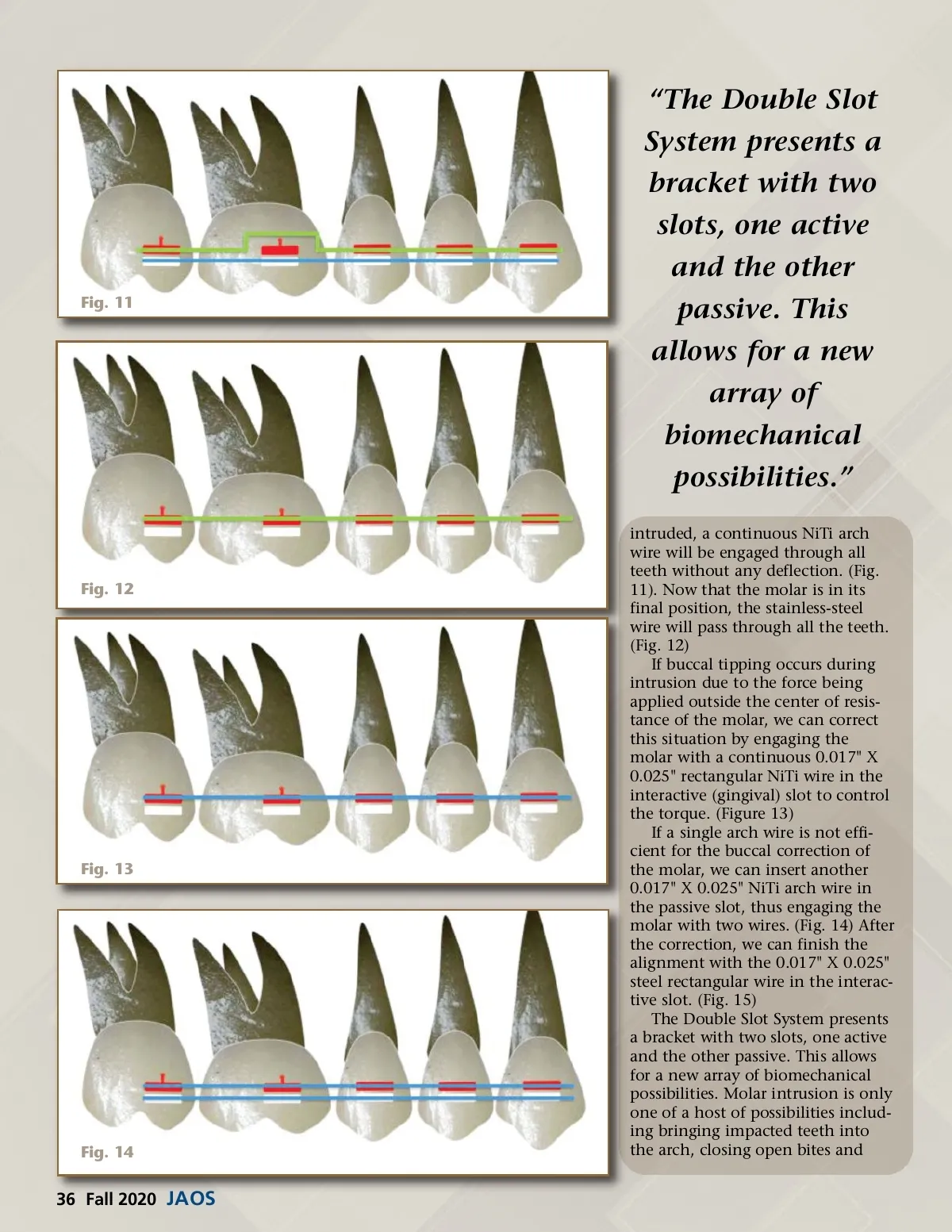
Fig. 11 “The Double Slot System presents a bracket with two slots, one active and the other passive. This allows for a new array of biomechanical possibilities.” intruded, a continuous NiTi arch wire will be engaged through all teeth without any deflection. (Fig. 11). Now that the molar is in its final position, the stainless-steel wire will pass through all the teeth. (Fig. 12) If buccal tipping occurs during intrusion due to the force being applied outside the center of resis-tance of the molar, we can correct this situation by engaging the molar with a continuous 0.017" X 0.025" rectangular NiTi wire in the interactive (gingival) slot to control the torque. (Figure 13) If a single arch wire is not effi-cient for the buccal correction of the molar, we can insert another 0.017" X 0.025" NiTi arch wire in the passive slot, thus engaging the molar with two wires. (Fig. 14) After the correction, we can finish the alignment with the 0.017" X 0.025" steel rectangular wire in the interac-tive slot. (Fig. 15) The Double Slot System presents a bracket with two slots, one active and the other passive. This allows for a new array of biomechanical possibilities. Molar intrusion is only one of a host of possibilities includ-ing bringing impacted teeth into the arch, closing open bites and Fig. 12 Fig. 13 Fig. 14 36 Fall 2020 JAOS
Journal of the American Orthodontic Society Fall 2020: Page 36