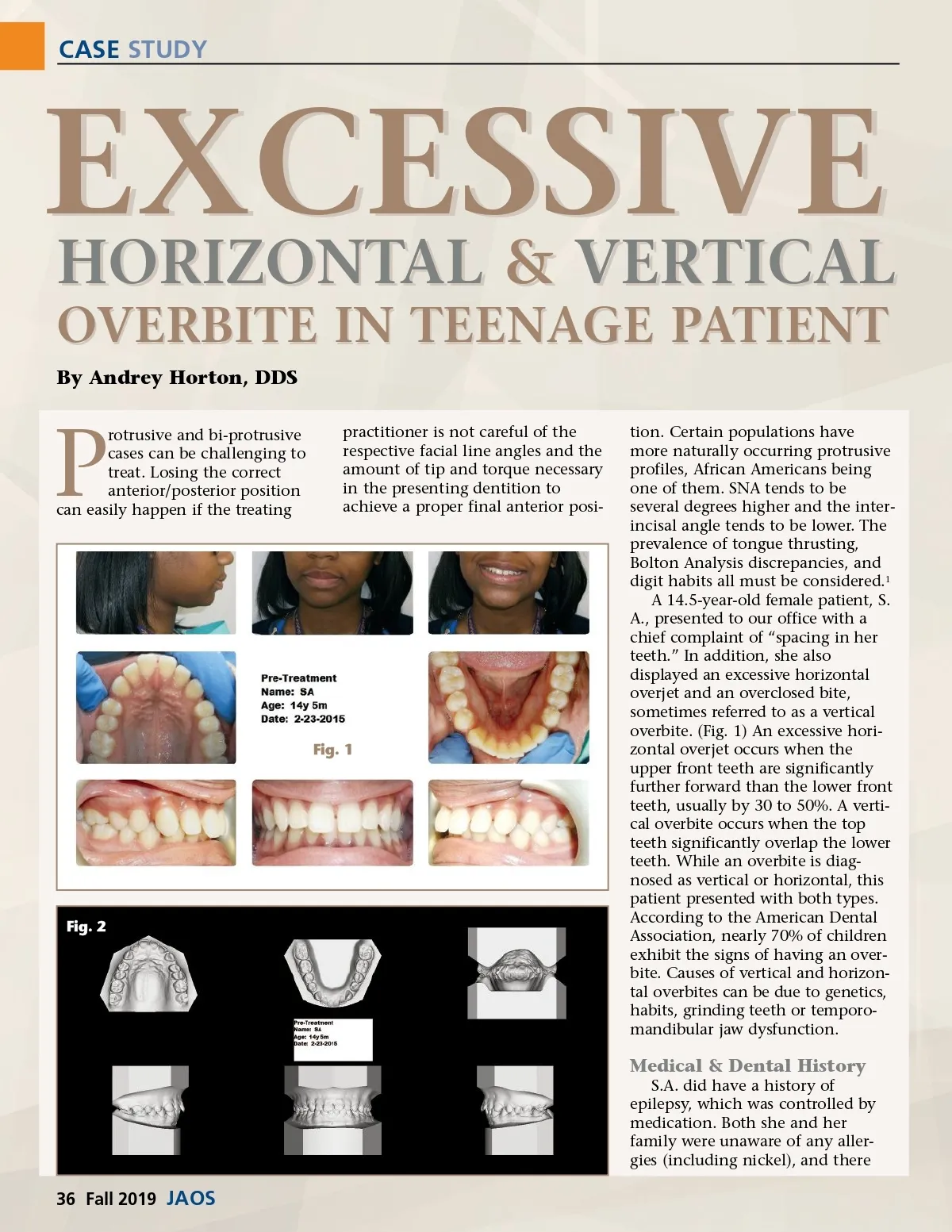
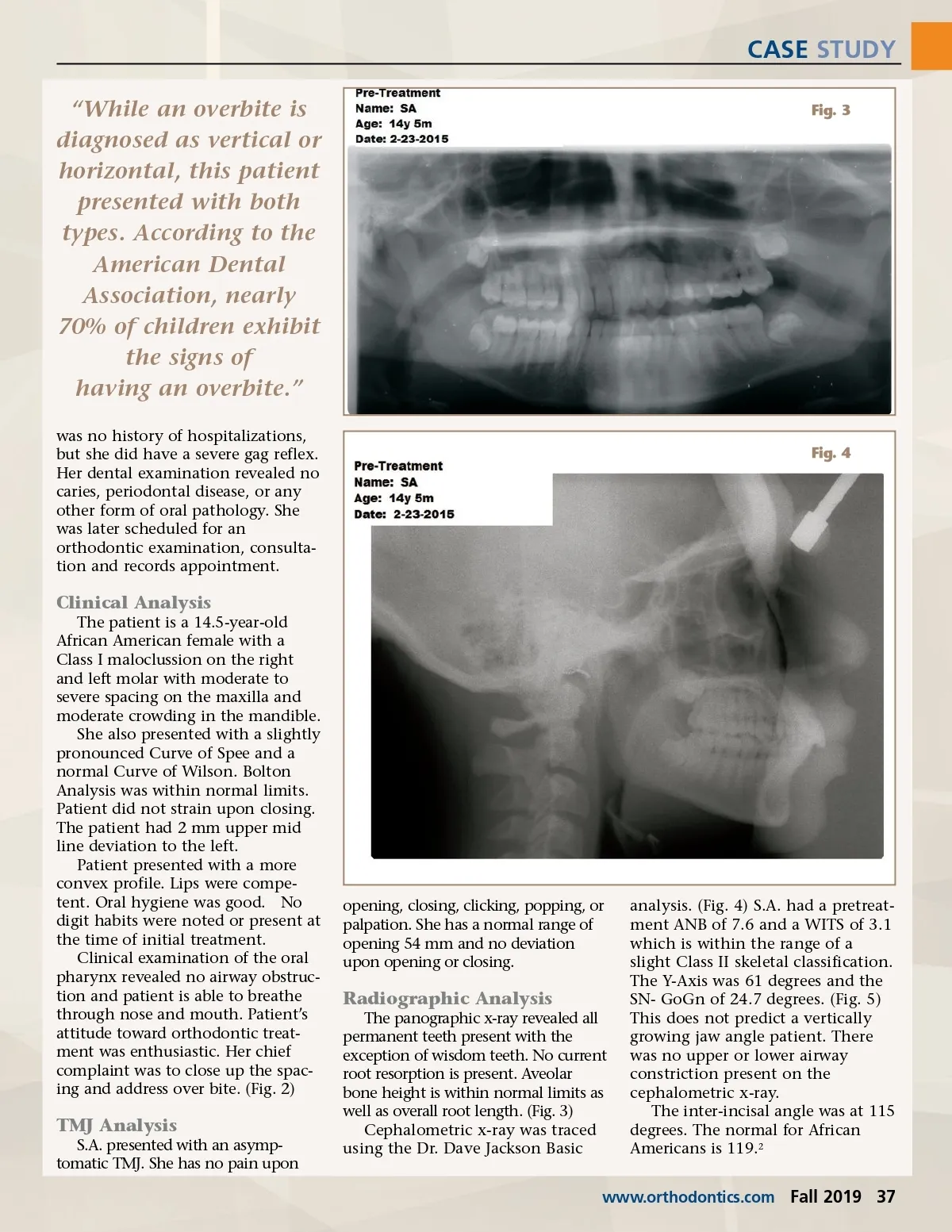
CASE STUDY “While an overbite is diagnosed as vertical or horizontal, this patient presented with both types. According to the American Dental Association, nearly 70% of children exhibit the signs of having an overbite.” was no history of hospitalizations, but she did have a severe gag reflex. Her dental examination revealed no caries, periodontal disease, or any other form of oral pathology. She was later scheduled for an orthodontic examination, consulta-tion and records appointment. Fig. 3 Fig. 4 Clinical Analysis The patient is a 14.5-year-old African American female with a Class I maloclussion on the right and left molar with moderate to severe spacing on the maxilla and moderate crowding in the mandible. She also presented with a slightly pronounced Curve of Spee and a normal Curve of Wilson. Bolton Analysis was within normal limits. Patient did not strain upon closing. The patient had 2 mm upper mid line deviation to the left. Patient presented with a more convex profile. Lips were compe-tent. Oral hygiene was good. No digit habits were noted or present at the time of initial treatment. Clinical examination of the oral pharynx revealed no airway obstruc-tion and patient is able to breathe through nose and mouth. Patient’s attitude toward orthodontic treat-ment was enthusiastic. Her chief complaint was to close up the spac-ing and address over bite. (Fig. 2) opening, closing, clicking, popping, or palpation. She has a normal range of opening 54 mm and no deviation upon opening or closing. Radiographic Analysis The panographic x-ray revealed all permanent teeth present with the exception of wisdom teeth. No current root resorption is present. Aveolar bone height is within normal limits as well as overall root length. (Fig. 3) Cephalometric x-ray was traced using the Dr. Dave Jackson Basic TMJ Analysis S.A. presented with an asymp-tomatic TMJ. She has no pain upon analysis. (Fig. 4) S.A. had a pretreat-ment ANB of 7.6 and a WITS of 3.1 which is within the range of a slight Class II skeletal classification. The Y-Axis was 61 degrees and the SN-GoGn of 24.7 degrees. (Fig. 5) This does not predict a vertically growing jaw angle patient. There was no upper or lower airway constriction present on the cephalometric x-ray. The inter-incisal angle was at 115 degrees. The normal for African Americans is 119. 2 www.orthodontics.com Fall 2019 37
Journal of the American Orthodontic Society Fall 2019: Page 37