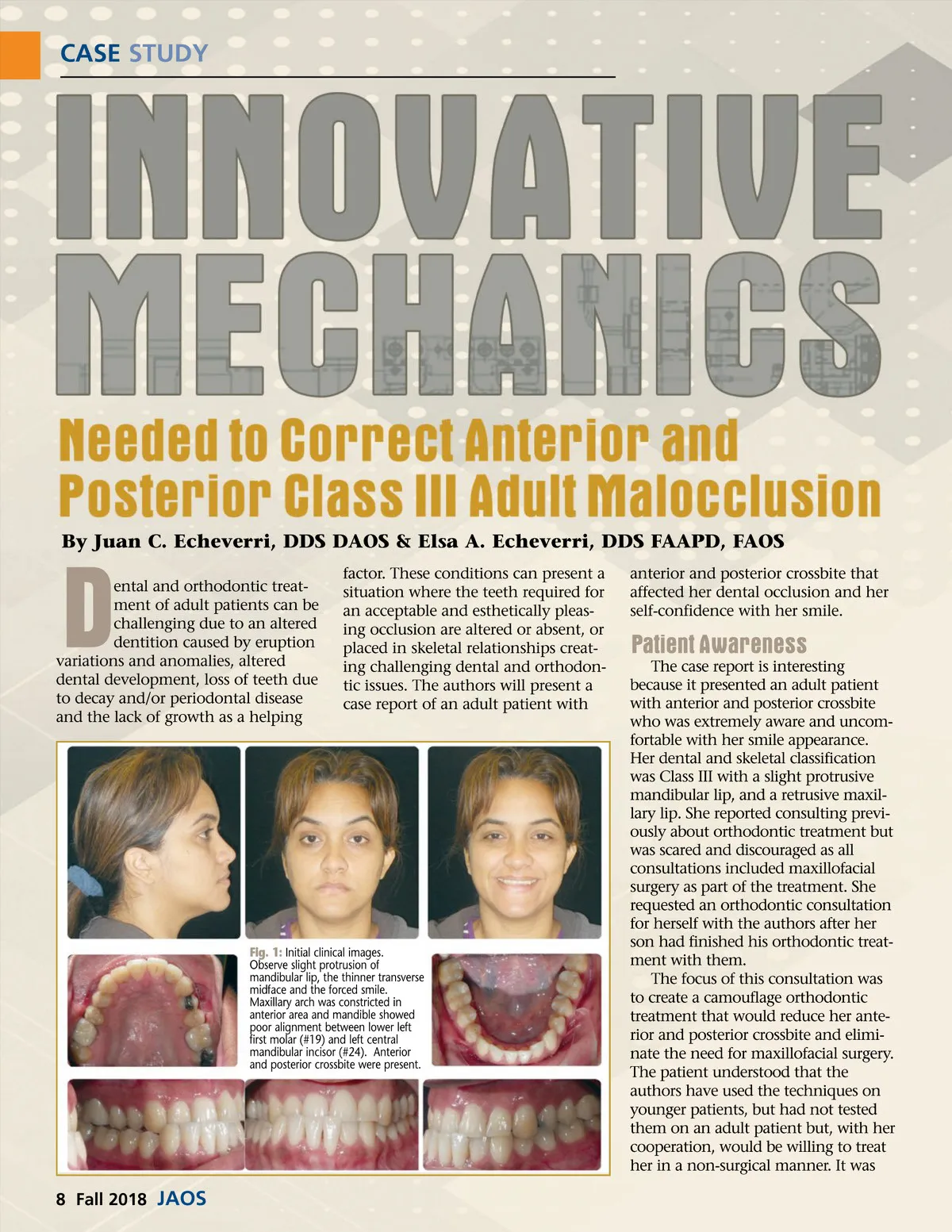
CASE STUDY By Juan C. Echeverri, DDS DAOS & Elsa A. Echeverri, DDS FAAPD, FAOS D ental and orthodontic treat-ment of adult patients can be challenging due to an altered dentition caused by eruption variations and anomalies, altered dental development, loss of teeth due to decay and/or periodontal disease and the lack of growth as a helping factor. These conditions can present a situation where the teeth required for an acceptable and esthetically pleas-ing occlusion are altered or absent, or placed in skeletal relationships creat-ing challenging dental and orthodon-tic issues. The authors will present a case report of an adult patient with anterior and posterior crossbite that affected her dental occlusion and her self-confidence with her smile. Patient Awareness The case report is interesting because it presented an adult patient with anterior and posterior crossbite who was extremely aware and uncom-fortable with her smile appearance. Her dental and skeletal classification was Class III with a slight protrusive mandibular lip, and a retrusive maxil-lary lip. She reported consulting previ-ously about orthodontic treatment but was scared and discouraged as all consultations included maxillofacial surgery as part of the treatment. She requested an orthodontic consultation for herself with the authors after her son had finished his orthodontic treat-ment with them. The focus of this consultation was to create a camouflage orthodontic treatment that would reduce her ante-rior and posterior crossbite and elimi-nate the need for maxillofacial surgery. The patient understood that the authors have used the techniques on younger patients, but had not tested them on an adult patient but, with her cooperation, would be willing to treat her in a non-surgical manner. It was Fig. 1: Initial clinical images. Observe slight protrusion of mandibular lip, the thinner transverse midface and the forced smile. Maxillary arch was constricted in anterior area and mandible showed poor alignment between lower left first molar (#19) and left central mandibular incisor (#24). Anterior and posterior crossbite were present. 8 Fall 2018 JAOS
Journal of the American Orthodontic Society Fall 2018: Page 8