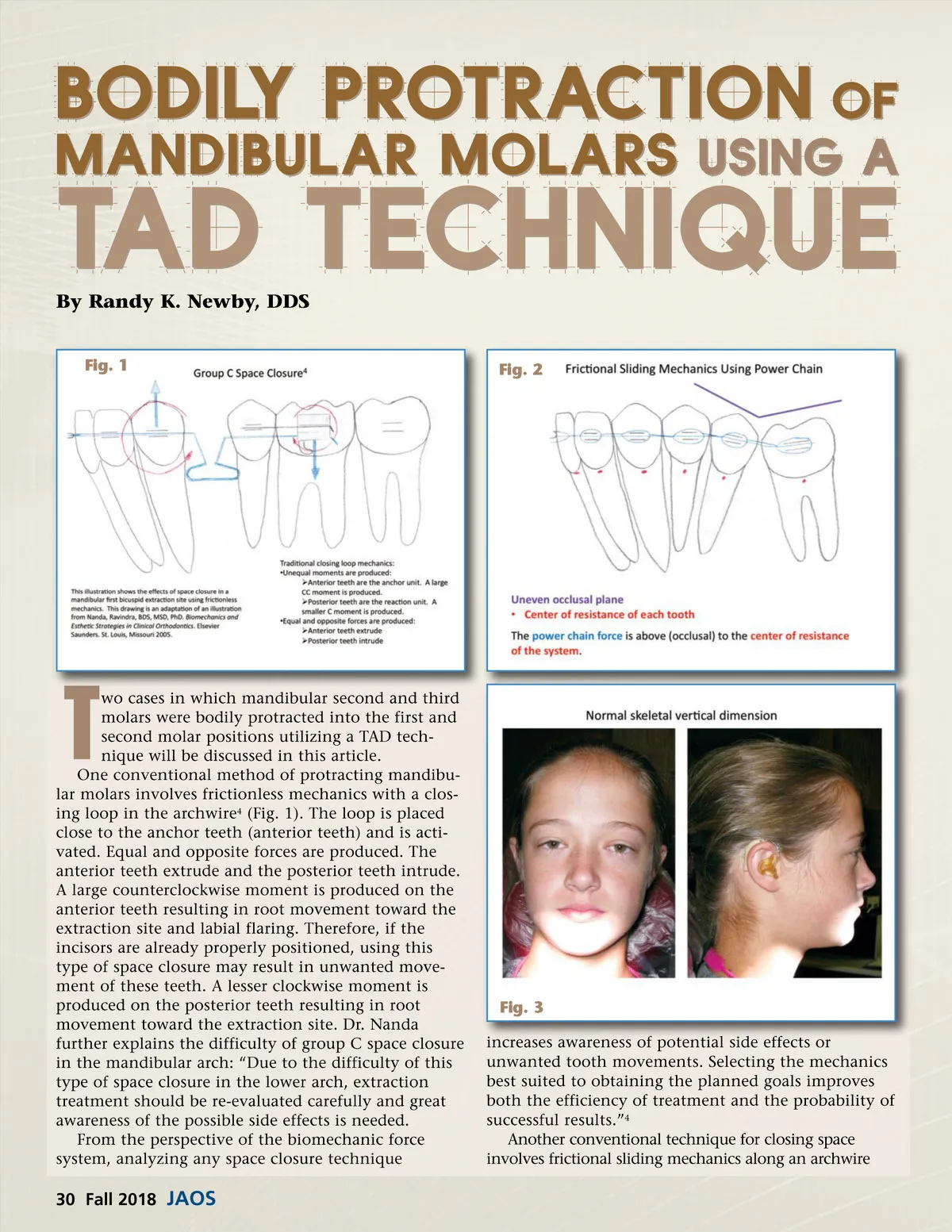
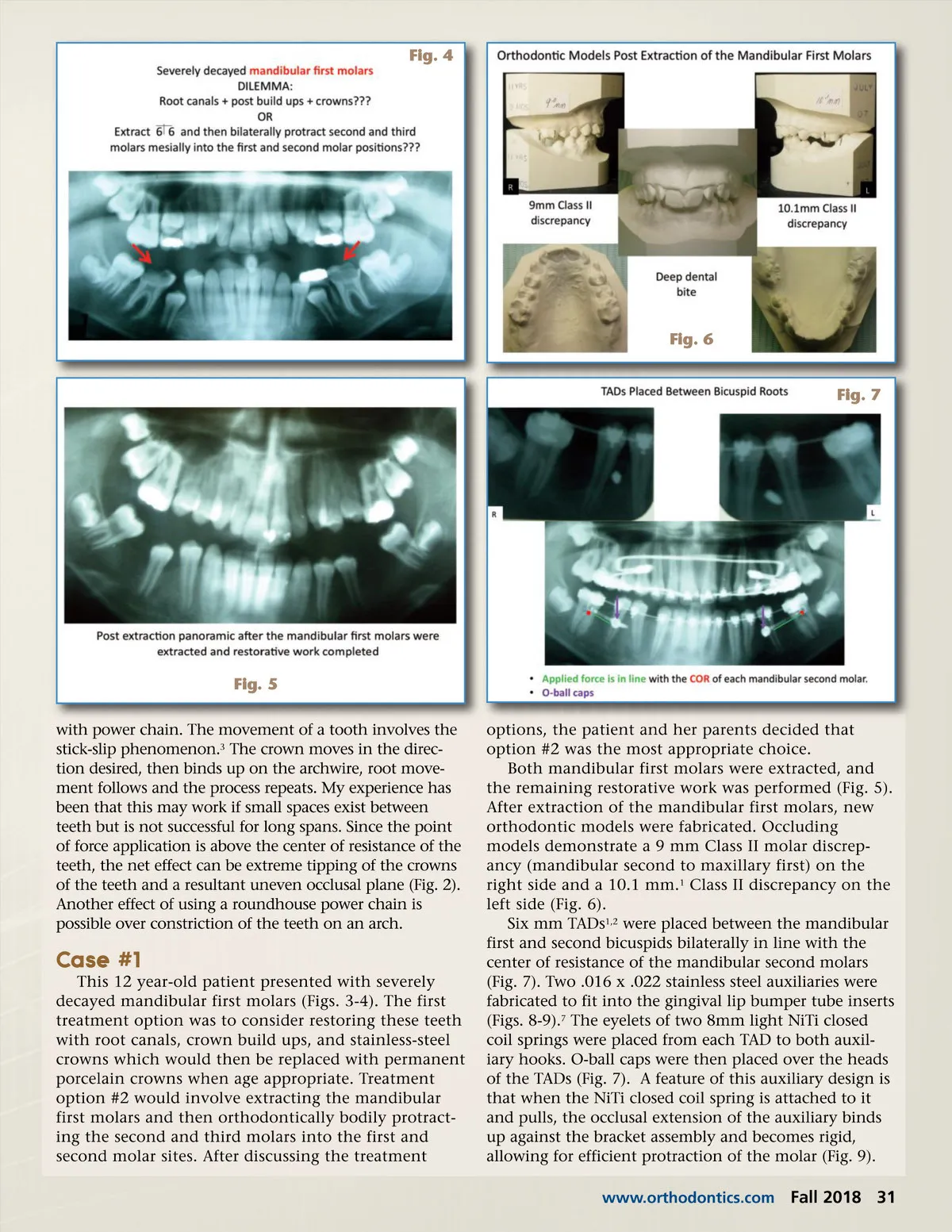
Fig. 4 Fig. 6 Fig. 7 Fig. 5 with power chain. The movement of a tooth involves the stick-slip phenomenon. 3 The crown moves in the direc-tion desired, then binds up on the archwire, root move-ment follows and the process repeats. My experience has been that this may work if small spaces exist between teeth but is not successful for long spans. Since the point of force application is above the center of resistance of the teeth, the net effect can be extreme tipping of the crowns of the teeth and a resultant uneven occlusal plane (Fig. 2). Another effect of using a roundhouse power chain is possible over constriction of the teeth on an arch. options, the patient and her parents decided that option #2 was the most appropriate choice. Both mandibular first molars were extracted, and the remaining restorative work was performed (Fig. 5). After extraction of the mandibular first molars, new orthodontic models were fabricated. Occluding models demonstrate a 9 mm Class II molar discrep-ancy (mandibular second to maxillary first) on the right side and a 10.1 mm. 1 Class II discrepancy on the left side (Fig. 6). Six mm TADs 1,2 were placed between the mandibular first and second bicuspids bilaterally in line with the center of resistance of the mandibular second molars (Fig. 7). Two .016 x .022 stainless steel auxiliaries were fabricated to fit into the gingival lip bumper tube inserts (Figs. 8-9). 7 The eyelets of two 8mm light NiTi closed coil springs were placed from each TAD to both auxil-iary hooks. O-ball caps were then placed over the heads of the TADs (Fig. 7). A feature of this auxiliary design is that when the NiTi closed coil spring is attached to it and pulls, the occlusal extension of the auxiliary binds up against the bracket assembly and becomes rigid, allowing for efficient protraction of the molar (Fig. 9). www.orthodontics.com Case #1 This 12 year-old patient presented with severely decayed mandibular first molars (Figs. 3-4). The first treatment option was to consider restoring these teeth with root canals, crown build ups, and stainless-steel crowns which would then be replaced with permanent porcelain crowns when age appropriate. Treatment option #2 would involve extracting the mandibular first molars and then orthodontically bodily protract-ing the second and third molars into the first and second molar sites. After discussing the treatment Fall 2018 31
Journal of the American Orthodontic Society Fall 2018: Page 31