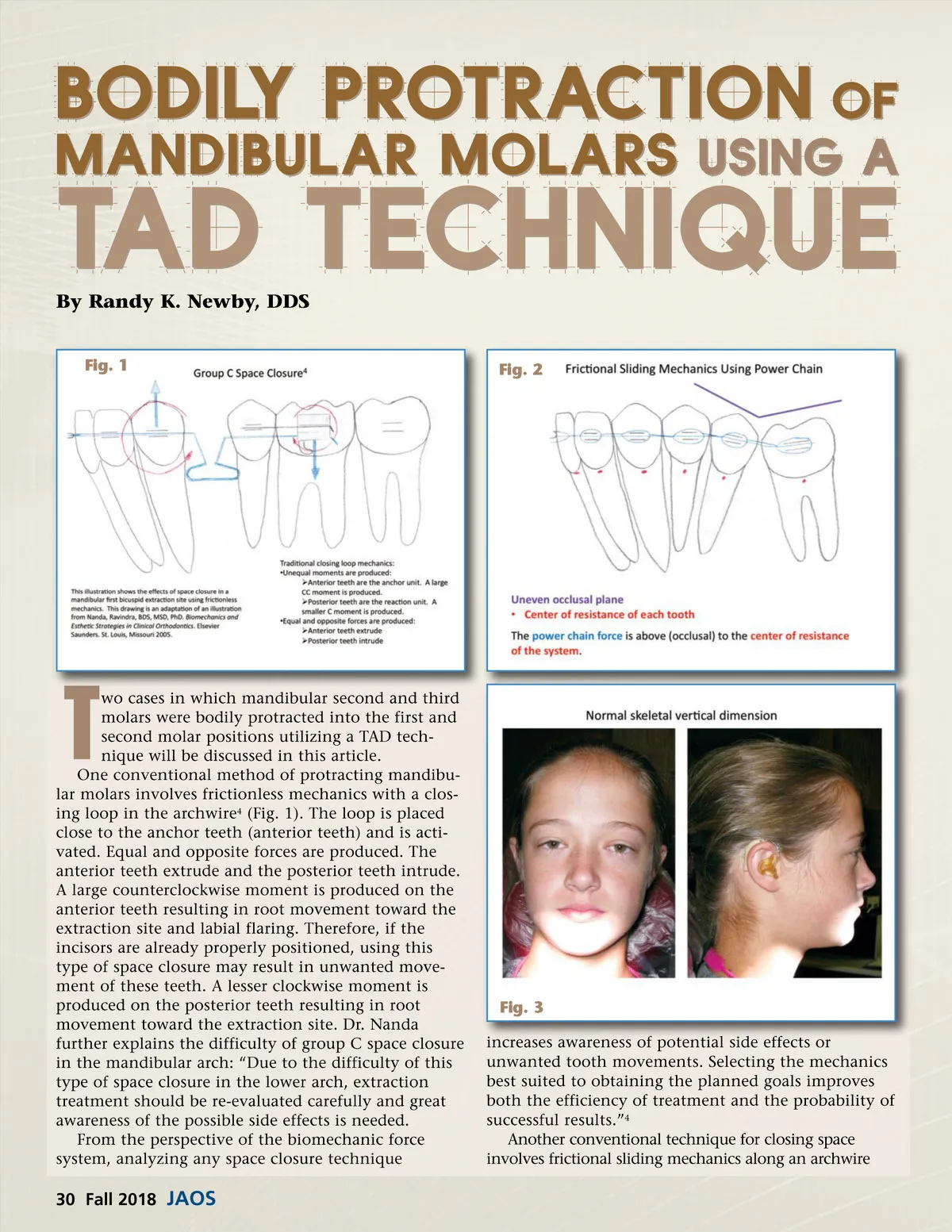
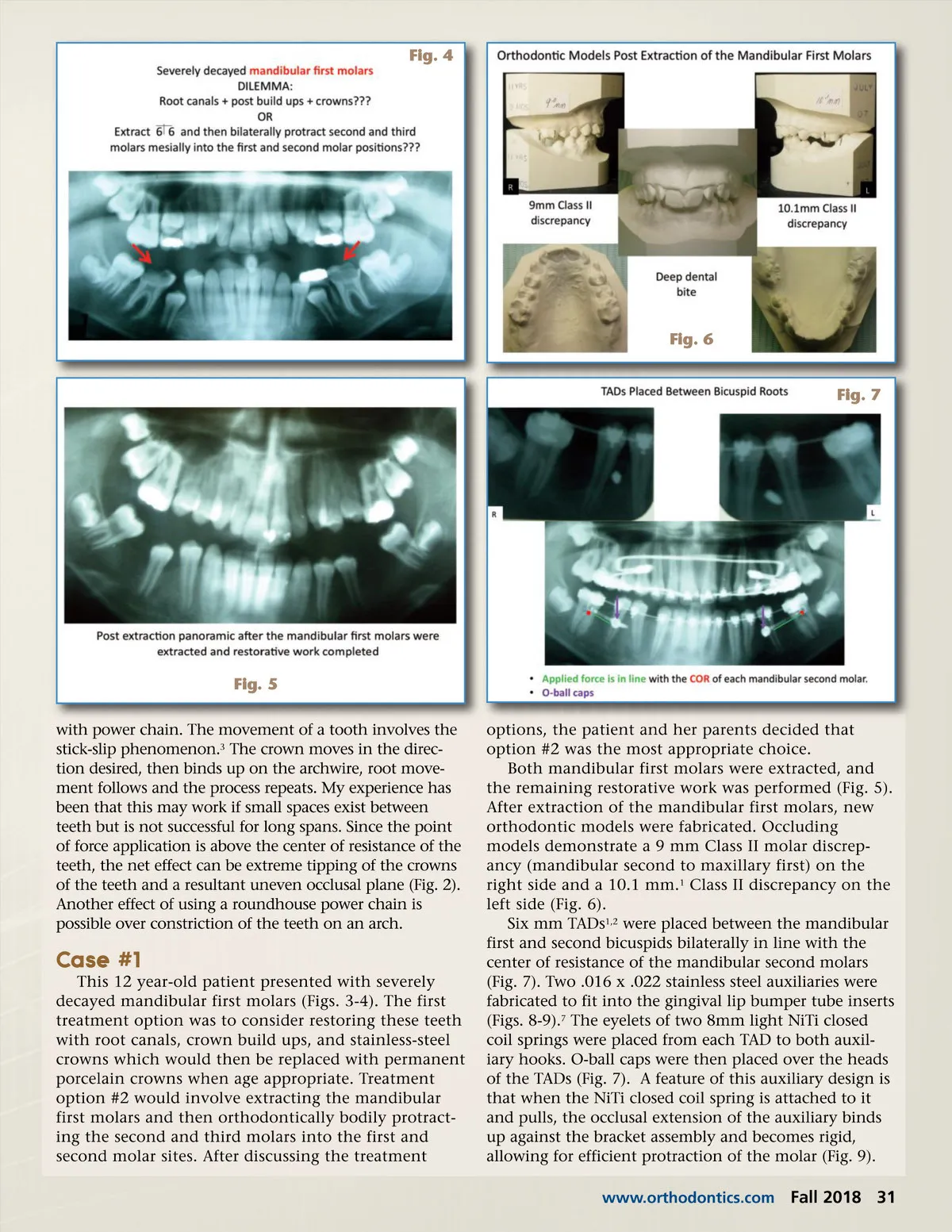
BODILY PROTRACTION OF MANDIBULAR MOLARS USING A TAD TECHNIQUE By Randy K. Newby, DDS Fig. 1 Fig. 2 wo cases in which mandibular second and third molars were bodily protracted into the first and second molar positions utilizing a TAD tech-nique will be discussed in this article. One conventional method of protracting mandibu-lar molars involves frictionless mechanics with a clos-ing loop in the archwire 4 (Fig. 1). The loop is placed close to the anchor teeth (anterior teeth) and is acti-vated. Equal and opposite forces are produced. The anterior teeth extrude and the posterior teeth intrude. A large counterclockwise moment is produced on the anterior teeth resulting in root movement toward the extraction site and labial flaring. Therefore, if the incisors are already properly positioned, using this type of space closure may result in unwanted move-ment of these teeth. A lesser clockwise moment is produced on the posterior teeth resulting in root movement toward the extraction site. Dr. Nanda further explains the difficulty of group C space closure in the mandibular arch: “Due to the difficulty of this type of space closure in the lower arch, extraction treatment should be re-evaluated carefully and great awareness of the possible side effects is needed. From the perspective of the biomechanic force system, analyzing any space closure technique T Fig. 3 increases awareness of potential side effects or unwanted tooth movements. Selecting the mechanics best suited to obtaining the planned goals improves both the efficiency of treatment and the probability of successful results.” 4 Another conventional technique for closing space involves frictional sliding mechanics along an archwire 30 Fall 2018 JAOS
Journal of the American Orthodontic Society Fall 2018: Page 30